
After a failed transit AVL deploy, leadership asks how long it typically takes to restore vehicle-location service. Which metric answers that?
Select an answer to reveal the explanation.
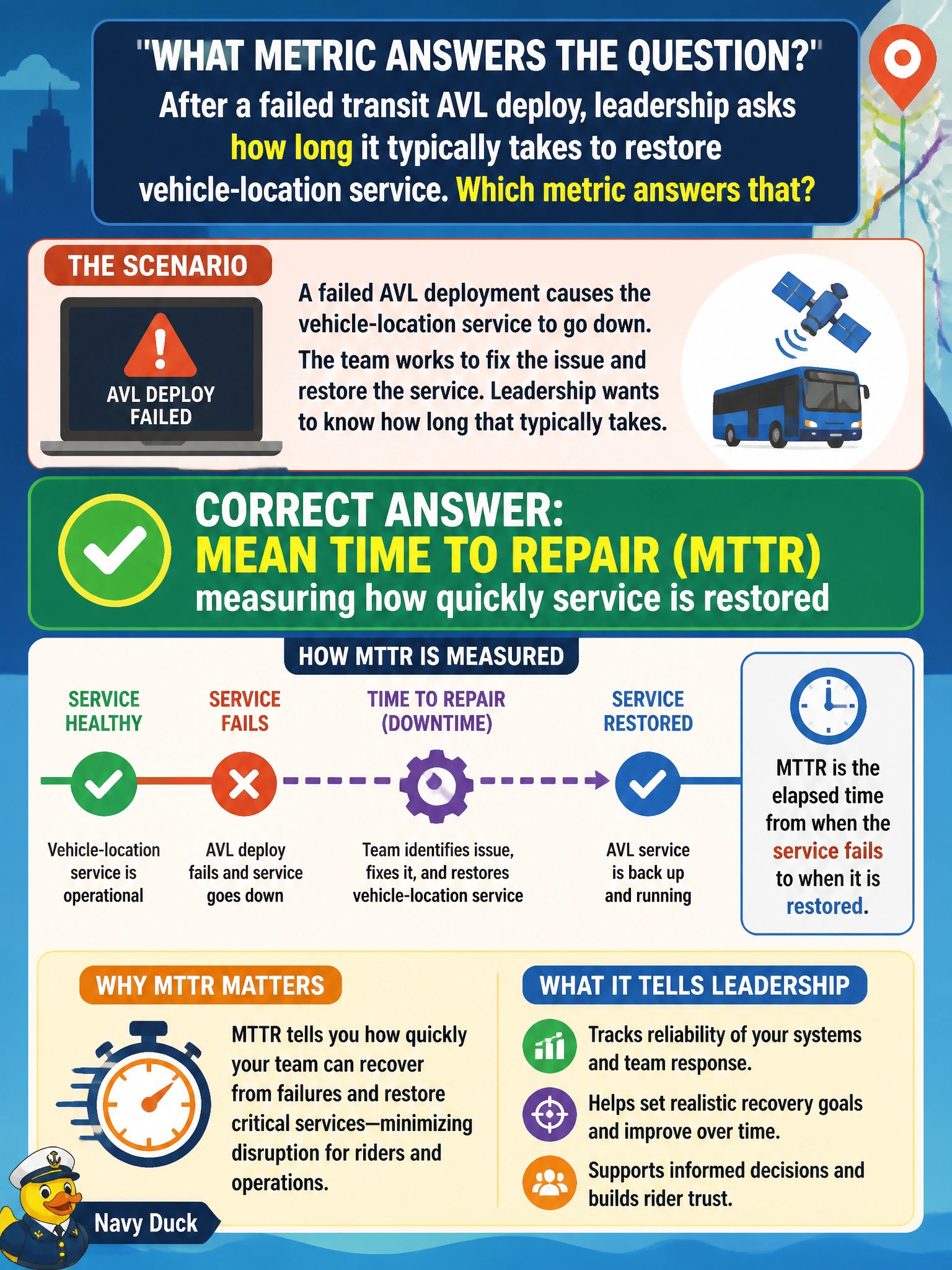
Short Explanation
MTTR is the stopwatch from AVL going down to buses showing up again. MTBF is how long you usually enjoy quiet between those fires — not how fast you put this one out.
Full Explanation
Mean time to repair (MTTR) measures how long it typically takes to restore service after a failure—the recovery stopwatch from impact to restored capability. After a failed transit AVL deploy, leadership asking how long it typically takes to restore vehicle-location service is asking for MTTR or a closely related restore-time metric, not for how long systems usually run between outages.
Mean time between failures (MTBF) measures the quiet interval before the next outage; it answers reliability-over-time between incidents, not restore speed for this class of AVL failure. Story-point velocity for the transit backlog measures planning throughput and says nothing about outage restore time on election of vehicle location. License seat count for the AVL vendor portal is procurement inventory, unrelated to restoration performance for buses and dispatch.
Exam caveat: MTTR definitions vary (detect-to-restore versus repair-only); agree on clock start and stop for AVL incidents so leadership reports stay comparable month to month. Operational check: timestamp AVL outage start and service-restored events, compute restore durations across recent incidents, and track whether rollback automation is shrinking MTTR after bad deploys.