
For a parks reservation app, how does a canary release differ from blue-green delivery?
Select an answer to reveal the explanation.
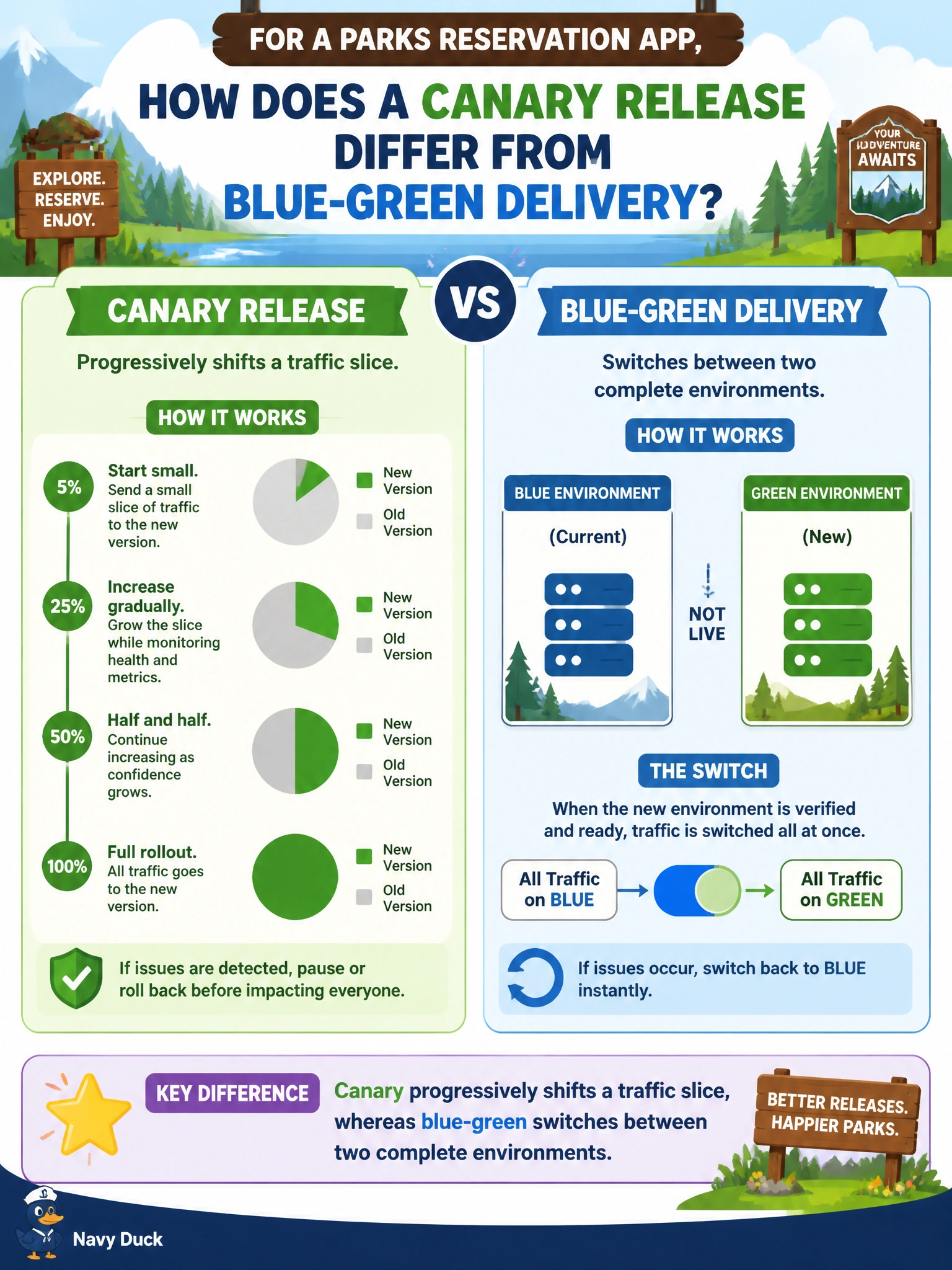
Short Explanation
Canary dribbles parks traffic to the new version; blue-green flips the whole circus between two full tents. One is a progressive slice, the other a binary environment swap.
Full Explanation
Canary delivery progressively shifts a traffic slice to the new version, whereas blue-green switches traffic between two complete environments. For a parks reservation app, that distinction drives planning: canary gradually increases the share of citizens on the new build; blue-green prepares a full green stack and flips. Mixing the terms leads to wrong capacity plans and wrong rollback expectations for recreation systems.
Claiming canary and blue-green are identical binary swaps with no progressive traffic shift fails by concept because it erases canary's defining progressive slice. Saying blue-green always sends 5% first while canary always swaps full environments reverses the definitions. Claiming neither strategy involves traffic routing and both only rename DNS after midnight fails because both strategies are fundamentally about how traffic is routed during release—and neither is "DNS rename only after midnight" as a defining property.
Exam caveat: implementations vary (weighted load balancers, service mesh, DNS), but the conceptual contrast remains progressive slice versus dual-environment switch. Blue-green can sometimes be executed with DNS, but that does not make canary and blue-green the same, and it does not make midnight DNS renames the essence of either pattern.
Operational check: if parks chooses canary, verify traffic weights move 5%→25%→100% (or similar) with gates; if blue-green, verify two full environments exist and cutover is a switch, with blue retained for rollback—not a progressive minority weight as the primary model.