
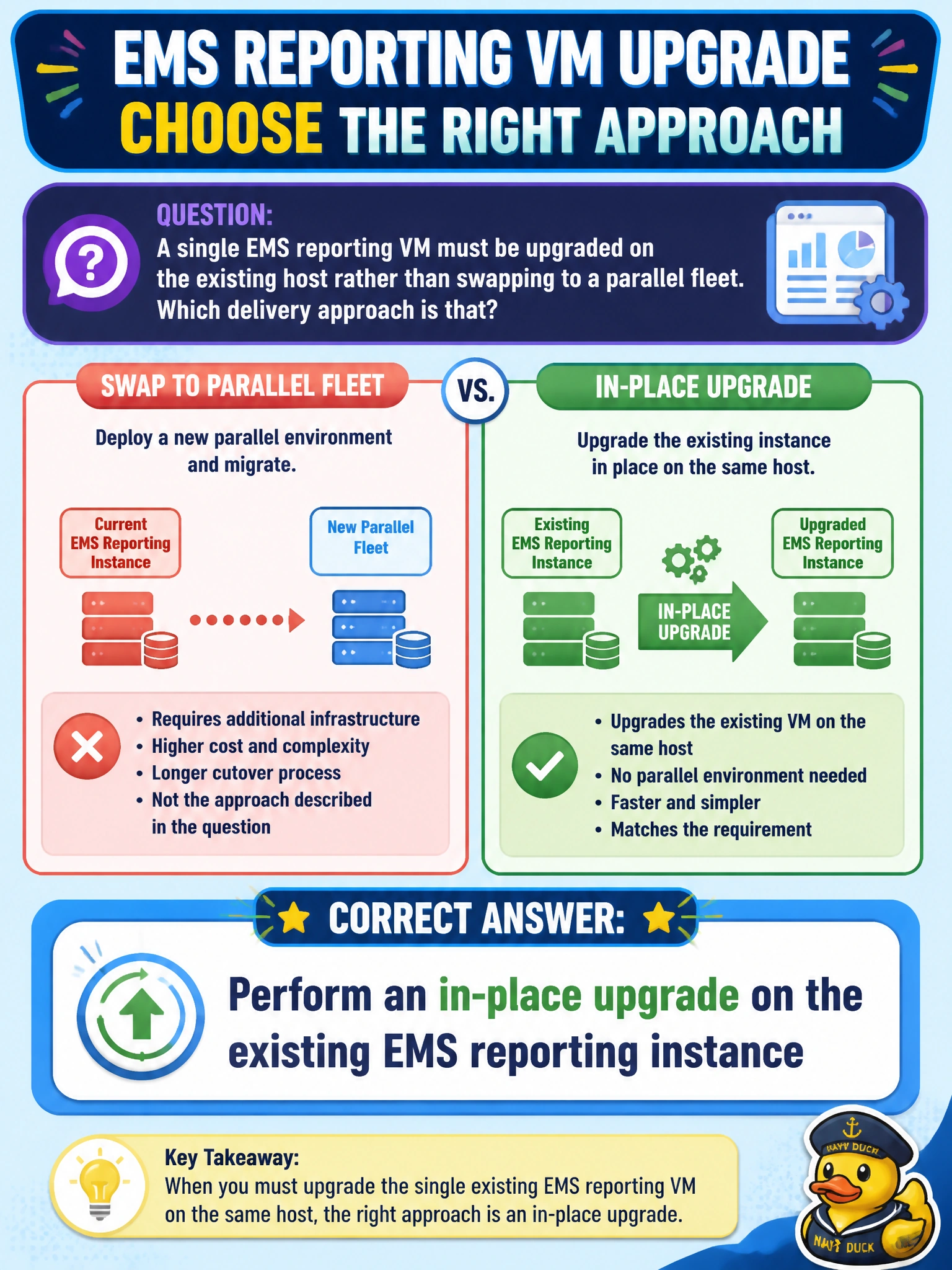
A single EMS reporting VM must be upgraded on the existing host rather than swapping to a parallel fleet. Which delivery approach is that?
Select an answer to reveal the explanation.
Short Explanation
In-place means upgrading the EMS box you already have—same host, new bits—not spinning a twin farm or trickling batches across a pool. One VM, one upgrade path.
Full Explanation
In-place delivery upgrades the existing instance on the host it already occupies rather than cutting over to a parallel environment or shifting traffic percentages across a fleet. A single EMS reporting VM that must be upgraded on the existing host is an in-place upgrade: the same node is mutated to the new version. That approach fits constrained single-box municipal EMS reporting where standing up a twin farm is out of scope.
Standing up an identical green EMS farm and cutting all traffic in one DNS flip is blue-green, not in-place. Routing 5% of EMS reports to a new cluster while keeping 95% on the old version is canary traffic shifting, which implies parallel capacity and percentage routing. Replacing EMS workers one batch at a time across a multi-node pool is a rolling update, which requires a pool of instances rather than a single VM upgraded on the existing host.
Exam caveat: in-place is simple on capacity but weak on instant rollback because the prior environment is overwritten. When the scenario specifies a single VM and no parallel fleet, choose in-place; when it emphasizes instant switchback or progressive slices, choose blue-green or canary instead.
Operational check: document the pre-upgrade version and backup/snapshot on the EMS VM, perform the in-place upgrade, verify the reporting service on the same host now runs the new build, and confirm rollback would require restore/reinstall rather than a DNS flip to a warm twin.