
Municipal CI agents keep failing with intermittent out-of-memory errors that are hard to spot in raw logs. What enhancement helps?
Select an answer to reveal the explanation.
Short Explanation
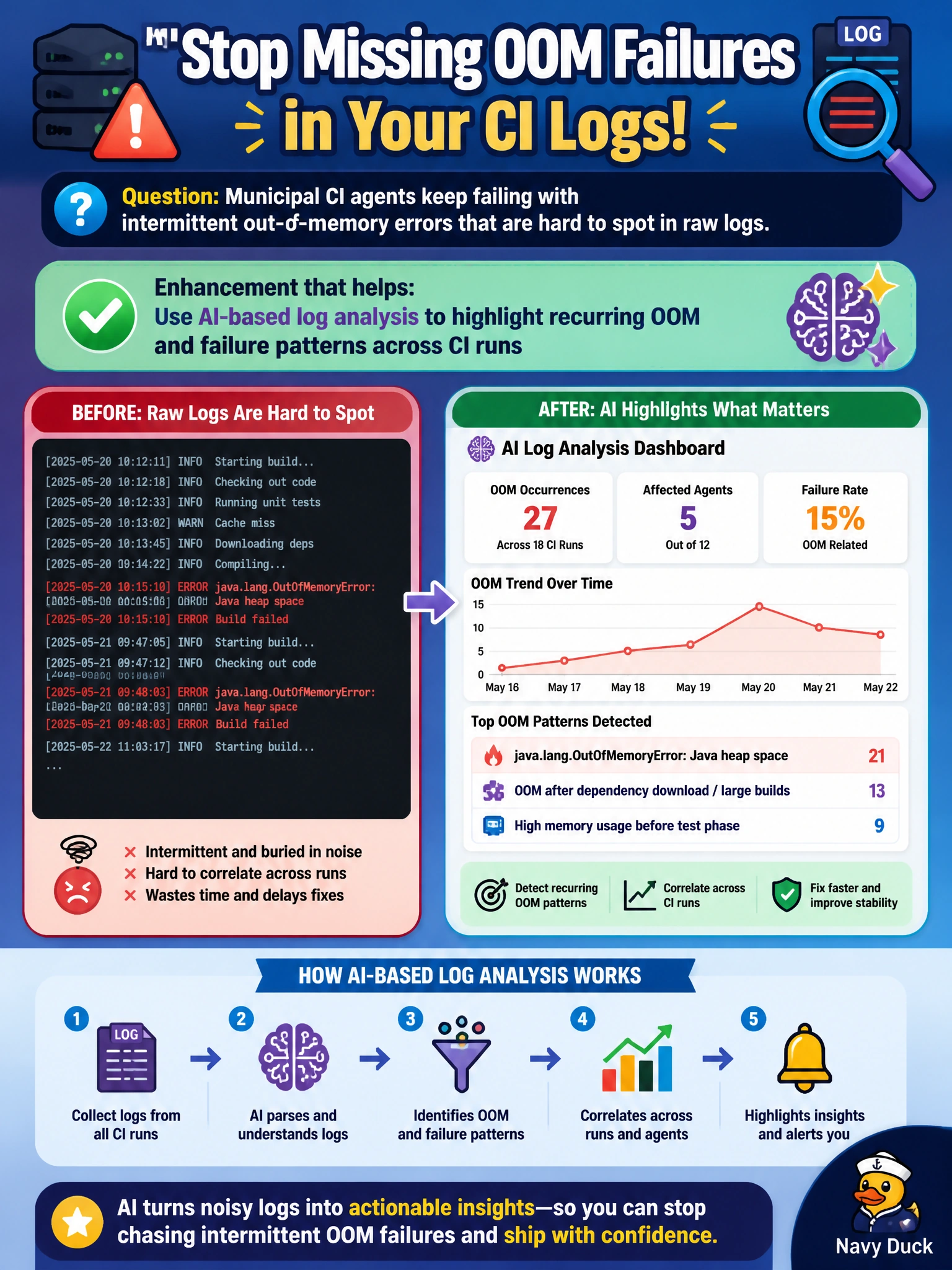
AI log analysis is the librarian who notices the same OOM chapter keeps showing up across agent diaries. Deleting logs or hoping memory "fixes itself" hides the pattern.
Full Explanation
AI-based log analysis helps operators highlight recurring failure patterns—such as intermittent out-of-memory errors—across CI history when raw logs are too noisy for manual spotting. Municipal CI agents that fail sporadically with OOM symptoms benefit from that enhancement because the same failure signature may be buried across many job logs and nights. The correct approach works by correlating repeated error shapes and timelines so platform teams can size agents, fix memory leaks, or split jobs based on evidence rather than anecdote.
Deleting historical job logs so patterns cannot be reviewed fails because destroying history removes the only corpus that can prove recurrence; intermittent OOM then looks like one-off noise forever. Ignoring OOM lines because memory issues always fix themselves overnight fails conceptually: transient recovery does not mean the defect is gone—it means the next large parks, courts, or clerk pipeline may fail again under load. Increasing every agent to maximum size with no analysis of recurring failures fails because blind upsizing is expensive for municipal CI budgets and may mask leaks until even maximum size is insufficient.
Exam caveat: AI log insights are decision support, not automatic root cause—validate highlighted patterns against metrics and reproduce before changing fleet sizing citywide. Operational check: retain CI logs for a defined window, enable analysis that flags recurring OOM signatures, verify a known injected OOM pattern is surfaced, and track whether recommended agent or job changes reduce the failure rate over subsequent sprints.