
Courts e-filing clients suddenly receive HTTP 503 during a filing rush. How should AutoOps interpret that status?
Select an answer to reveal the explanation.
Short Explanation
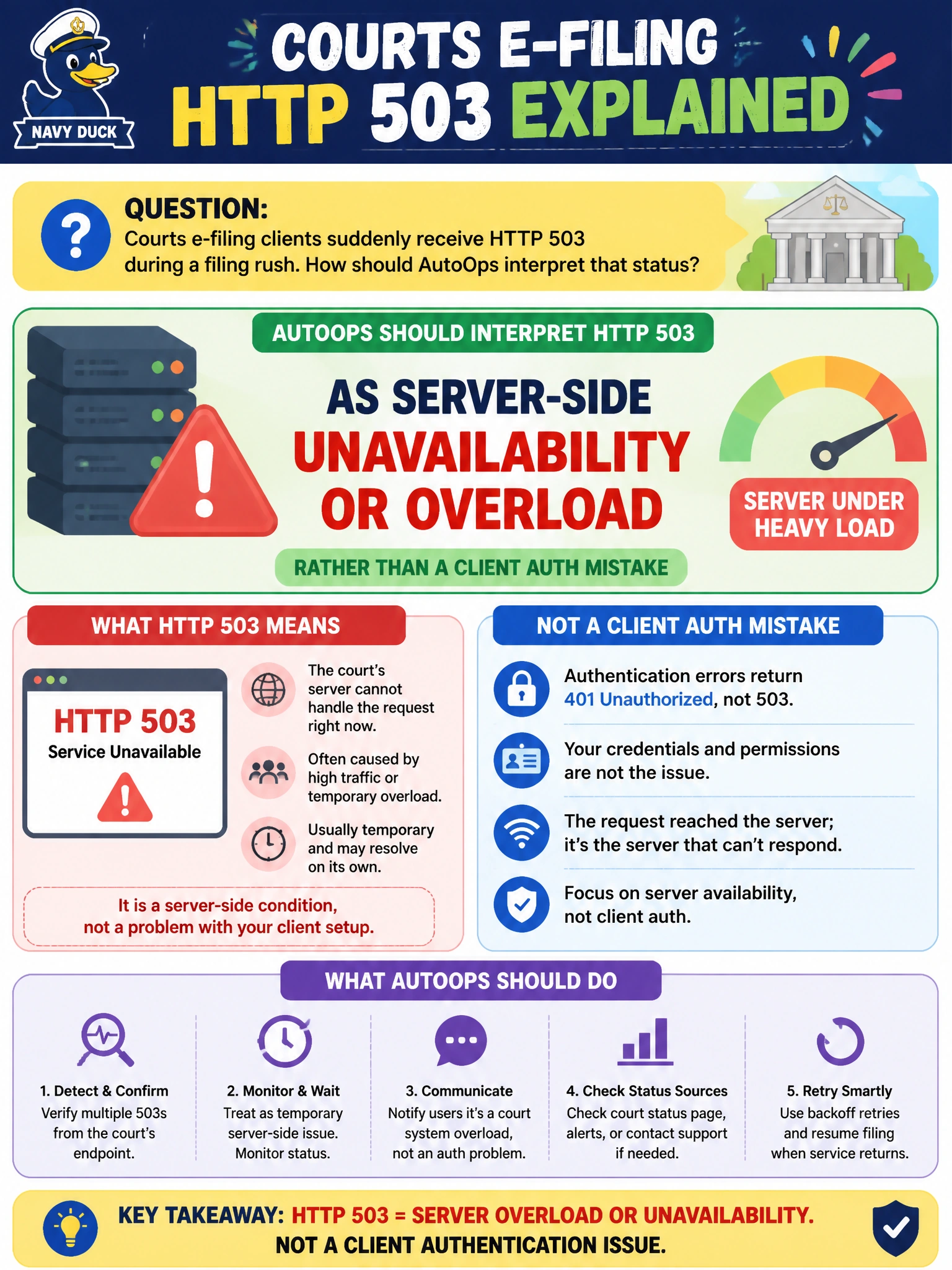
503 is the courthouse lights blinking 'temporarily closed'—not 'wrong ID badge.' Retry or wait on capacity; do not treat it like bad credentials. Creation success would look like 2xx, not 503.
Full Explanation
HTTP 503 during a courts e-filing rush should be interpreted as server-side unavailability or overload: the filing API (or an upstream dependency) cannot fulfill the request right now. AutoOps should classify 503 as a transient capacity or outage condition—queue, back off, retry with policy, or fail over—rather than as proof the client forged bad credentials or permanently malformed every payload. Under municipal filing load spikes, 503 commonly appears when application pools, databases, or gateways shed load.
Treating 503 as identical to HTTP 401 fails by concept: 401 is an authentication problem on the client credential path; 503 does not mean the filing attorney’s token is wrong. Interpreting 503 as proof the filing was permanently created and indexed fails because successful create/index outcomes are 2xx (often 201); 503 means the server did not complete the work. Treating 503 as a permanent client syntax error that requires rewriting every payload fails because 4xx classes (for example 400) cover malformed requests; blanket payload rewrites waste effort when the real issue is server capacity.
Exam caveat: 503 can include a Retry-After hint, but absence of that header does not change the class meaning. Do not conflate 503 with 500 (generic server error) in runbooks without checking dependency health, yet both remain server-side rather than auth-failure codes.
Operational check: rate-limit and retry e-filing clients with exponential backoff, watch gateway and app saturation metrics, shed noncritical traffic if needed, verify auth separately with a lightweight authenticated health or metadata call that should not return 401 if credentials are fine, and reopen full filing volume only after 503 rates normalize.