
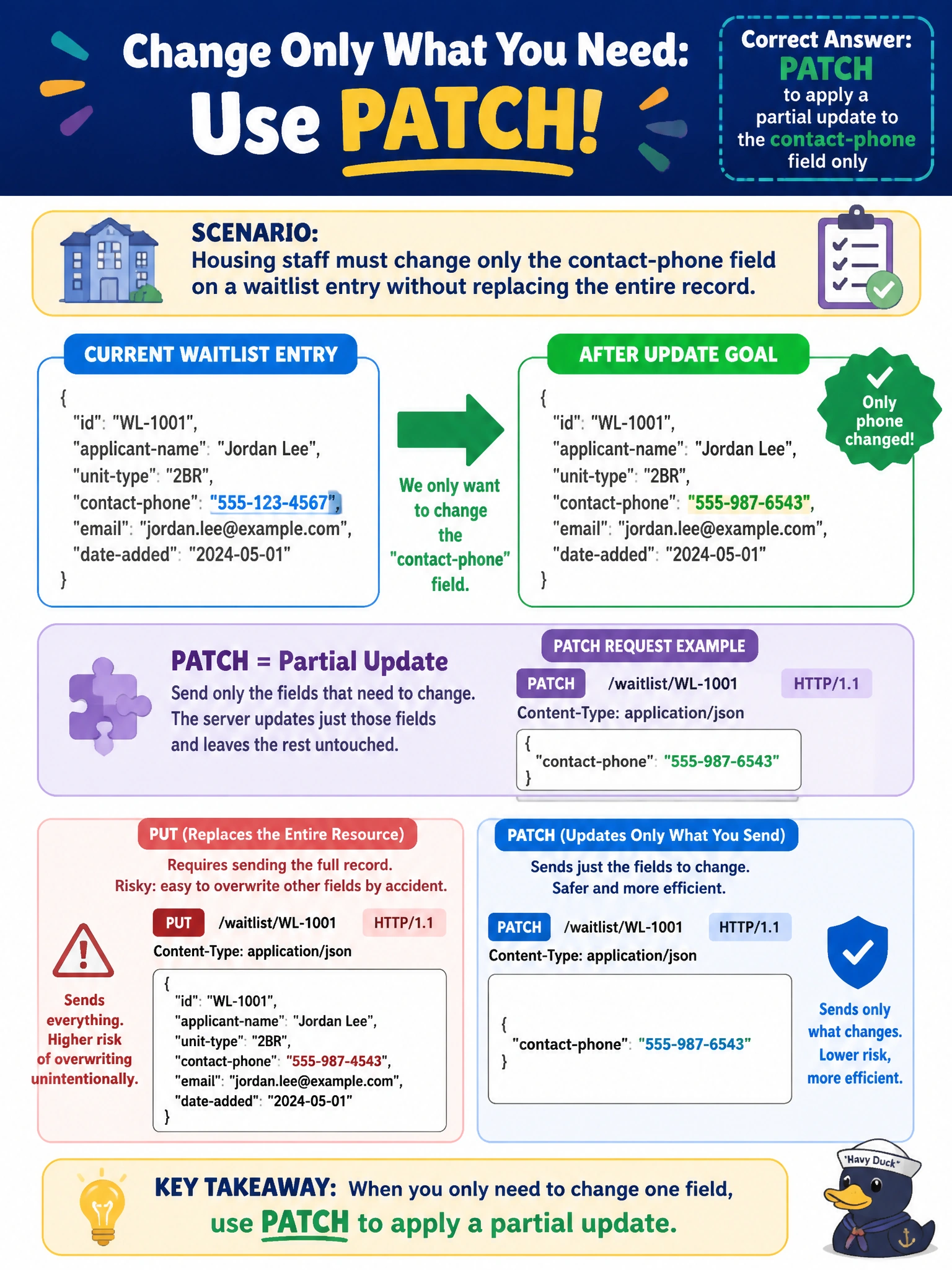
Housing staff must change only the contact-phone field on a waitlist entry without replacing the entire record. Which HTTP method fits that partial update?
Select an answer to reveal the explanation.
Short Explanation
PATCH is correcting one line on the waitlist card without rewriting the whole card. Phone-only updates belong there. PUT wants the full document back; DELETE throws the card away.
Full Explanation
Housing staff changing only the contact-phone field on a waitlist entry need HTTP PATCH to apply a partial update. PATCH sends a sparse modification—just the phone field (or a patch document describing that change)—so other waitlist attributes remain intact. That is the correct method when the business intent is a narrow field edit rather than rewriting the entire waitlist resource.
PUT that requires resending the complete waitlist resource every time fails this scenario's "only the contact-phone field" constraint: full replacement risks wiping fields the client did not intend to change if the complete document is stale or incomplete. GET cannot modify server-side fields; it is read-only and will not update the phone number. DELETE removes the waitlist entry entirely, which is the opposite of updating a single field and would destroy the resident's place in line.
Exam caveat: if an API does not implement PATCH, clients sometimes emulate partial updates carefully with PUT by read-modify-write, but that is riskier and not what this question asks. Prefer PATCH when the exam contrasts partial versus full replace.
Operational check: PATCH only the phone field on a test waitlist record, GET the resource and confirm other fields unchanged, attempt a mistaken DELETE in non-prod only to validate safeguards, and ensure production automation never uses PUT with partial bodies unless the API contract explicitly defines that behavior.