
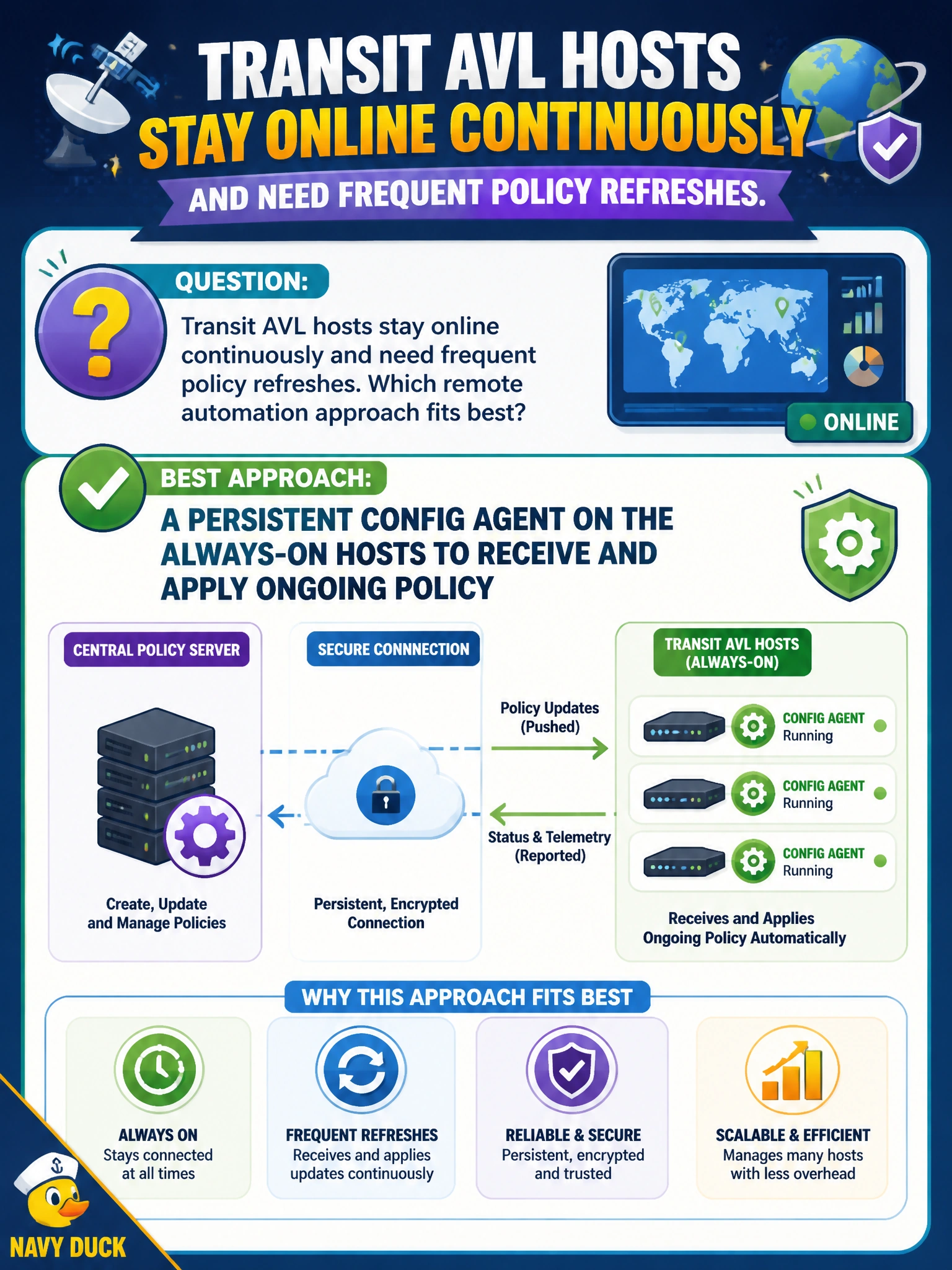
Transit AVL hosts stay online continuously and need frequent policy refreshes. Which remote automation approach fits best?
Select an answer to reveal the explanation.
Short Explanation
Always-on AVL boxes are like radios that stay powered in the garage—keep an agent aboard so policy updates ride along without a truck roll. Persistent agents fit continuous management. Hourly full reimages for tiny tweaks are overkill with downtime to match.
Full Explanation
Transit AVL hosts that stay online continuously and need frequent policy refreshes are best managed with a persistent configuration agent on those always-on systems. The agent maintains a management channel to receive updated policy, apply changes, and report compliance without requiring physical media or full rebuilds for each tweak. Continuous availability plus frequent change is exactly the profile where resident agents outperform rare break-glass visits.
Mailing configuration CDs to each garage after every policy change fails on speed, chain-of-custody, and scale for frequent refreshes. Relying solely on rare break-glass console visits with no ongoing management fails the frequent-policy requirement and leaves drift undetected between emergencies. Reimaging every AVL host from scratch hourly to apply tiny setting tweaks fails by using a destructive, high-disruption lifecycle for incremental policy—reimaging is for rebuilds, not minute-to-minute configuration.
Exam caveat: agents must be monitored, authenticated, and updatable themselves; persistent agents are ideal for always-on fleets but may be wrong for severely constrained appliances (see agentless patterns). Match approach to device capability and change frequency.
Operational check: deploy policy through the agent to a pilot AVL host, confirm apply and inventory reports, measure time-to-enforce versus media/console workflows, and prohibit hourly reimage jobs as a substitute for configuration management.