
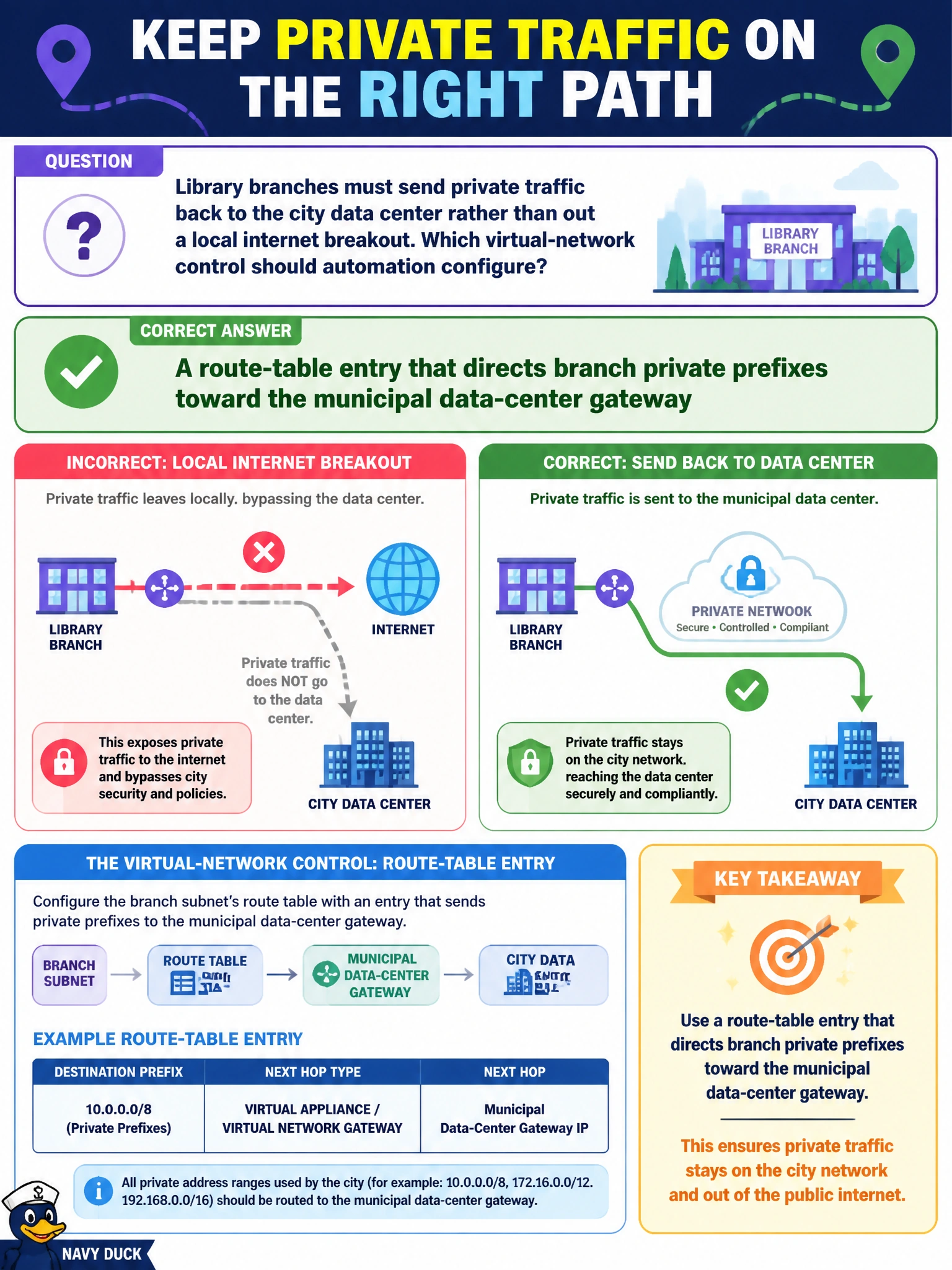
Library branches must send private traffic back to the city data center rather than out a local internet breakout. Which virtual-network control should automation configure?
Select an answer to reveal the explanation.
Short Explanation
Think of the route table as the branch's turn-by-turn directions: 'city DC this way, not the local coffee-shop exit.' Automation should install a route that sends private branch prefixes to the municipal data-center gateway. Blank routes or random NAT hops leave librarians talking to the wrong place.
Full Explanation
Library branch sites that must backhaul private municipal traffic to the city data center rely on correct routing, not on DNS tricks or random NAT. Automation should configure a route-table entry that directs the branch private prefixes toward the municipal data-center gateway (or the overlay/VPN next hop that represents that gateway). Route tables define next hops for destination prefixes; installing the proper private-prefix route keeps library systems, directory traffic, and internal APIs on the intended municipal path instead of leaking out a local internet breakout where policy, logging, and inspection may be absent.
A public wildcard DNS record pointing every branch hostname to 8.8.8.8 fails conceptually because DNS name resolution is not the same as IP forwarding policy, and redirecting names to a public resolver address does not create private backhaul to the city data center. Disabling all routes so each branch becomes an isolated island fails the stated requirement: branches still need private reachability to central services, and removing routes breaks that connectivity rather than steering it. NAT that rewrites every packet to a random cloud region for load sharing fails because indiscriminate destination rewriting destroys deterministic municipal routing, breaks return paths and security policy, and does not implement controlled backhaul to the city DC.
Exam caveat: many designs combine SD-WAN, IPsec, or private connectivity with the route entry; the exam focus here is the virtual-network control—the route that selects the DC gateway as next hop for private prefixes—not the physical circuit brand.
Operational check: from a branch host, traceroute or path checks toward a private city DC prefix should egress via the municipal gateway, not the local ISP default; route tables should show the private prefix more-specific or preferred over breakout; and monitoring should alert if branch private traffic suddenly shifts to local internet exit.