
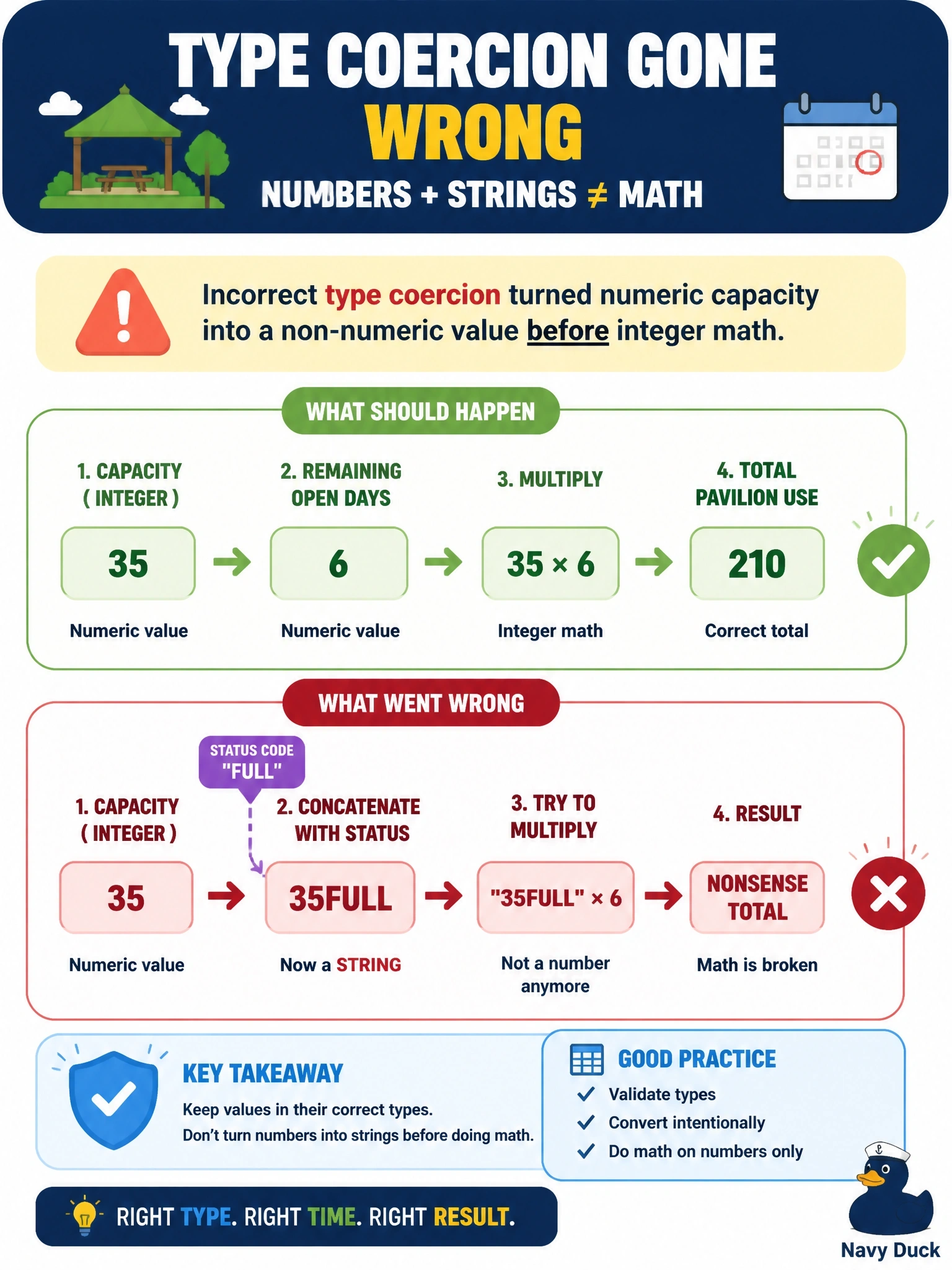
A parks reservation script multiplies pavilion capacity (an integer) by remaining open days. A developer concatenates the capacity value with a string status code before the math runs, producing nonsense totals. What went wrong?
Select an answer to reveal the explanation.
Short Explanation
Mix a number with a text sticker and the calculator chokes—your capacity stopped being an integer. Keep capacity numeric until the multiply finishes, then attach status strings separately.
Full Explanation
Parks reservation math depends on intact numeric types. Pavilion capacity is an integer; remaining open days is also numeric. Multiplying them yields total capacity-days only if both operands remain numbers through the calculation. When a developer concatenates the capacity value with a string status code before the math runs, many languages coerce the integer into a string or produce a non-numeric composite, so subsequent arithmetic yields nonsense totals or runtime type errors. The root cause is incorrect type coercion that turned numeric capacity into a non-numeric value before integer math, not networking, markup layout, or source-control mechanics. The claim that the open-days counter exceeded the maximum TCP window size confuses application arithmetic with transport-layer flow control; TCP windows do not govern pavilion capacity products in a reservation script. The claim that YAML indentation silently deleted the parks database is unrelated to concatenating capacity with a status string; database loss is not explained by type coercion in this stem. The claim that Git merge conflicts always convert integers to floating point is also wrong; merges may introduce conflicting lines, but they are not a general type-conversion mechanism and do not explain string concatenation before multiply. Exam caveat: dynamically typed languages may silently coerce; statically typed languages may fail at compile time—either way, keep numeric values numeric until math completes, then format or attach status strings for display or logging. Operational check: unit-test capacity times open days with integer fixtures, assert numeric results, add a regression test that fails if capacity is concatenated with a status code before multiply, and verify production reservation totals match expected pavilion math after the fix.