
Several customers run on the same cloud hosts, and no customer can see another's data. Which cloud trait is that sharing?
Select an answer to reveal the explanation.
Short Explanation
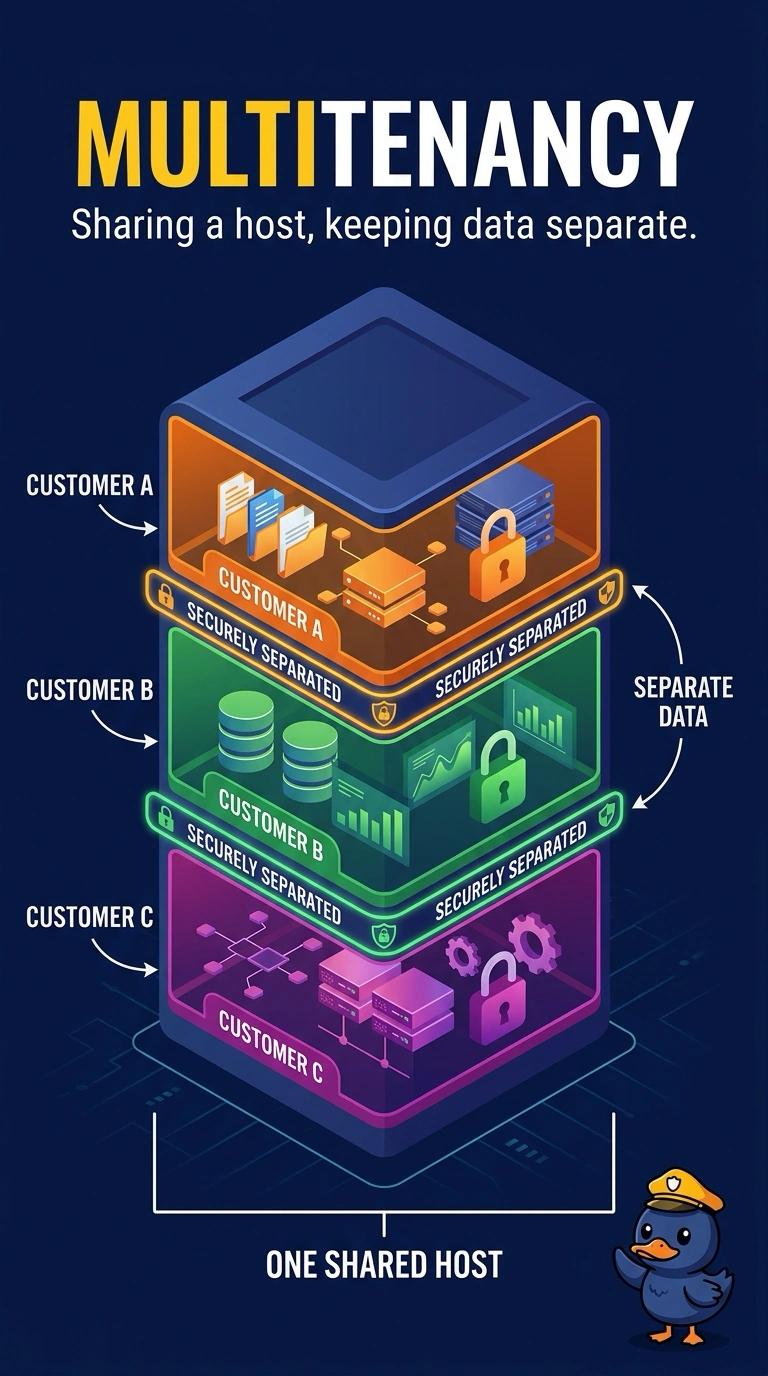
The customers are tenants in one building, and the walls between the apartments hold. That sharing is the multitenancy you are paying for. Growing and shrinking capacity, a cloud built for one owner, and a bill for outbound data do not describe neighbors who cannot see each other's rooms.
Full Explanation
Multitenancy means several customers share the same physical systems while their data and configuration stay separated. These customers on the same hosts, unable to see each other's data, match that trait. Rapid elasticity is scaling resources as demand changes. It is not the name of the separation between customers. A private cloud serves one organization. Several unrelated customers on the same hosts are not a single private cloud. Metered egress charges for data leaving the provider. A charge does not hide one customer's data from another. Exam caveat: separation is a configuration and a control, not a hope. A tenant who can read another tenant's storage is a broken design, not multitenancy working as intended. Operational check: sign in as one customer and confirm another customer's files and machines are not visible. Sign in as one customer and confirm the other customer's files are invisible. Repeat the check from the second customer account. Save a screenshot of the empty foreign-tenant view with the ticket.