
A build server runs many small application instances that share the host kernel and start faster than full guest machines. Which technology is that?
Select an answer to reveal the explanation.
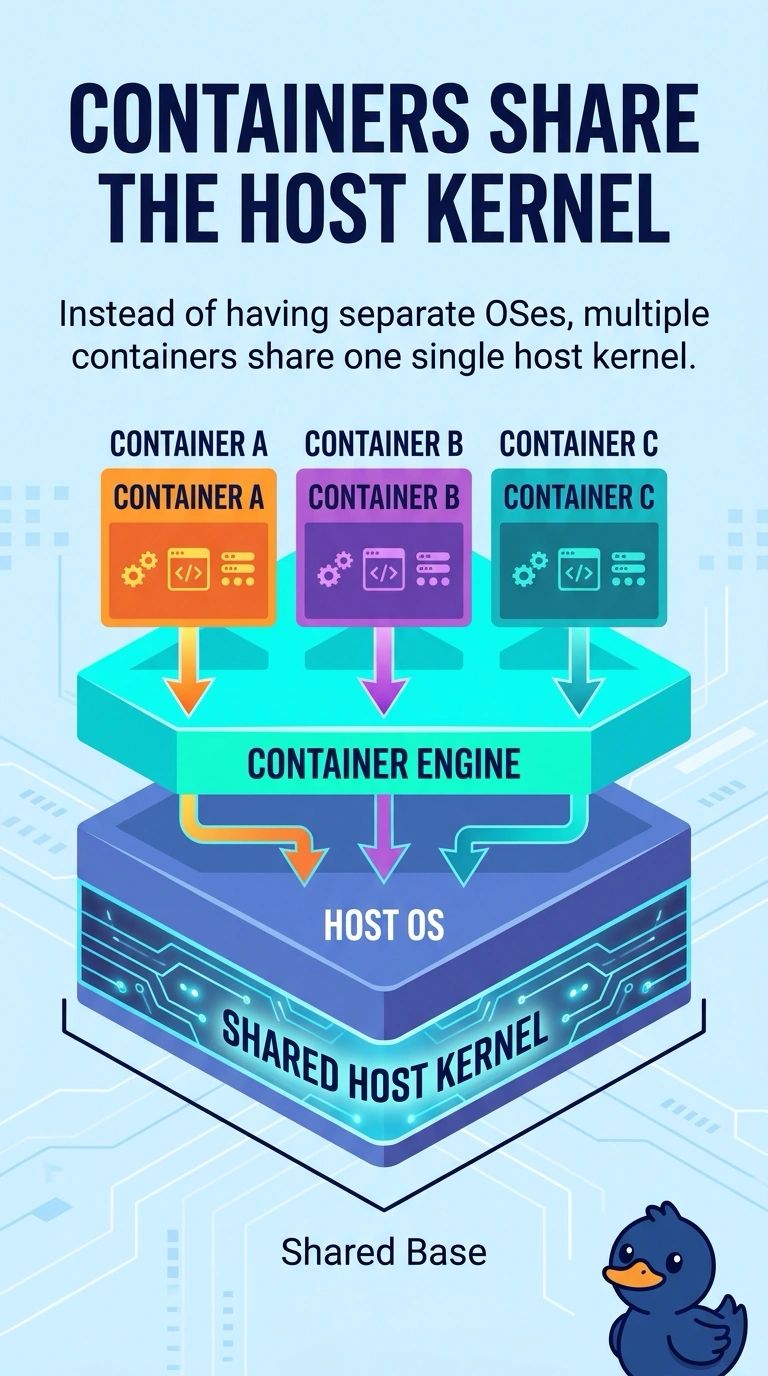
Short Explanation
The applications are tenants in one building, not each in a house with its own foundation. You are looking at containers that share the host kernel. A full hypervisor per application, a disk stripe, or an industry cloud does not describe that lightweight share.
Full Explanation
Containers package an application and share the host operating system's kernel, which is why they start faster and use less overhead than a full virtual machine with its own kernel. The build server's instances match containers. A type 1 hypervisor runs full guest machines, each with its own kernel. Giving every small application its own hypervisor would be the heavy approach the stem is not using. RAID 0 stripes disks for speed and has no redundancy. It does not share a kernel among applications. A community cloud is a cloud shared by a group of organizations. Shared-kernel instances on one build server are not that model. Exam caveat: because the kernel is shared, a container is a weaker isolation boundary than a separate virtual machine. Do not treat it as a full sandbox for untrusted code. Operational check: start one of the instances, confirm it does not boot its own kernel, and confirm it is running on the build server's kernel. Inspect one instance and confirm its process list is on the build server rather than inside a separate guest kernel.