
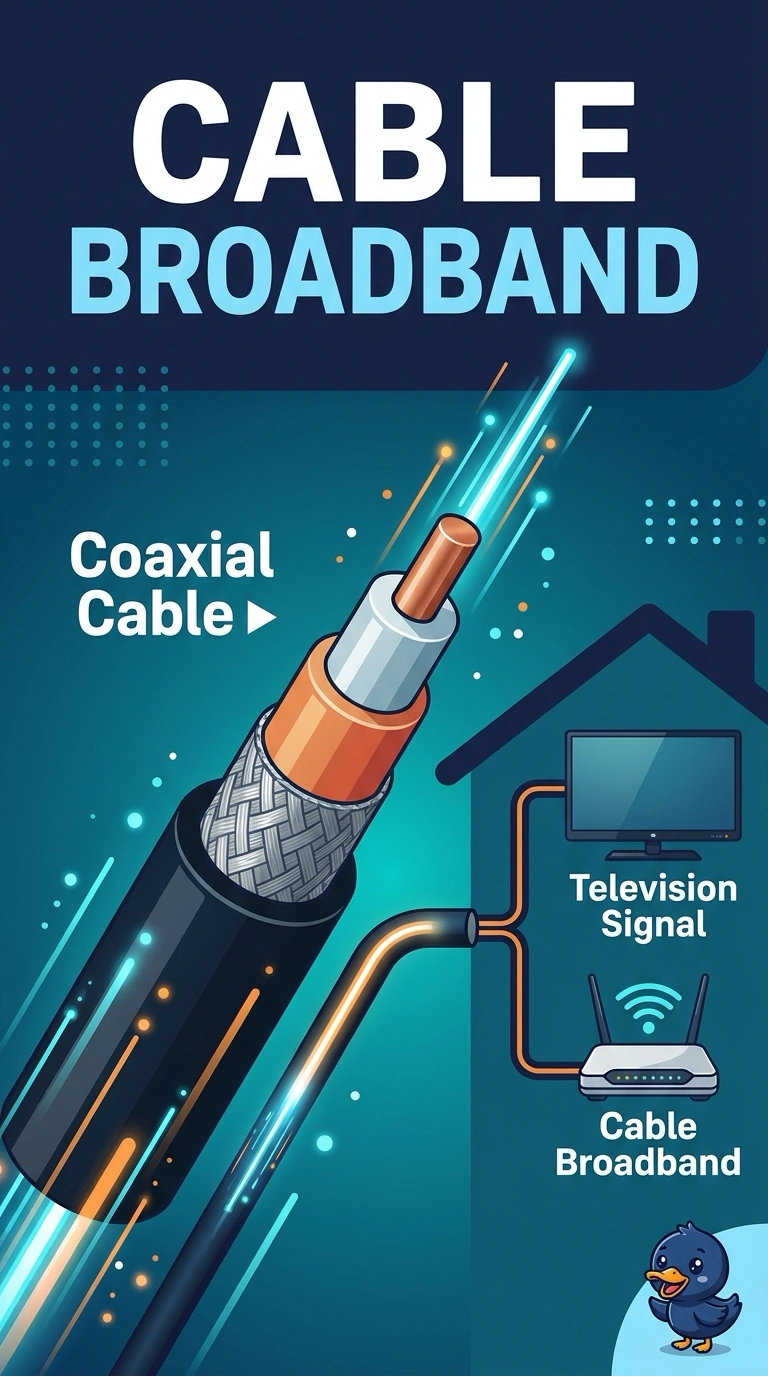
A house gets its internet from a provider that delivers the service on the same coaxial cable as the television signal. Which connection type is that?
Select an answer to reveal the explanation.
Short Explanation
The internet is coming in on the same thick round cable as the television picture. You call that cable broadband. A phone-line service, a dish, and a cell tower do not use the television coax as their path into the house.
Full Explanation
Cable broadband carries data on the coaxial cable plant, often alongside television service. A provider that delivers internet on that same coax is a cable connection. DSL uses telephone wiring, not the television coax. Satellite uses a dish aimed at a satellite. The coax drop on the side of a house is the opposite of a sky path. Cellular uses the mobile network and a radio in the device or a gateway. It does not turn the television coax into its antenna. Exam caveat: the coax still ends at a cable modem, which hands Ethernet to the router. The connection type is cable even after that handoff. Operational check: trace the provider cable to the modem, confirm it is coax, and confirm the modem's WAN path is the cable service rather than a phone line or a dish. Follow the coax from the wall plate to the modem and photograph the connector for the install record. Confirm the modem sync light is up after you trace the coax. Compare the modem's WAN type with the work order so a DSL modem is not left on a cable drop.