
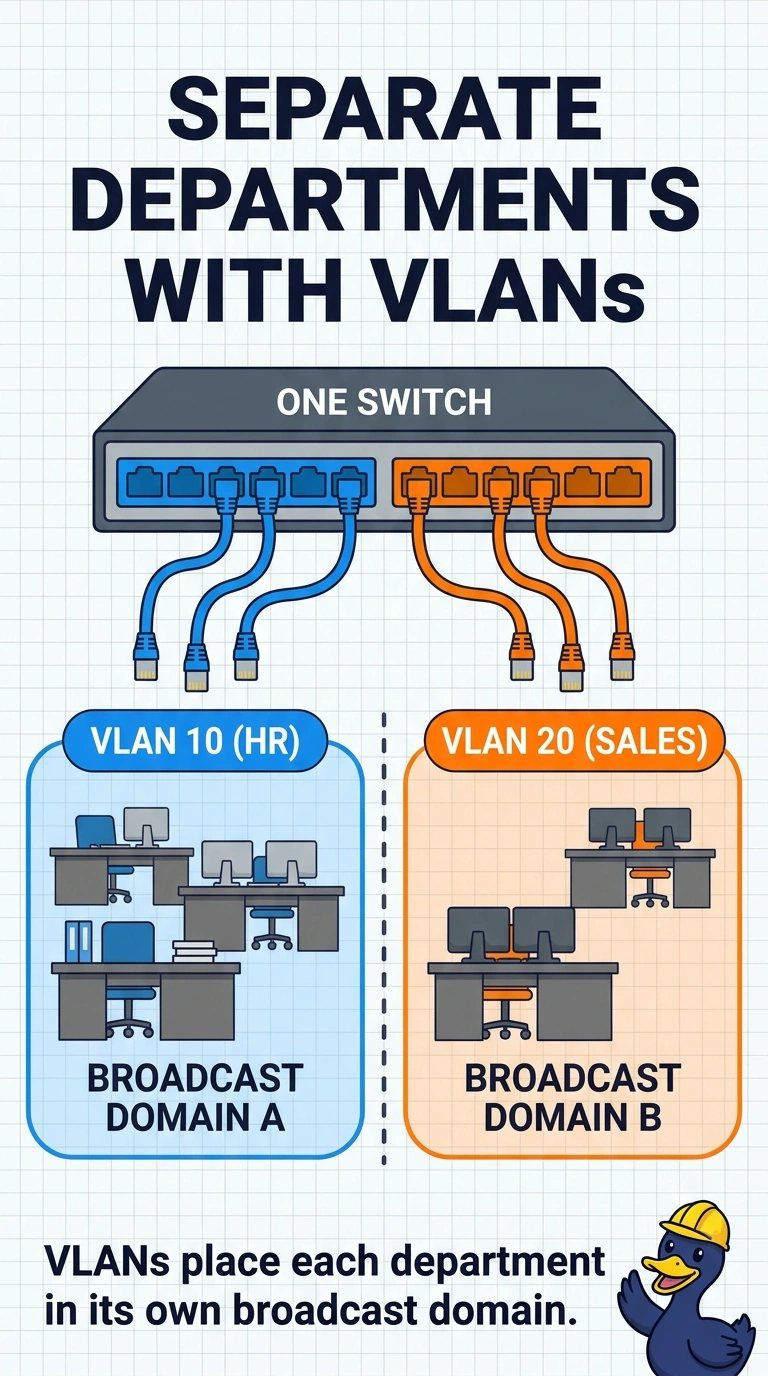
Two departments share one switch, and each department must be its own broadcast domain. Which feature does that on the switch?
Select an answer to reveal the explanation.
Short Explanation
The departments share the same piece of equipment and still need their own rooms. You build those rooms with VLANs. A longer address timer, one big shared network, or a tunnel out to the internet does not split the switch into two broadcast domains.
Full Explanation
A VLAN is a logical separation on a switch. Ports in different VLANs are different broadcast domains even though they share the hardware. Putting each department in its own VLAN is the feature that meets the requirement. A DHCP lease controls how long an address is kept. It does not split broadcasts. One shared subnet on every port is a single broadcast domain, which is the opposite of isolating the departments. A VPN encrypts traffic to another network, typically across the internet. It does not divide two groups of ports on the local switch. Exam caveat: devices in different VLANs need a router or a layer-3 switch if they must still talk to each other. The VLAN split alone does not route between them. Operational check: assign the two departments to two VLANs, and confirm a broadcast in one does not appear on a port in the other. Confirm a broadcast in one department stays out of the other department's ports. If the departments must still share a printer, route between the VLANs on purpose.