
A records server has four disks. The array must keep working even if any two of those disks fail. Which RAID level fits?
Select an answer to reveal the explanation.
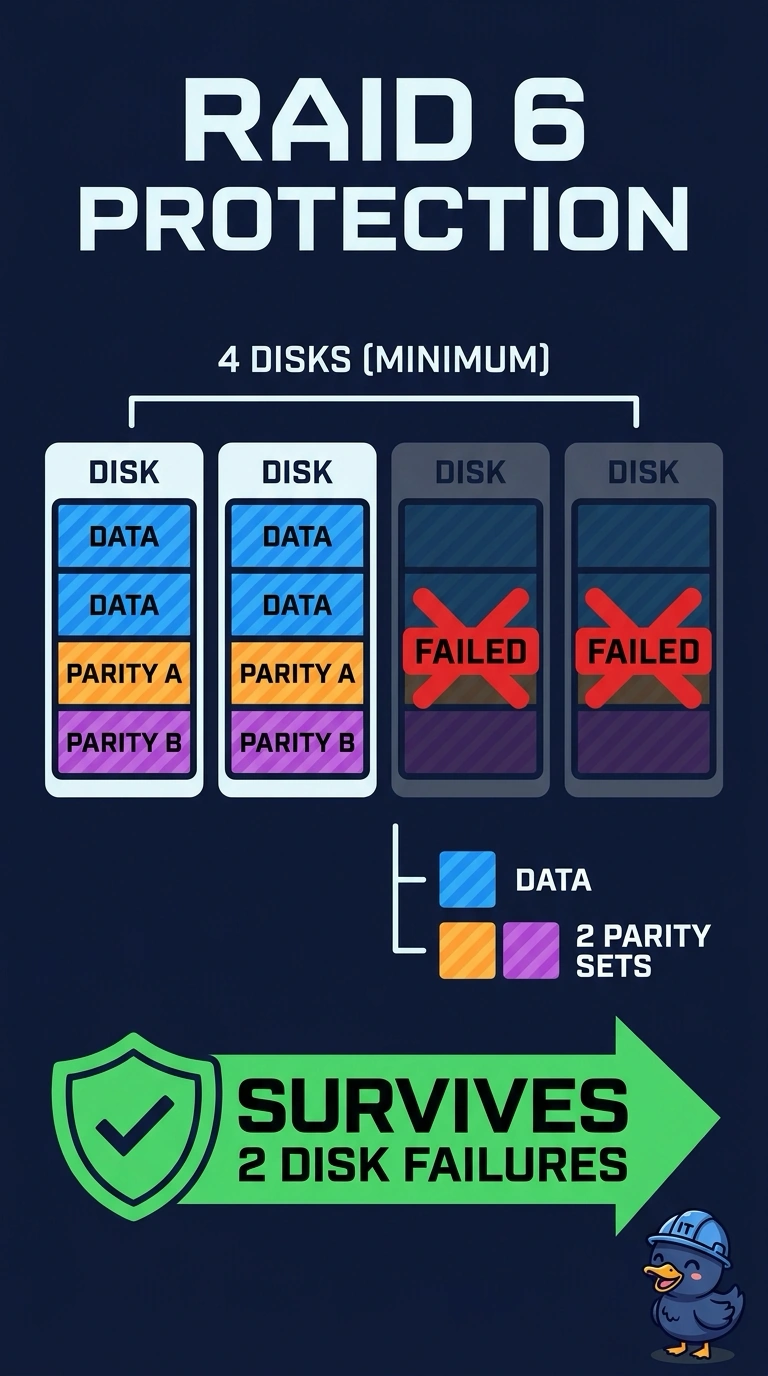
Short Explanation
You want the array to stay standing after it loses two disks, not one. With four disks, that is RAID 6 and its two parity sets. A stripe with no parity, a single parity set, or a mirror of only two disks cannot make that promise.
Full Explanation
RAID 6 stores two independent parity sets and can survive the failure of any two disks. Four disks meet its minimum, so it fits the records server. RAID 0 has no parity. Two disk failures, or even one, lose the array. RAID 5 stores one parity set and survives a single disk failure. A second failure before a rebuild finishes loses the data, so it does not meet a requirement to survive any two failures. RAID 1 on two of the four disks only mirrors that pair. The other two disks are not protected by it, and a mirror does not cover two failures inside the same pair. Exam caveat: a RAID 6 rebuild after two failures is slow and is not a backup. Keep copies that are not in the array. Operational check: confirm the controller reports RAID 6, then review its documentation for a dual-failure test before you trust the window. Keep a backup that is not stored on the same four disks. Review the controller manual before any dual-failure drill. Document that two disks can fail before the array is lost.