
A desktop hard disk is not spinning. The technician checks the power-supply rail that feeds drive motors. Which rail is that?
Select an answer to reveal the explanation.
Short Explanation
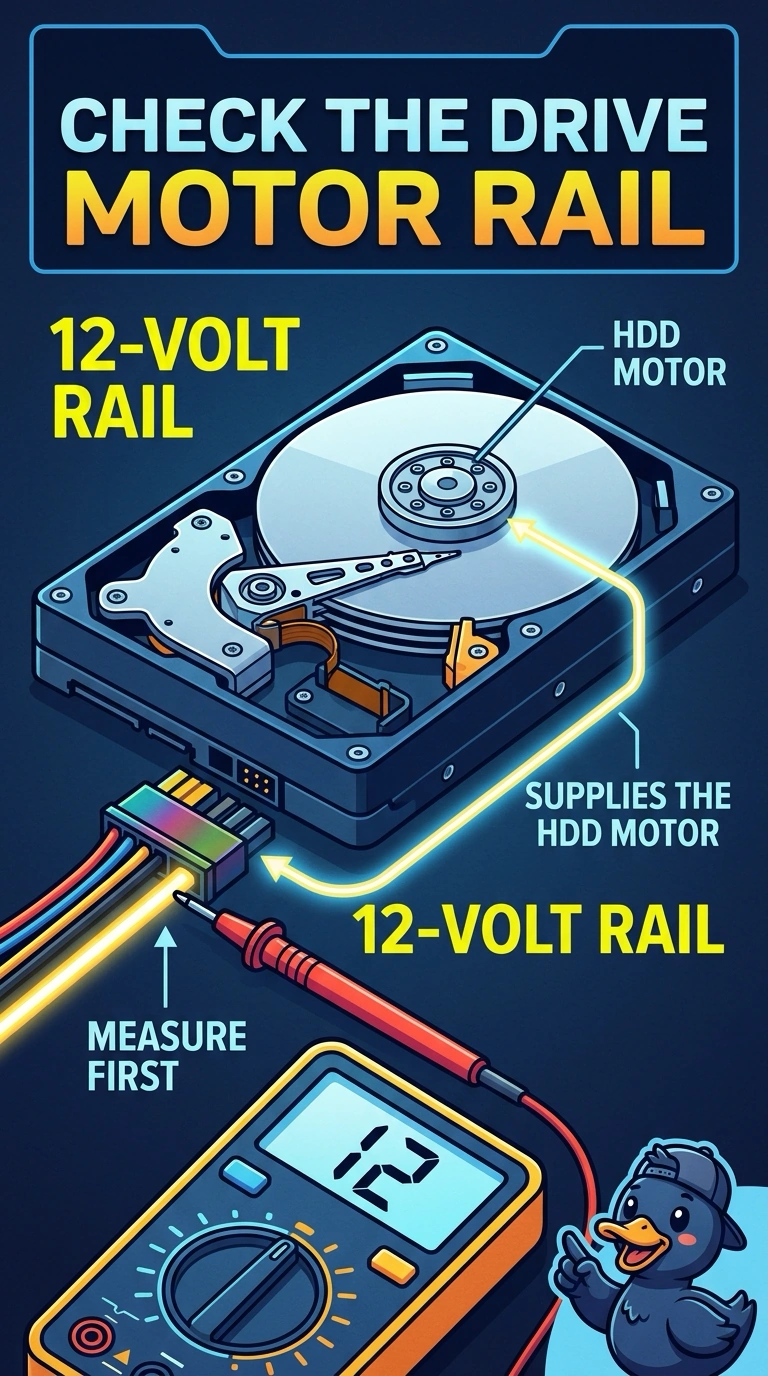
The motor in a spinning disk is a heavier load than a logic chip, and the supply gives that motor the higher rail. You check the 12-volt rail. The low logic rail, the tiny clock battery, and a network power feature do not turn an internal drive's platters.
Full Explanation
A desktop power supply provides 3.3-volt, 5-volt, and 12-volt outputs. Spinning hard-disk motors draw on the 12-volt rail, so that is the rail to check when the disk is not spinning. The 3.3-volt rail feeds low-voltage logic. It is not the rail that turns the platters. The CMOS coin cell keeps firmware settings and the clock when the PC is off. It does not run a drive motor while the supply is on. Power over Ethernet feeds power over a network cable to devices such as phones and access points. An internal hard disk is powered by the supply's drive connector, not by the Ethernet port. Exam caveat: a SATA drive also uses the 5-volt portion of its power connector for electronics. A dead motor still points you at 12 volts first, and a drive with no power connector seated at all will not spin on any rail. Operational check: confirm the drive power plug is seated, then measure the 12-volt pins on a spare connector before you replace the disk. If the 12-volt reading is healthy and the plug is seated, the drive motor itself is the next part to suspect.