
A school has four identical disks. The array must keep working after one disk fails, and it must keep more usable space than a two-disk mirror. Which RAID level fits?
Select an answer to reveal the explanation.
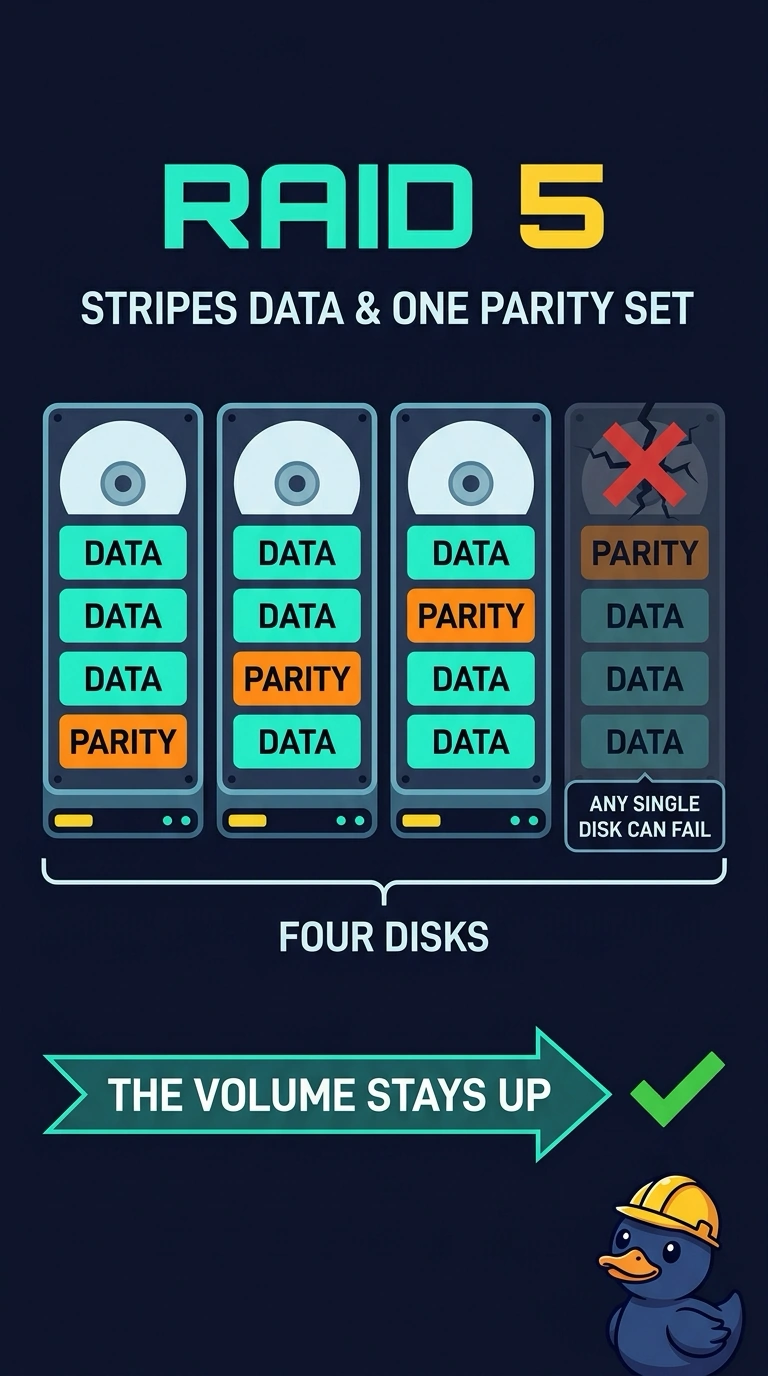
Short Explanation
You want a spare tire, not a second full car, and you still want most of the trunk. RAID 5 spreads the data and keeps one set of parity, so one disk can die and three disks' worth of space remains. A stripe with no parity, a plain mirror, or double parity on only four disks does not match both halves of that request.
Full Explanation
RAID 5 stripes data and parity across at least three disks and survives the loss of one disk. With four disks, usable capacity is three disks, which is more than a two-disk mirror's single disk of usable space. That matches the school's two requirements. RAID 0 stripes with no parity. One disk failure loses the array, so it fails the survival requirement even though it looks fast. RAID 1 mirrors two disks and stores only one disk of unique data. Using two of the four disks as a mirror does not give more usable space than RAID 5 on four disks. RAID 6 stores two independent parity sets and survives two disk failures. On four disks it leaves only two disks of usable space, which is not more generous than a mirror and is not the level that spends the least space on a single failure. Exam caveat: RAID 5 still needs a healthy backup, because a second disk failure during a rebuild loses the array. Operational check: confirm the controller shows a degraded array that still serves files after one disk is pulled in a test, then rebuild onto a replacement.