
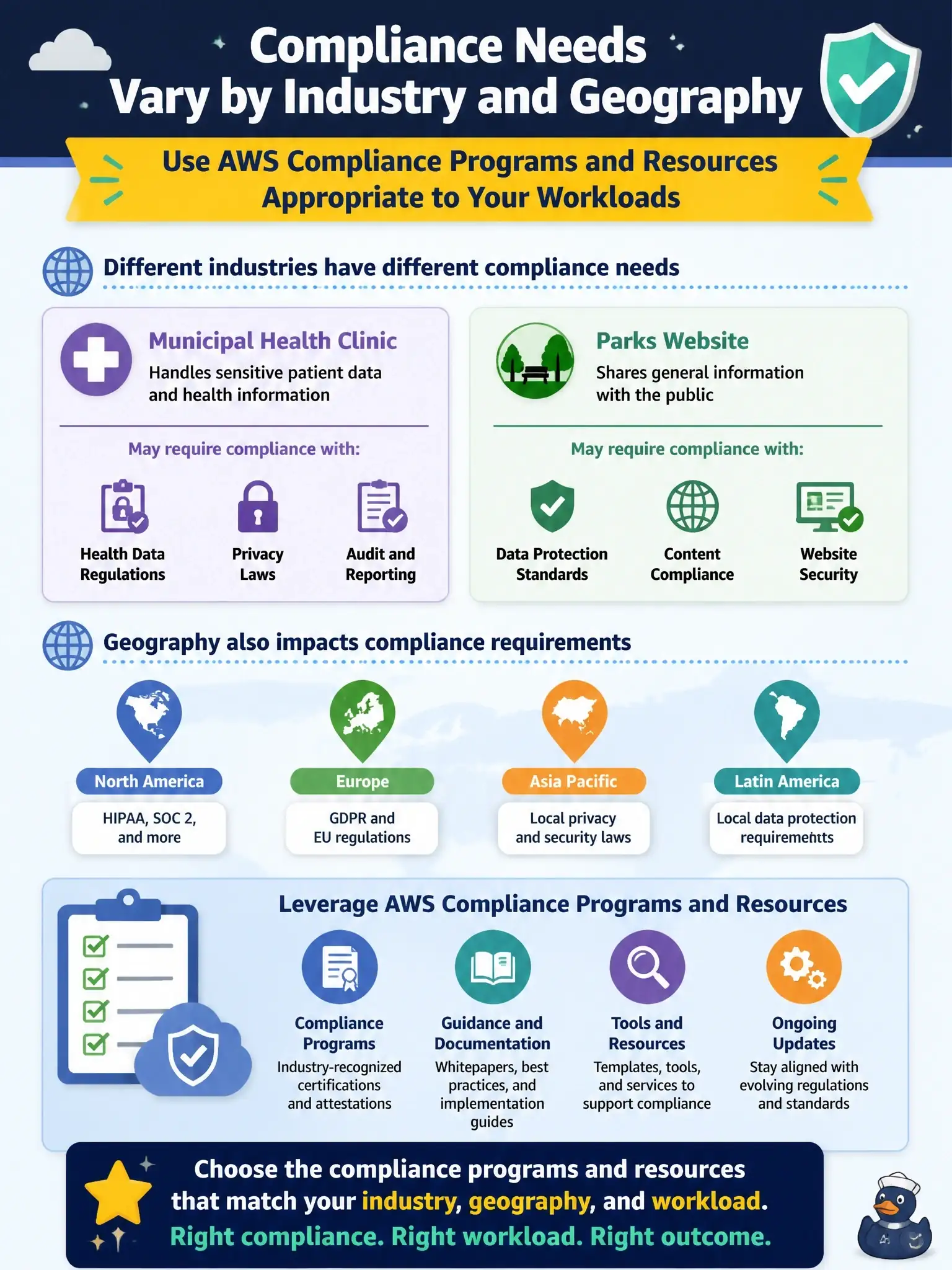
A municipal health clinic workload may need industry-specific compliance evidence that a parks website does not. Which statement reflects how compliance needs relate to AWS?
Select an answer to reveal the explanation.
Short Explanation
You don't grade a clinic and a parks blog on the same clipboard. Rules change by industry and place, so you match AWS compliance programs and reports to each workload. AWS helps with evidence, but you still close the gaps.
Full Explanation
The correct statement is that compliance needs vary by industry and geography; customers should use AWS compliance programs and resources appropriate to their workloads rather than assuming a single global checkbox. A clinic portal and a parks department blog are not graded on the same clipboard, and residency rules may differ across jurisdictions. The claim that only on-premises systems can be in scope for healthcare or regional regulations is wrong because cloud workloads can absolutely be in scope. The claim that every AWS workload automatically meets every industry regulation worldwide with no customer action is wrong because AWS provides shared responsibility and evidence, not automatic universal compliance. The claim that compliance requirements never vary by industry or geography when using AWS is wrong because industry rules and geographic data-residency rules change the required evidence. These wrong options fail by excluding cloud from scope, by promising automatic universal compliance, or by denying geographic and industry variation. Exam caveat: AWS provides programs, certifications, and Artifact reports that support customer compliance journeys; responsibility for designing and operating a compliant solution still sits heavily with the customer. Operational check: identify applicable regimes for each civic system, select Regions and services accordingly, gather Artifact evidence, engage legal/privacy early, and document customer controls that close residual requirements beyond AWS's attestations.