
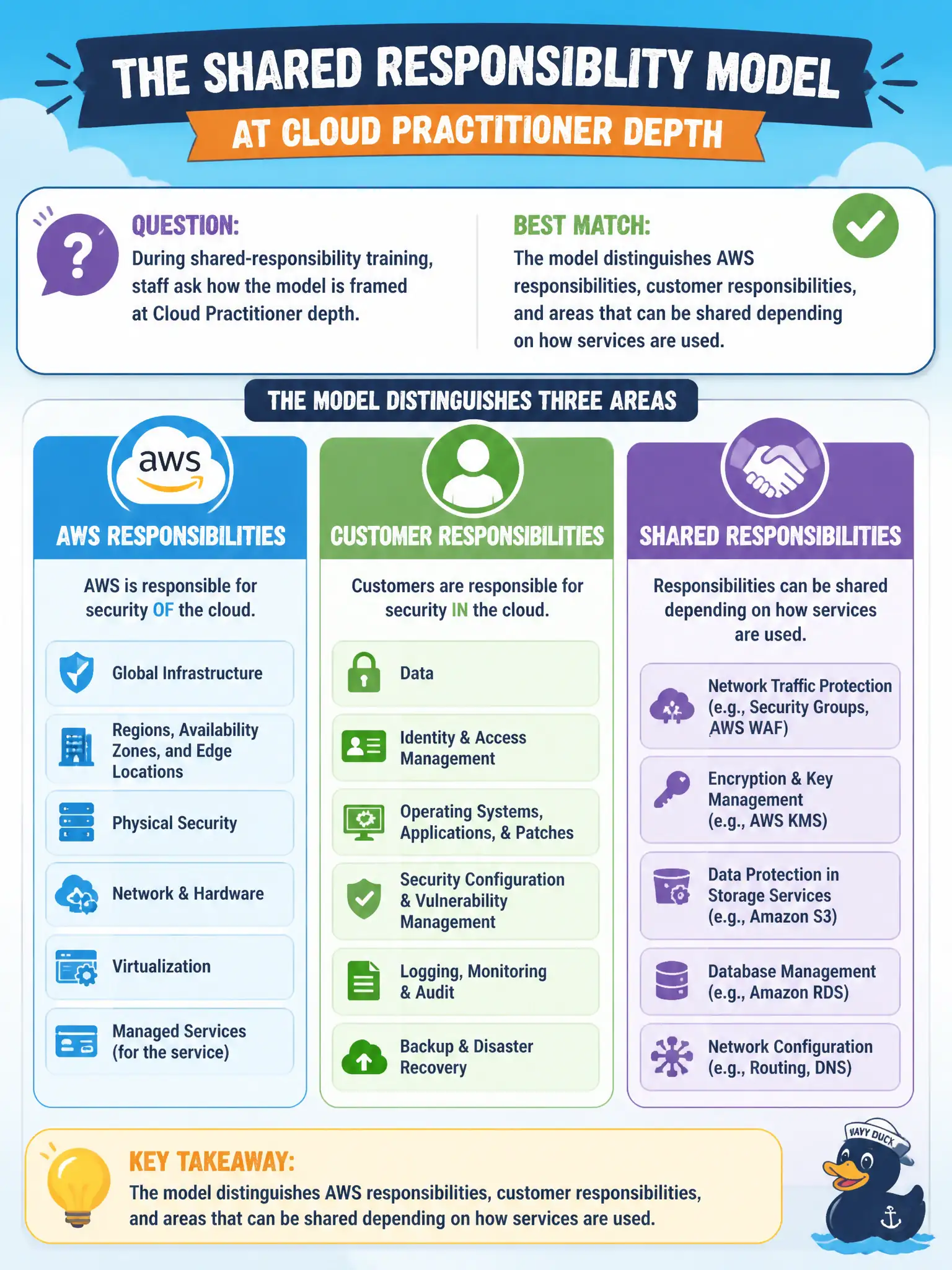
During shared-responsibility training, staff ask how the model is framed at Cloud Practitioner depth. Which description best matches the guide-style components?
Select an answer to reveal the explanation.
Short Explanation
It is a labeled map, not a single dump truck of blame. AWS covers the cloud foundation, customers cover what they put in and how they configure it, and some themes sit in both camps depending on the service. Knowing those buckets beats treating everything as "somebody else's problem."
Full Explanation
At Cloud Practitioner depth, the shared responsibility model is framed as distinguishing AWS responsibilities, customer responsibilities, and areas that can be shared depending on how services are used — not as a single dump of blame onto one party. AWS covers foundational security of the cloud (facilities, hardware, global infrastructure, and service-dependent platform layers). Customers cover what they place in the cloud and how they configure identity, data protection, applications, and many network controls. Some themes, such as network controls or encryption configuration, sit in customer hands even when AWS provides the features, and the exact OS or runtime split moves with the service model. Descriptions that say only AWS has duties, only customers have duties, or only Marketplace vendors own cloud security for all accounts are incomplete or false. Exam caveat: "shared" does not mean "identical percentage on every service," and it never means "customers outsource every control by signing up." Operational check for municipal training: teach staff the three buckets — AWS, customer, and service-dependent overlap — then walk through EC2 versus managed database versus Lambda examples so people can place a control on the correct side of the map before an audit interview.