
Which statement correctly distinguishes AWS infrastructure duties from customer duties on Amazon EC2 for a city website?
Select an answer to reveal the explanation.
Short Explanation
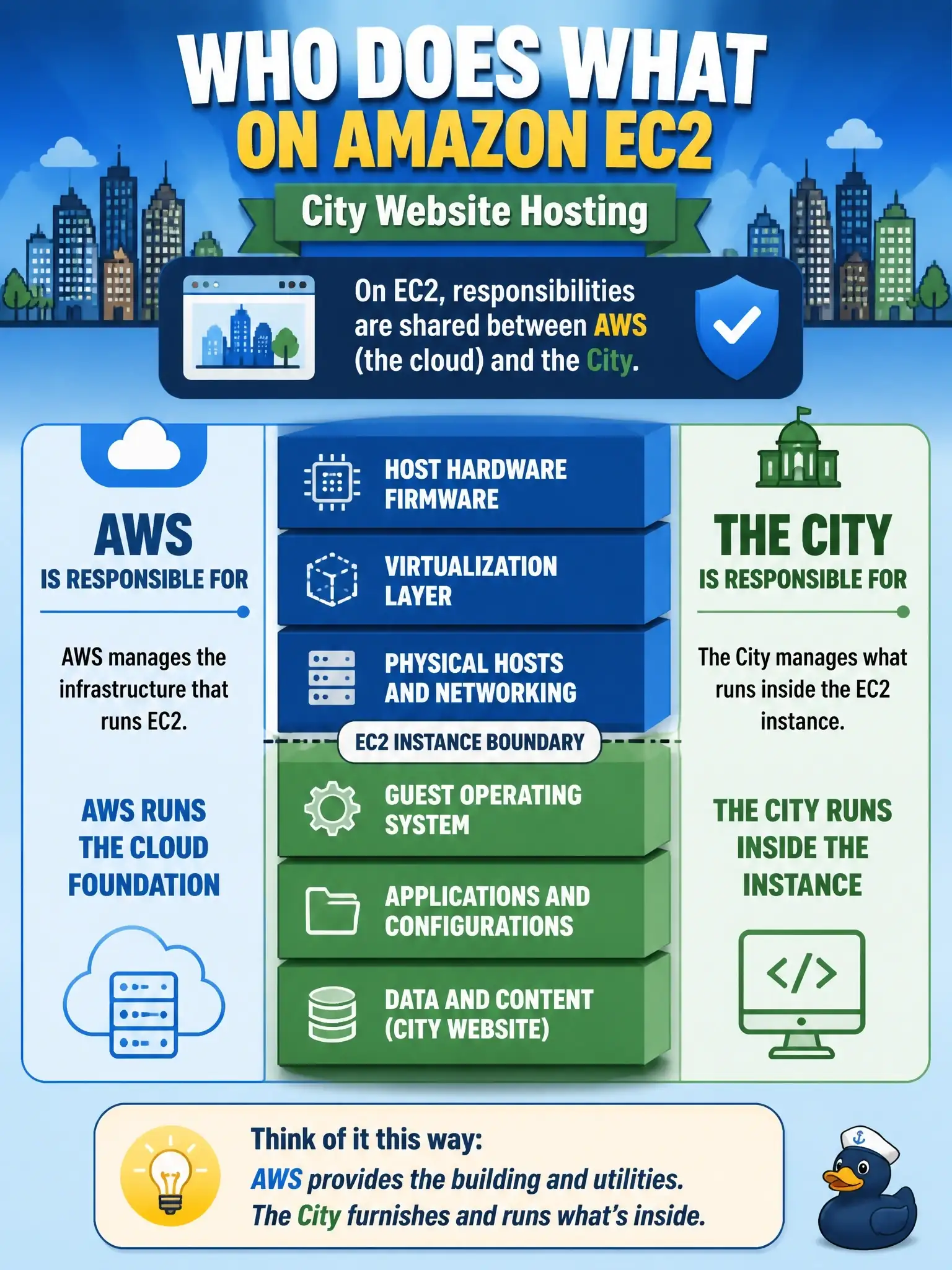
Think of it like renting space: AWS keeps the building and elevator machinery running, while you maintain what's inside your unit. On EC2, AWS handles host hardware, firmware, and the hypervisor, and you're still responsible for patching and hardening the guest OS.
Full Explanation
On Amazon EC2, AWS is responsible for security of the cloud elements such as physical facilities, host hardware, host firmware, and the virtualization (hypervisor) layer, while the city remains responsible for the guest operating system running the municipal website — including patching, hardening, and related configuration. That distinction matches the landlord-versus-tenant analogy: AWS maintains the building systems and elevator machinery; the city maintains what runs inside its virtual machines. The claim that the city patches AWS host firmware and the hypervisor while AWS patches the guest OS reverses the model. The claim that AWS and the city jointly edit hypervisor source code for every Region used is not a customer shared-coding task. The claim that the city is responsible for physical rack power in AWS Regions that host the site likewise misplaces infrastructure facility duties onto the customer. Exam caveat: some item banks accidentally invert option flags; always anchor on the shared responsibility boundary taught in Cloud Practitioner materials — physical and virtualization substrate to AWS, guest OS on EC2 to the customer. Operational check: ensure patching runbooks cover guest OS and application packages on city EC2 fleets, while facility power, hardware firmware, and hypervisor issues are treated as AWS-managed concerns escalated through AWS support channels when relevant.