
A municipal IT lead compares Amazon EC2, Amazon RDS, and AWS Lambda for who manages the operating system or runtime layer. Which ordering correctly shows increasing AWS responsibility for that layer?
Select an answer to reveal the explanation.
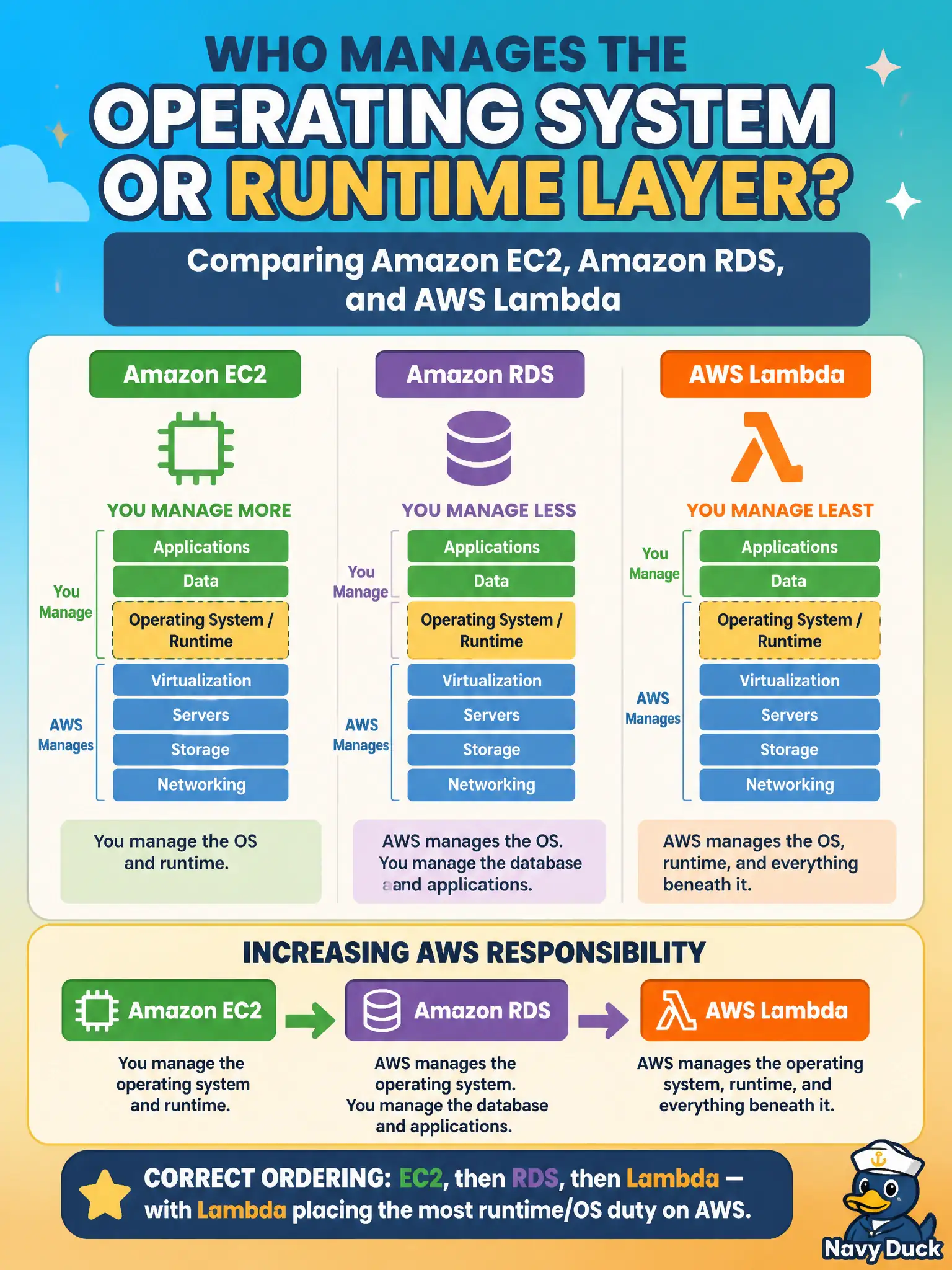
Short Explanation
Imagine mowing your own lawn, hiring a landscaper for the yard, then moving into a hotel where facilities handle the grounds. EC2 is closest to DIY OS work, RDS shifts more database-host duties to AWS, and Lambda pushes runtime patching furthest toward AWS. The city's app and data duties do not vanish.
Full Explanation
Ordering Amazon EC2, Amazon RDS, and AWS Lambda by increasing AWS responsibility for the operating system or runtime layer yields EC2, then RDS, then Lambda. On EC2, customers typically manage the guest operating system, including patching and hardening. RDS is a managed database service where AWS takes on more of the underlying host and database engine operations, reducing undifferentiated OS toil for the city while leaving data, access, and configuration choices with the customer. Lambda goes further: AWS operates and patches the execution environment, while the city remains responsible for function code, permissions, and secrets handling. The reverse ordering that places the most OS duty on AWS for EC2 is conceptually backwards. Claiming Lambda leaves guest OS patching on the city misunderstands serverless. Asserting identical guest OS patching across all three ignores service-model differences. Exam caveat: increasing AWS responsibility at the runtime layer does not mean the city has no security work — application logic, IAM, and data protection remain. Operational check: when selecting a compute or data service for a municipal system, document who patches what, who rotates credentials, and which runbooks still belong to city staff so expectations match the shared responsibility boundary.