
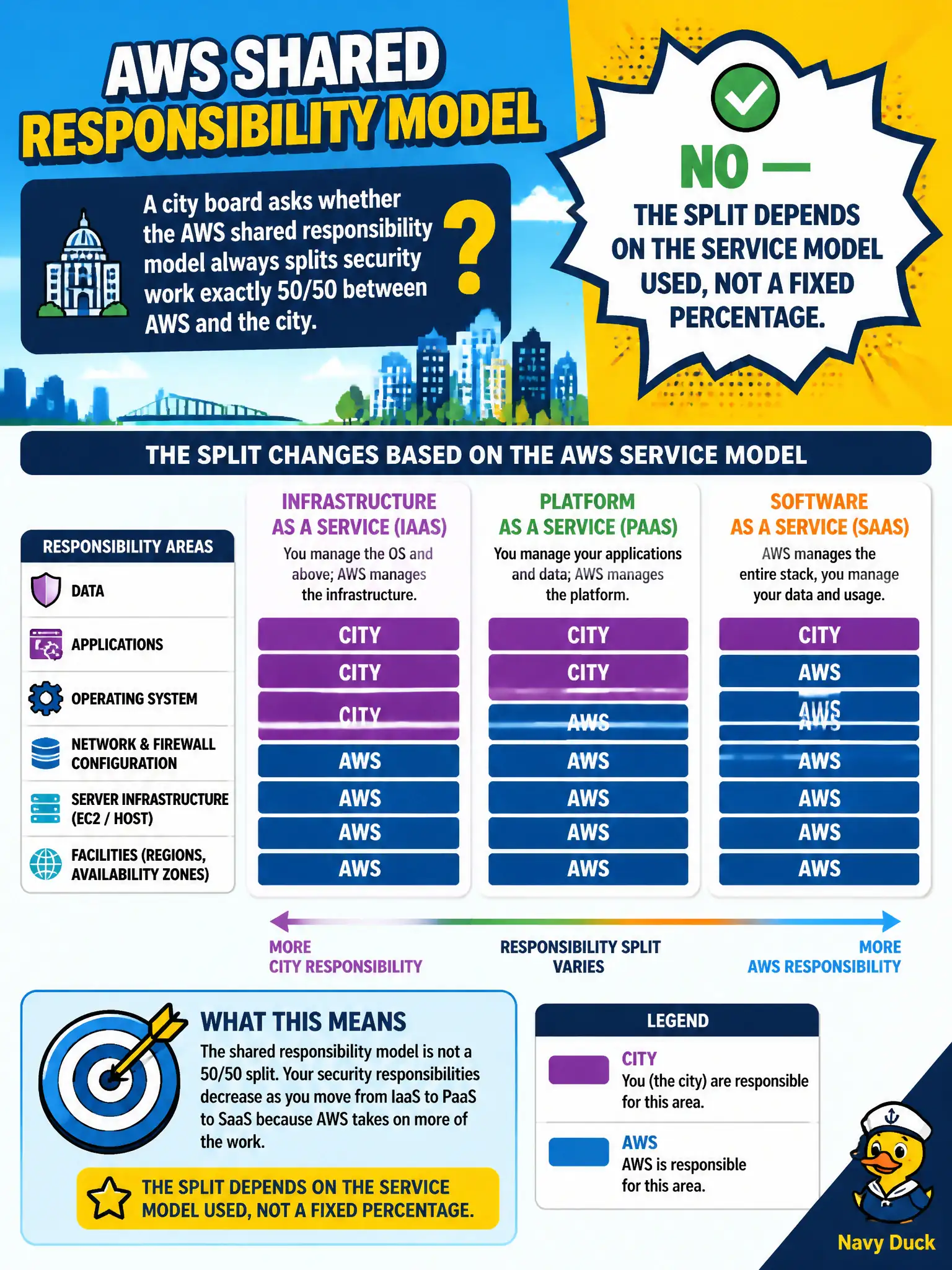
A city board asks whether the AWS shared responsibility model always splits security work exactly 50/50 between AWS and the city. Which response is accurate?
Select an answer to reveal the explanation.
Short Explanation
Think of renting a bare room versus a furnished apartment with utilities included — your chores change with what you rented. Shared responsibility is not a locked 50/50 pie chart. EC2 leaves more OS work with the customer; managed and serverless services shift more of that layer to AWS.
Full Explanation
The AWS shared responsibility model is not a fixed fifty-fifty pie chart. How much OS patching, runtime maintenance, or platform control sits with AWS versus the city depends on the service model in use — for example, Amazon EC2 leaves more guest operating system work with the customer, Amazon RDS shifts more of the database host layer to AWS, and AWS Lambda places still more of the execution environment under AWS operation. Board-level messaging that every service always splits security work identically is therefore inaccurate. Equally wrong is claiming customers have zero remaining security duties after migration; identity, data, application, and configuration responsibilities typically remain. Distractors fail by freezing the split at half-and-half, by asserting identical OS patching duties across service types, or by erasing customer accountability entirely. Exam caveat: Cloud Practitioner questions often contrast IaaS-style versus managed or serverless offerings specifically to test whether you understand that the boundary moves. Operational check for municipal IT: for each major workload, record which layer AWS manages and which layer the city still patches, configures, and monitors — then train staff against that map rather than a single percentage slogan.