
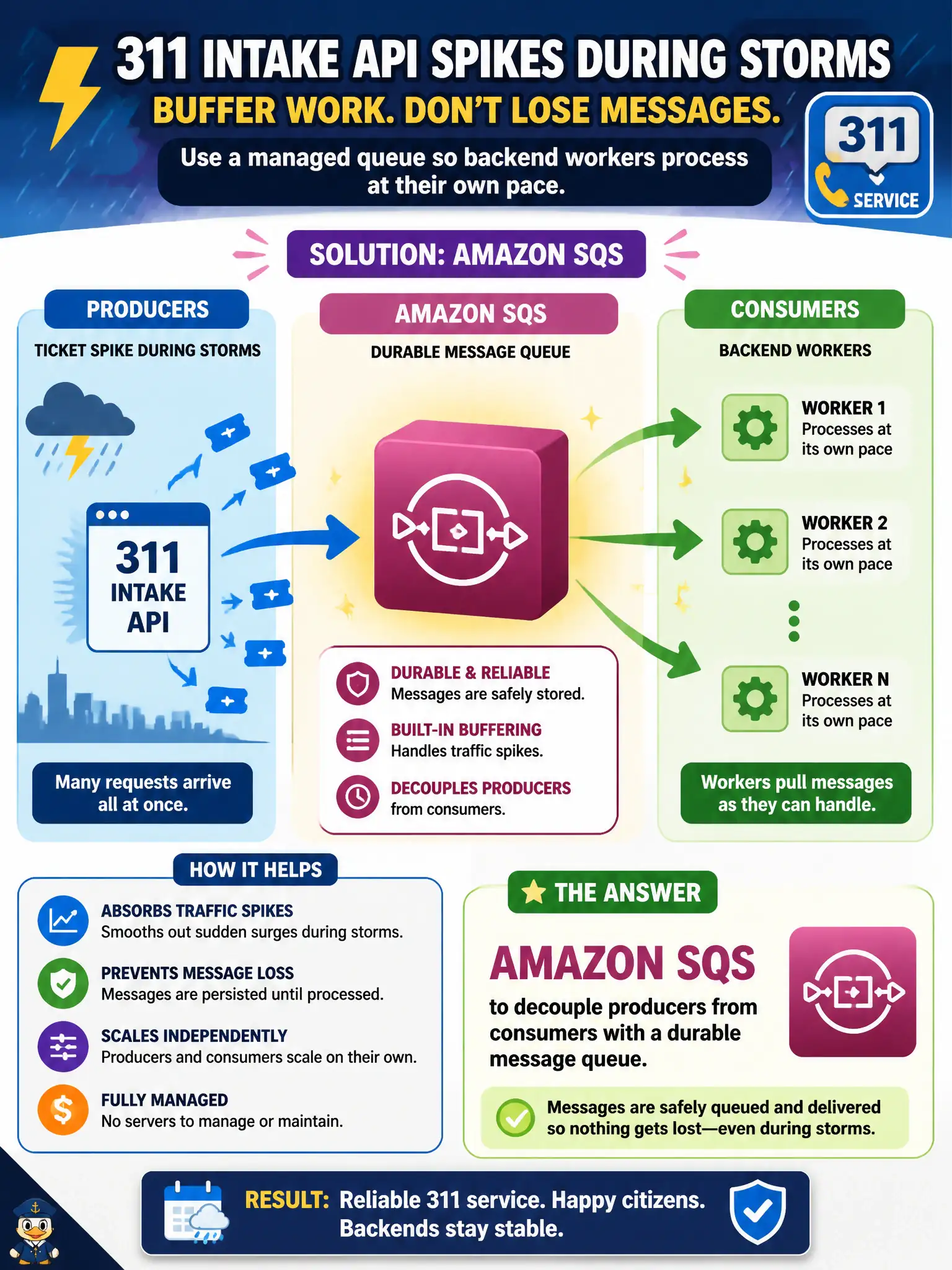
A 311 intake API receives ticket spikes during storms and must buffer work so backend workers process requests at their own pace without losing messages. Which AWS service provides that managed queue?
Select an answer to reveal the explanation.
Short Explanation
SQS is the ticket basket on the counter — intake drops requests in, workers grab the next one when ready, and nothing vanishes in the rush. SNS shouts to everyone at once, CloudWatch watches health numbers, and a load balancer spreads live clicks; they are not the durable work queue.
Full Explanation
A 311 intake API that receives ticket spikes during storms and must buffer work so backend workers process requests at their own pace—without losing messages—should use Amazon SQS as a managed durable message queue. Producers enqueue ticket messages; consumers poll or receive messages when ready; visibility timeouts and retries help ensure work is processed reliably under bursty civic demand. SQS decouples the spike-prone intake tier from slower downstream workers.
Amazon SNS alone broadcasts the same message to many subscribers at once; that fan-out pattern is different from a work queue where each ticket should be processed by a worker pattern (though SNS can feed SQS in architectures). Amazon CloudWatch Alarms page operators on metric thresholds; they do not buffer citizen tickets. Elastic Load Balancing spreads live HTTP traffic across healthy targets but does not provide durable asynchronous message buffering when workers cannot keep up. Live load balancing is not a durable work basket.
Exam caveat: Storm spike + buffer + process at own pace + do not lose messages → SQS. If every listener must get the same alert, think SNS. Many CLF items hinge on that contrast.
Operational check for 311: place intake messages on a standard or FIFO queue as required for ordering/dedup, scale consumer fleets on ApproximateNumberOfMessages, configure dead-letter queues for poison messages, set appropriate visibility timeouts for ticket handling duration, encrypt queues, and load-test a weather-event simulation so backlog drains without silent data loss.