
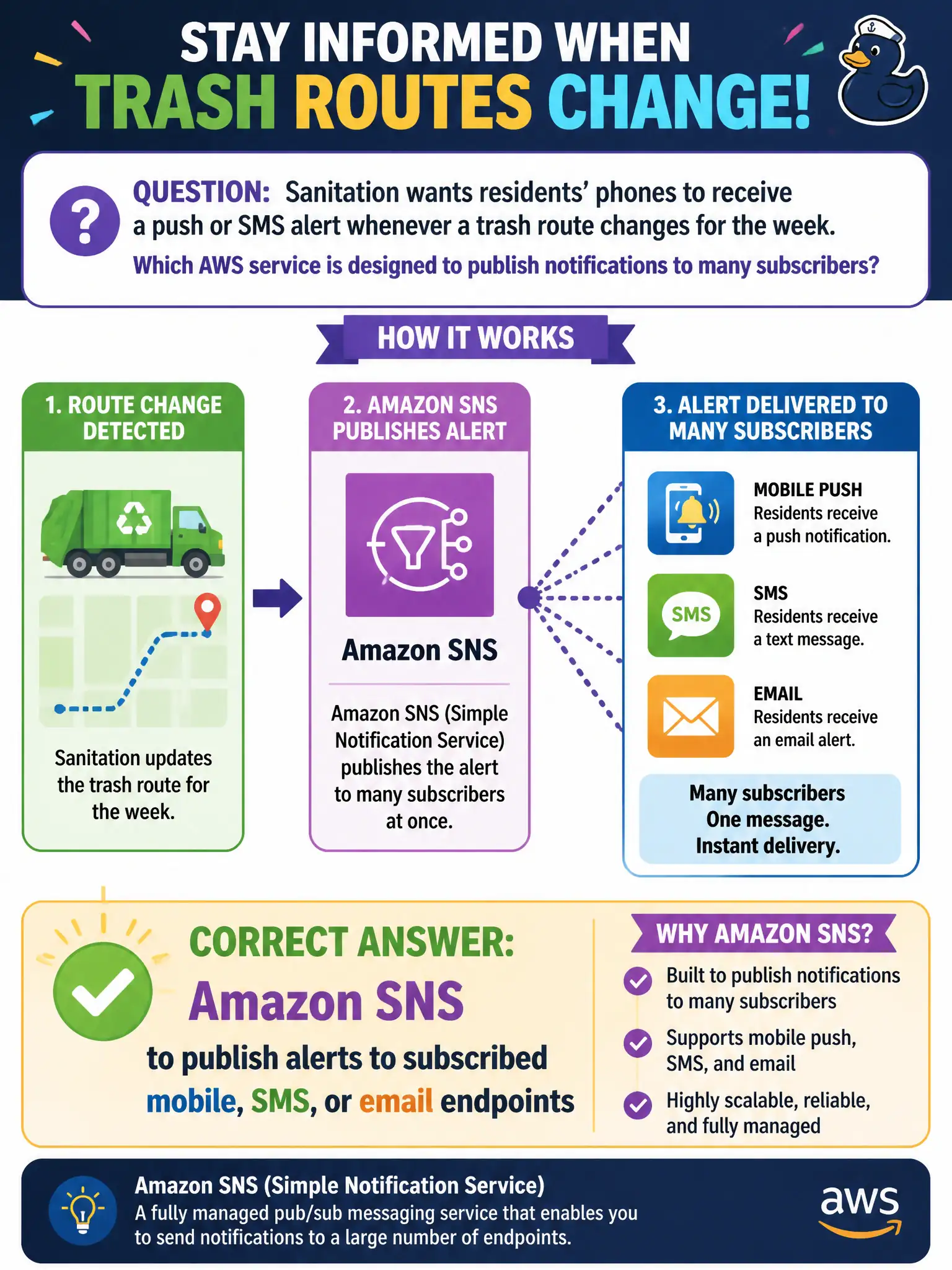
Sanitation wants residents’ phones to receive a push or SMS alert whenever a trash route changes for the week. Which AWS service is designed to publish notifications to many subscribers?
Select an answer to reveal the explanation.
Short Explanation
SNS is the town loudspeaker — one announcement, many listeners on phone, SMS, or email. SQS is a quiet inbox for workers to pull jobs one at a time, EBS is a hard drive for a server, and Snowball is a freight truck for bulk data, not weekly route pings.
Full Explanation
Sanitation that wants residents' phones to receive push or SMS alerts when a trash route changes should use Amazon SNS to publish notifications to many subscribers. SNS is a pub/sub notification service: publishers send a message to a topic, and subscribed endpoints—mobile push, SMS, email, or application endpoints—receive the alert. That town-loudspeaker pattern fits weekly route-change broadcasts to many households without building a custom notification farm.
Amazon SQS holds worker jobs in a queue for consumers to pull and process one at a time; it decouples backends rather than broadcasting citizen alerts. Amazon EBS attaches block volumes to instances; it is unrelated to messaging residents. AWS Snowball ships physical devices for bulk data transfer; it is not a weekly SMS channel. Queue, block storage, and physical transfer services fail the many-subscriber notification requirement.
Exam caveat: SNS = push/fan-out notifications; SQS = queue/pull work buffer; EventBridge = event routing with rules; SES = email sending. Route-change SMS/push to many citizens is classic SNS.
Operational check for sanitation: create an SNS topic per jurisdiction or route group, manage SMS/push subscriptions with opt-in compliance, publish concise route-change messages, monitor delivery failures and spend on SMS, integrate publishing from the routing system (API or EventBridge), and provide an unsubscribe path so residents retain control over civic alert traffic.