
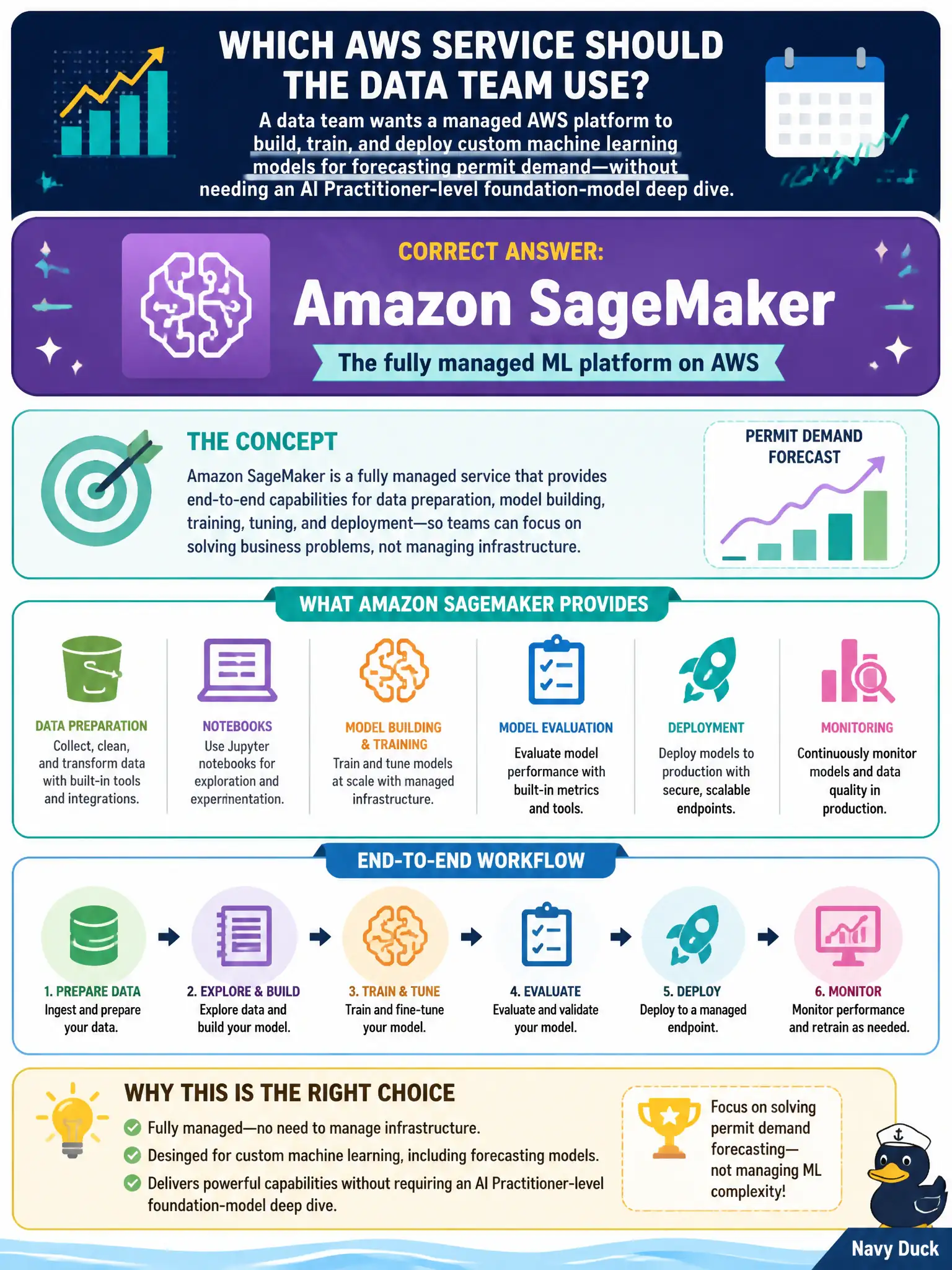
A data team wants a managed AWS platform to build, train, and deploy custom machine learning models for forecasting permit demand—without needing an AI Practitioner-level foundation-model deep dive. Which service should they identify?
Select an answer to reveal the explanation.
Short Explanation
When the ask is build, train, and deploy custom ML models on a managed AWS platform, Amazon SageMaker is the name to spot. Cloud Practitioner level is identify-the-service, not design a foundation-model lab from scratch.
Full Explanation
A data team that wants a managed AWS platform to build, train, and deploy custom machine learning models for forecasting permit demand—without an AI Practitioner-level foundation-model deep dive—should identify Amazon SageMaker. SageMaker is the managed ML platform associated with building, training, and deploying models on AWS. At Cloud Practitioner depth, the skill is recognizing the service name and purpose for custom ML workflows supporting civic forecasting, not designing transformer architectures from scratch.
Amazon Route 53 traffic flow policies route DNS; they do not train ML models. AWS Shield Advanced focuses on DDoS protection. Amazon VPC Reachability Analyzer troubleshoots network paths. None of those are ML build/train/deploy platforms. The distractors test whether you can ignore familiar networking and security brands when the stem clearly asks for machine learning.
Exam caveat: CLF may also mention AI services for specific pre-trained tasks (Transcribe, Translate, Rekognition, Lex, etc.). SageMaker is the broader platform for custom model development and hosting. Do not confuse "identify SageMaker" with needing deep ML math on this exam.
Operational check for permit-demand forecasting: prepare training data in S3, use SageMaker training jobs or appropriate workflows, deploy an endpoint or batch inference path, monitor cost of training instances and endpoints, govern access with IAM, and validate predictions with planning staff before using outputs in budget hearings.