
A GIS team debates Amazon EFS versus Amazon S3 for shared working files. Which contrast best captures the difference at Cloud Practitioner depth?
Select an answer to reveal the explanation.
Short Explanation
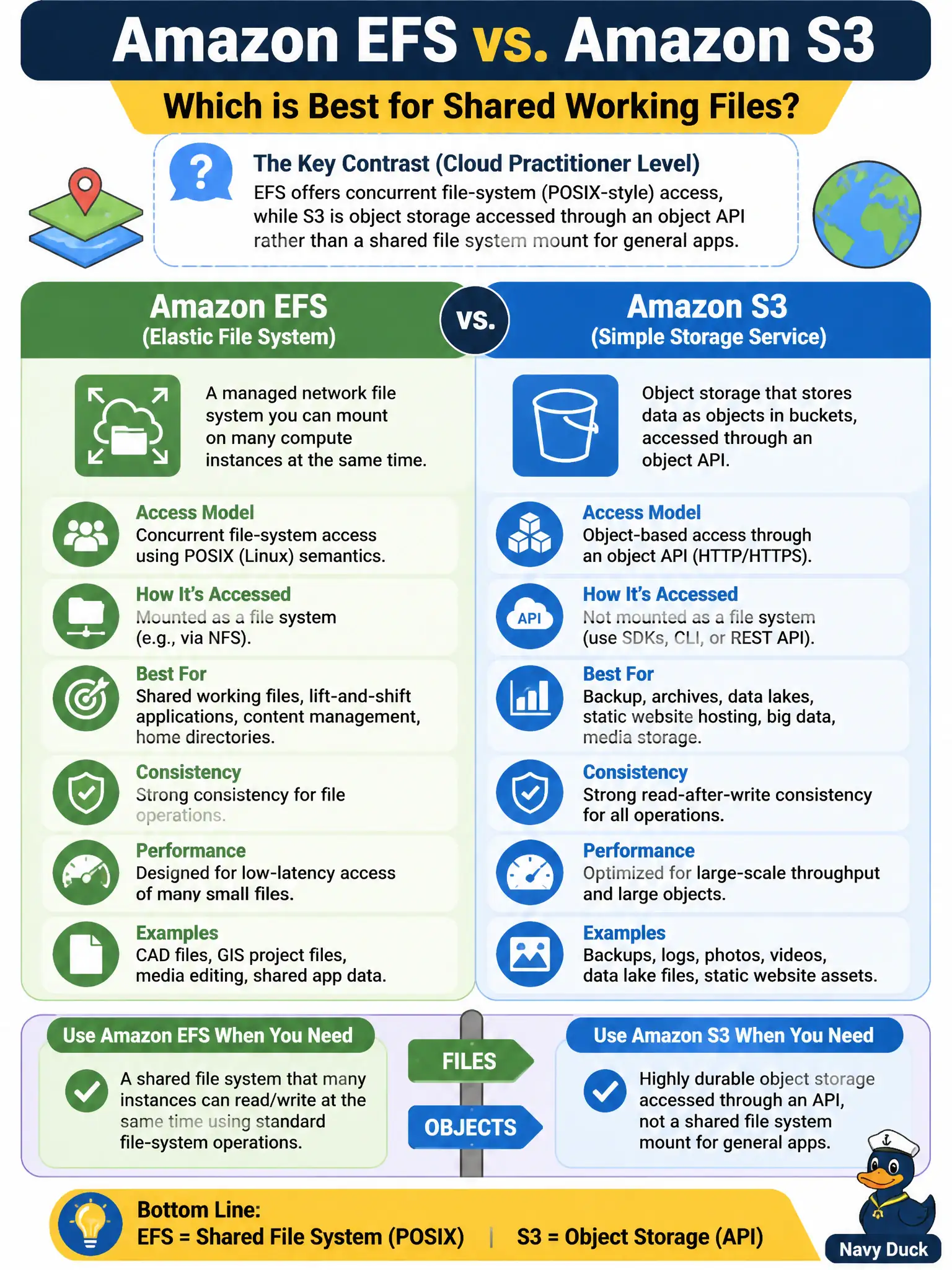
If the app expects a real file system—open, lock, many writers—lean toward EFS. If it speaks put/get object APIs to a data lake or asset store, that is S3. Same cloud, different storage personalities; do not treat the logos as interchangeable.
Full Explanation
GIS teams often debate Amazon EFS versus Amazon S3 because both store data, but they serve different access models. At Cloud Practitioner depth, EFS offers concurrent file-system (POSIX-style) access that Linux clients mount and use with familiar file semantics—open, read, write, lock—across many EC2 instances. S3 is object storage accessed through an object API (PUT/GET and related operations) rather than a general shared file-system mount for arbitrary applications. Shared working files that expect a real file system lean toward EFS; data lakes, asset libraries, and API-oriented object workflows lean toward S3.
EFS does not store only Glacier archives, and S3 does not store only boot volumes—those role reversals are incorrect. S3 does not provide POSIX file locks to thousands of EC2 mounts by default as a shared file system; EFS is not object-only. Treating EFS and S3 as identical services with different marketing names erases the file-versus-object distinction the exam expects you to keep.
Exam caveat: File system versus object store is one of the highest-yield storage contrasts on CLF. Add FSx when Windows/SMB or high-performance specialized file systems appear, and EBS when single-instance block disks appear.
Operational check for GIS: if desktop or server GIS tools require simultaneous file locks on a shared project directory, prototype on EFS; if the pipeline lands tiles, GeoJSON, or imagery as objects for analytics or distribution, use S3 (often with CloudFront). Measure latency and locking behavior before migrating production map edits, and cost both models because frequent small file operations can behave very differently on file systems versus object APIs.