
A parks department will expose HTTPS endpoints so mobile apps can call backend microservices. Which AWS service is commonly used as the managed front door to create, publish, and manage HTTP APIs?
Select an answer to reveal the explanation.
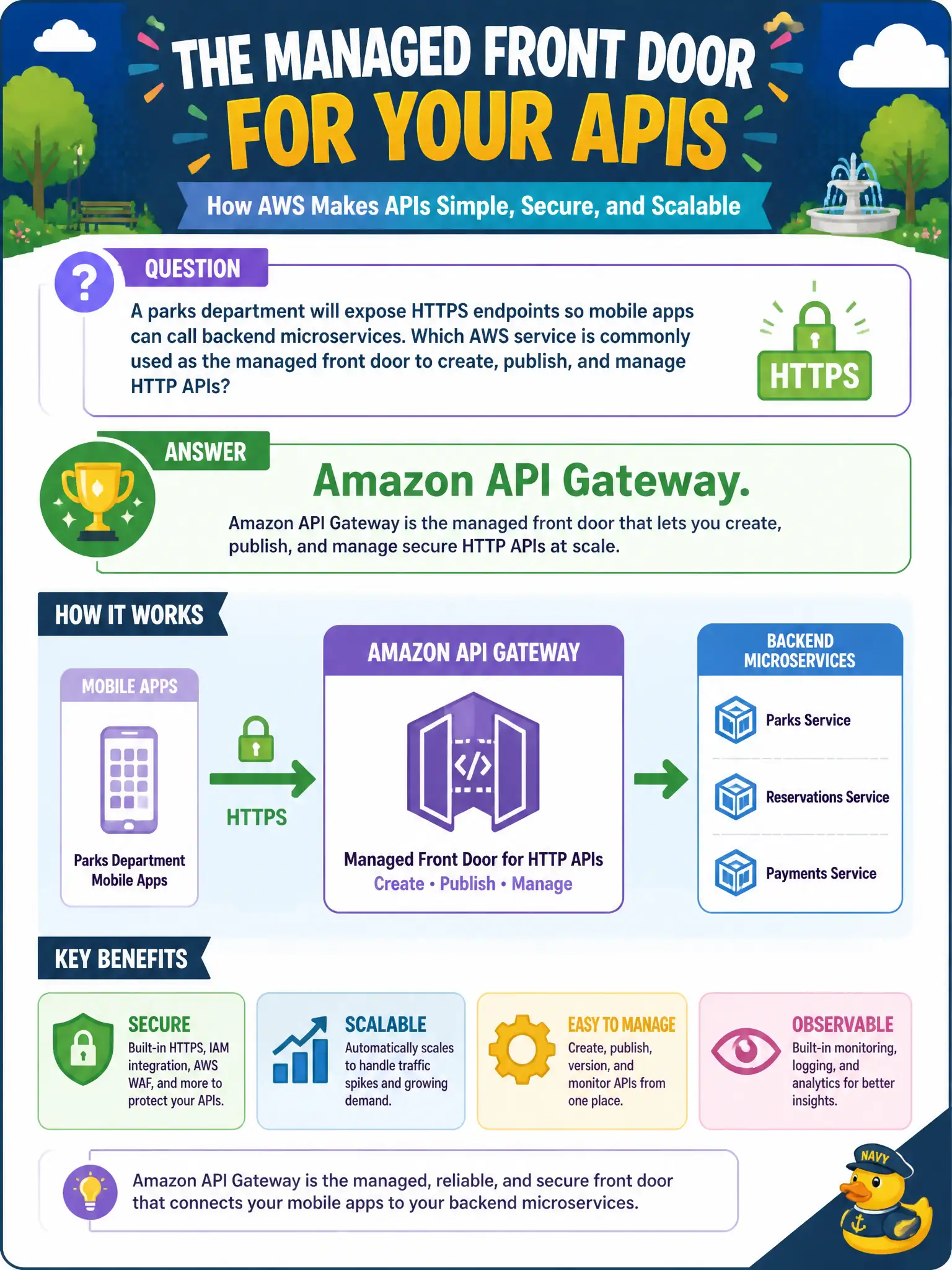
Short Explanation
Think of API Gateway as the receptionist for your HTTP APIs—create, publish, and manage endpoints without bolting a custom reverse-proxy farm together. Apps call the gateway; the gateway forwards to your backends. It is the common AWS front door for that pattern, not a DNS quirk or a private circuit alone.
Full Explanation
When a parks department exposes HTTPS endpoints for mobile apps to call backend microservices, Amazon API Gateway is the managed front door commonly identified at Cloud Practitioner depth. It creates, publishes, and manages HTTP or REST APIs (and WebSocket APIs where needed), handles request throttling, authorization integrations, stages, and routing to backends such as Lambda, HTTP endpoints, or other AWS services. Civic mobile clients call the gateway URL; the gateway presents a controlled API surface without the department assembling and patching its own reverse-proxy farm for every microservice.
Amazon Route 53 Resolver endpoints address hybrid DNS resolution between VPC and on-premises networks; they are not an API management layer for creating and publishing HTTP APIs. AWS Direct Connect provides private network connectivity from civic facilities to AWS; it is a connectivity path, not an API create/publish/manage service. Amazon VPC Lattice traffic mirroring is not the standard CLF identify answer for managed HTTP API front doors—API Gateway remains the service associated with that pattern in Practitioner-level materials.
Exam caveat: Distinguish API Gateway (API front door) from Application Load Balancer (HTTP(S) load balancing to targets), from CloudFront (CDN), and from Route 53 (DNS). Overlap exists in real architectures, but exam stems that say "create, publish, and manage HTTP APIs" point to API Gateway.
Operational check for the parks mobile backends: define the API in API Gateway, attach auth (for example IAM, Cognito, or API keys per design), deploy to a stage, point mobile clients at the invoke URL, confirm integration responses from microservices, enable logging/metrics for 4xx/5xx and latency, and apply throttling so a noisy client cannot overwhelm the civic backend during a festival weekend spike.