
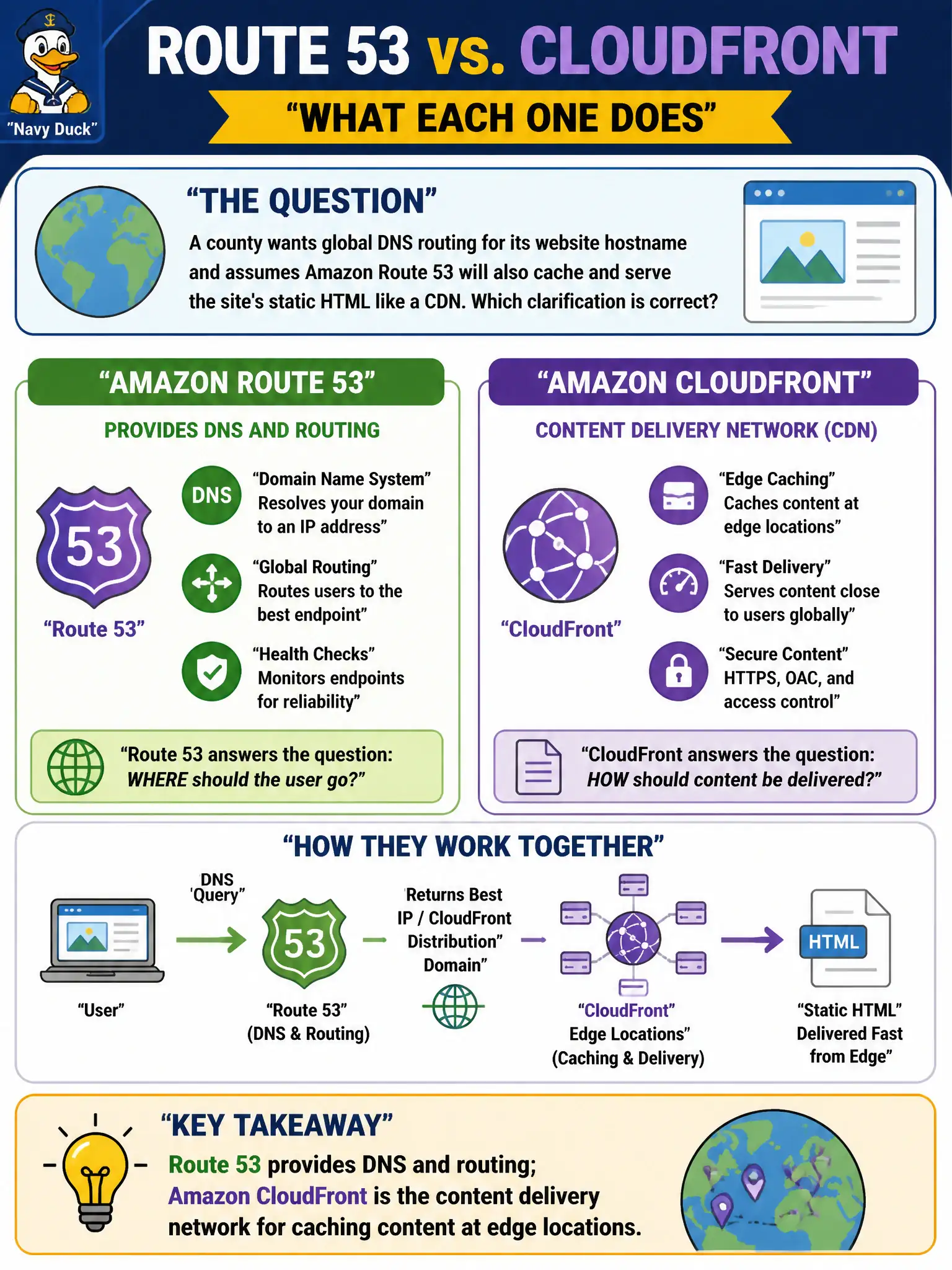
A county wants global DNS routing for its website hostname and assumes Amazon Route 53 will also cache and serve the site's static HTML like a CDN. Which clarification is correct?
Select an answer to reveal the explanation.
Short Explanation
DNS and a CDN are different tools in the toolbox. Route 53 answers "where is this name?" with routing smarts; CloudFront parks copies of your content at edge locations so users download faster. Want name resolution? Route 53. Want cached content delivery? CloudFront.
Full Explanation
County website architecture often blends DNS and content delivery, but they are different AWS responsibilities. Amazon Route 53 provides DNS hosting and global routing policies (simple, failover, latency, geolocation, weighted, and more) so the hostname resolves to the right endpoints. Amazon CloudFront is the CDN that caches and serves static HTML, images, and other objects from edge locations closer to citizens, reducing origin load and improving page performance. Route 53 answers "where should this name go?"; CloudFront answers "how do we cache and deliver the content efficiently at the edge?"
Route 53 does not replace CloudFront for worldwide static website caching; using DNS alone leaves every request hitting origin without edge caching benefits. CloudFront is not merely a DNS resolver—it terminates HTTP(S), applies cache behaviors, and can use S3 or custom origins. Treating Route 53 and CloudFront as interchangeable names for one edge caching service confuses two complementary services that cities commonly use together: Route 53 for the public hostname and CloudFront for CDN delivery.
Exam caveat: Cloud Practitioner items frequently pair Route 53 with "DNS/routing" and CloudFront with "CDN/edge caching." Watch for distractors that swap those roles. Also remember that Route 53 can health-check and fail over to alternate endpoints, which is routing resilience—not content caching.
Operational check for the municipal site: place static assets (or the whole site) behind CloudFront with an appropriate origin (often S3), point the public hostname's Route 53 alias or record at the CloudFront distribution, validate HTTPS certificates (commonly via ACM with CloudFront), confirm cache hit ratios and origin request reduction in CloudFront metrics, and verify DNS resolution still works independently of whether an object is cached at an edge location.