
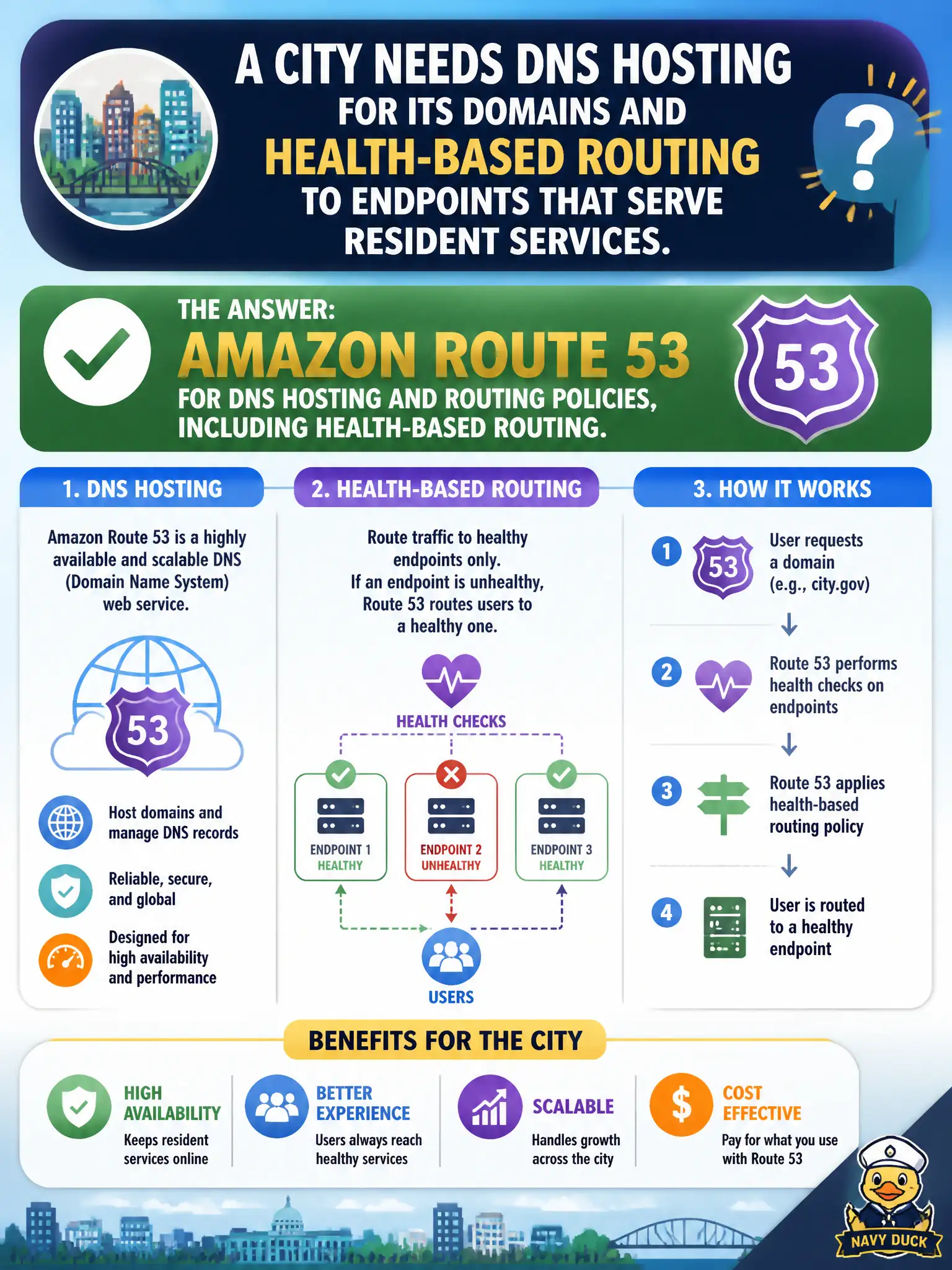
A city needs DNS hosting for its domains and health-based routing to endpoints that serve resident services. Which AWS service provides that?
Select an answer to reveal the explanation.
Short Explanation
Route 53 is AWS's DNS service—the phone book that can also check whether a number still answers before sending callers there. EBS is block storage, ECR stores container images, and Snowball Edge is an edge compute/storage device—not your DNS control plane.
Full Explanation
A city that needs DNS hosting for its domains and health-based routing to endpoints that serve resident services should use Amazon Route 53. Route 53 is AWS’s authoritative DNS service, offering public and private hosted zones, multiple routing policies, and health checks that can take unhealthy endpoints out of rotation. Municipal portals commonly rely on Route 53 to publish service names and to fail traffic over when a Regional endpoint fails health checks during an incident.
Amazon EBS provides block storage volumes for EC2; it does not offer authoritative DNS hosting or endpoint health checks. Amazon ECR stores container images for deployment pipelines; it is not a public DNS registrar or health-based router for citizen traffic. AWS Snowball Edge is an edge compute and data-transfer appliance family, not a global DNS control plane for city domains.
Exam caveat: DNS hosting plus routing policies and health-based routing maps to Route 53. Storage services, container registries, and physical transfer devices are frequent distractors when the stem is really about DNS.
Operational check: create a hosted zone for the city domain, configure health checks against critical citizen endpoints, implement failover or latency-based policies as designed, enable query logging if required by security standards, and test failover during a planned maintenance window before storm season or election nights.