
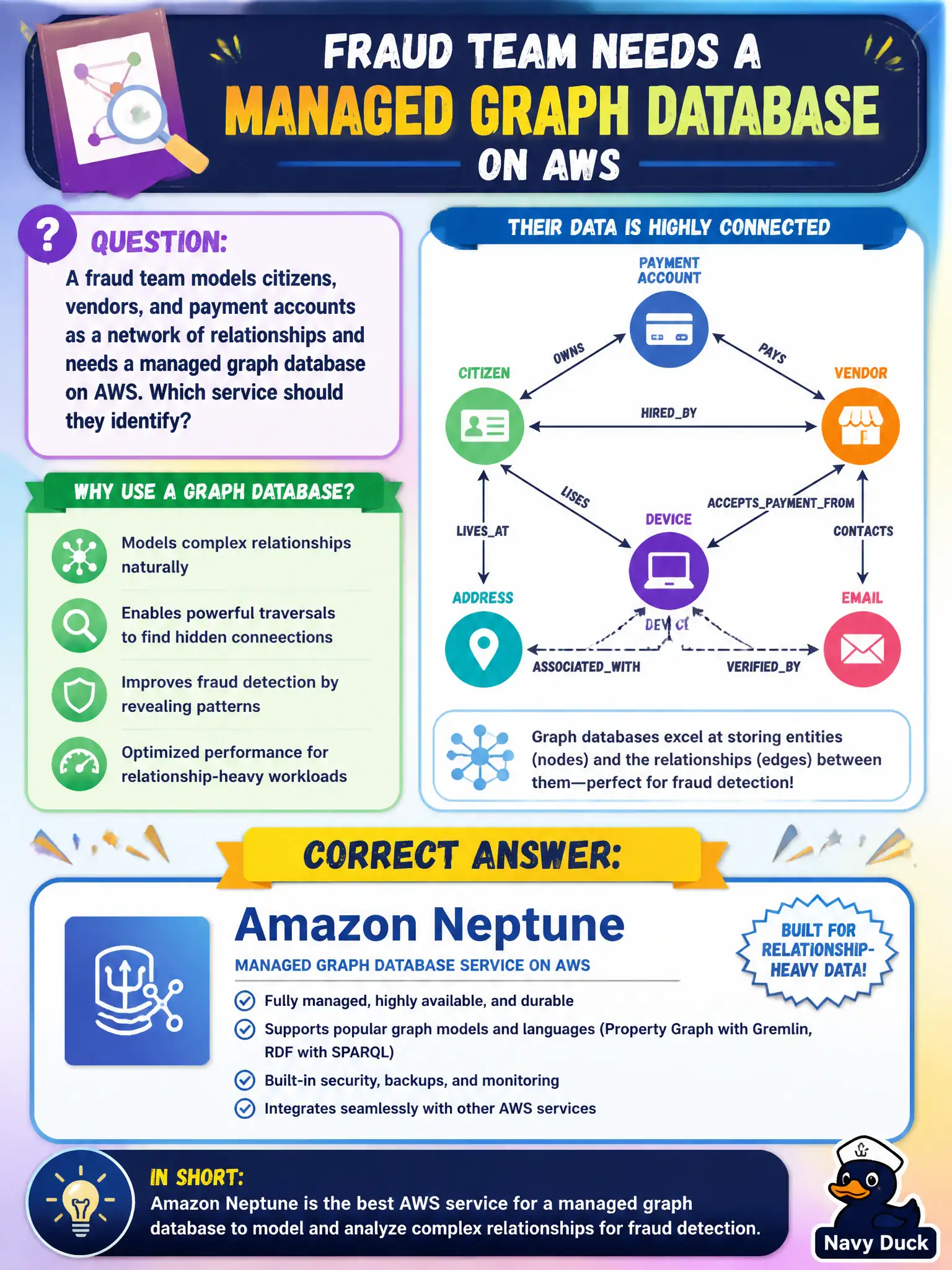
A fraud team models citizens, vendors, and payment accounts as a network of relationships and needs a managed graph database on AWS. Which service should they identify?
Select an answer to reveal the explanation.
Short Explanation
Graph databases shine when the story is "who connects to whom," not just rows in a table—think a web of people, vendors, and accounts. Neptune is AWS's managed graph database for that. RDS Oracle is relational, Athena queries data lakes with SQL, and Transit Gateway connects networks—not graph queries.
Full Explanation
A fraud team that models citizens, vendors, and payment accounts as a network of relationships and needs a managed graph database on AWS should identify Amazon Neptune. Neptune is AWS’s managed graph database service for relationship-heavy datasets, supporting graph models and query patterns suited to fraud rings, social-style links, and dependency maps that are awkward in purely relational or key-value forms.
Amazon RDS for Oracle is a managed relational engine, not the AWS graph database. Amazon Athena queries data in S3 with SQL; it is not a native graph store for entity networks. AWS Transit Gateway interconnects VPCs and on-premises networks; it is not a graph query engine for fraud investigations.
Exam caveat: Relationship/network graph data → Neptune. Relational joins → RDS/Aurora. Ad hoc S3 SQL → Athena. Networking hub → Transit Gateway. Pick by data model, not by the word “network” alone.
Operational check: prototype a small fraud graph in Neptune, choose a graph query model the analysts can support, place the cluster in private subnets, encrypt data, integrate with the investigation workflow, and document why graph traversal beats multi-hop self-joins for the city’s fraud use case.