
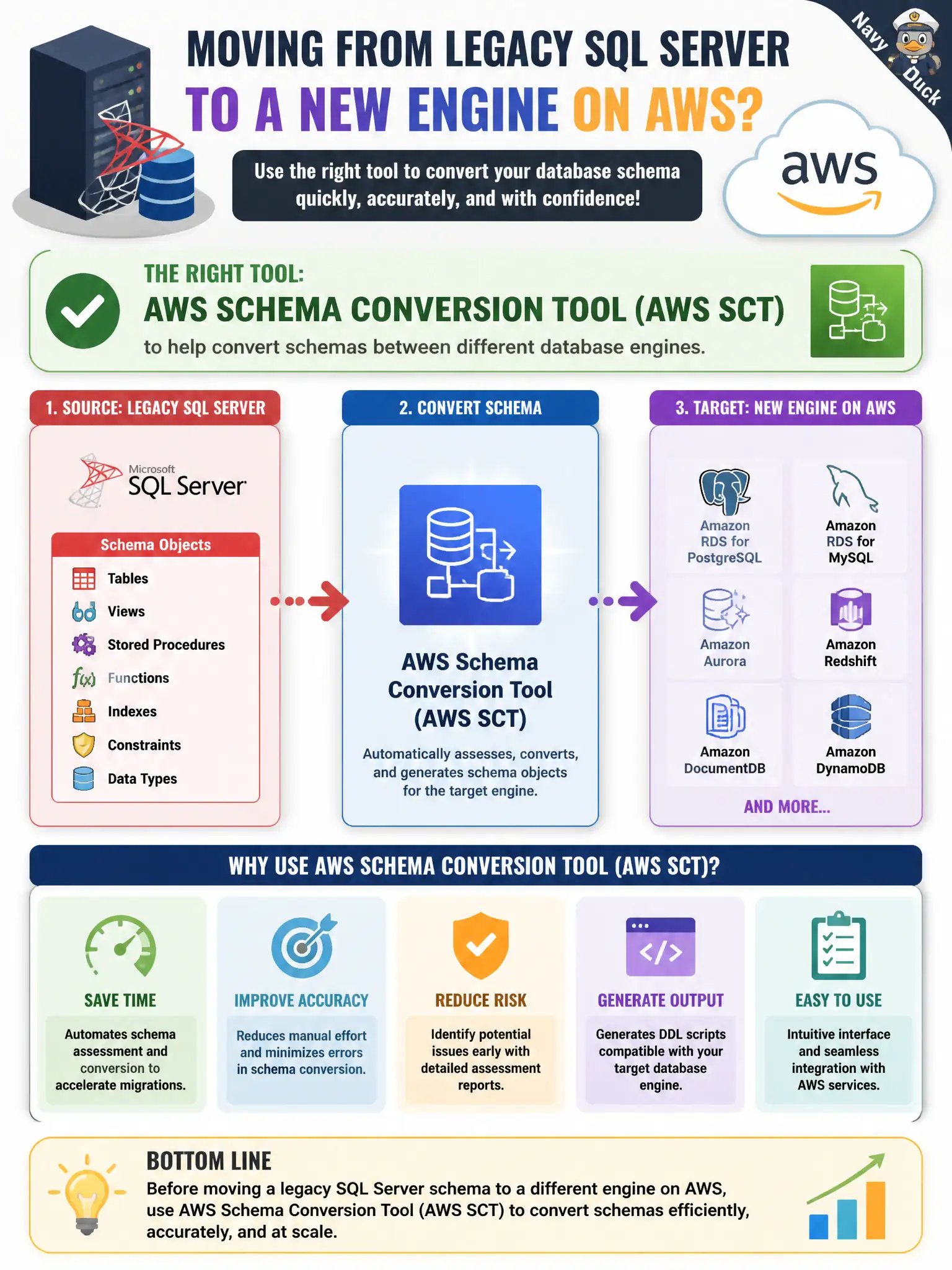
Before moving a legacy SQL Server schema to a different engine on AWS, planners need help converting database schema objects between engines. Which AWS tool should they identify?
Select an answer to reveal the explanation.
Short Explanation
When the blueprint of the house (the schema) needs to be redrawn for a different foundation, SCT is the conversion helper. Inspector looks for vulnerabilities, Config tracks resource settings, and Macie finds sensitive data in S3—they do not rewrite cross-engine schemas.
Full Explanation
Before moving a legacy SQL Server schema to a different engine on AWS, planners who need help converting database schema objects between engines should identify AWS Schema Conversion Tool (AWS SCT). SCT analyzes the source schema and helps convert objects—tables, views, routines where possible—into a format suitable for a different target engine, highlighting what converts automatically versus what needs manual redesign. That pre-migration conversion assistance is the Cloud Practitioner-level purpose of SCT, often paired with DMS for data movement.
Amazon Inspector assesses vulnerabilities and network exposure; it does not convert table DDL between engines. AWS Config records configuration compliance; it does not rewrite stored procedures into Aurora SQL as its job. Amazon Macie discovers sensitive data in S3 and is not a homogeneous schema cloning utility for SQL engines.
Exam caveat: Schema conversion between different engines → SCT. Data replication/migration → DMS. Heterogeneous migrations commonly need both. Homogeneous lift-and-shift may need less schema conversion.
Operational check: run SCT against a representative SQL Server database, review the assessment report with application owners, budget time for manual conversion items, store conversion outputs in source control, and only then schedule DMS data migration into the chosen AWS target engine.