
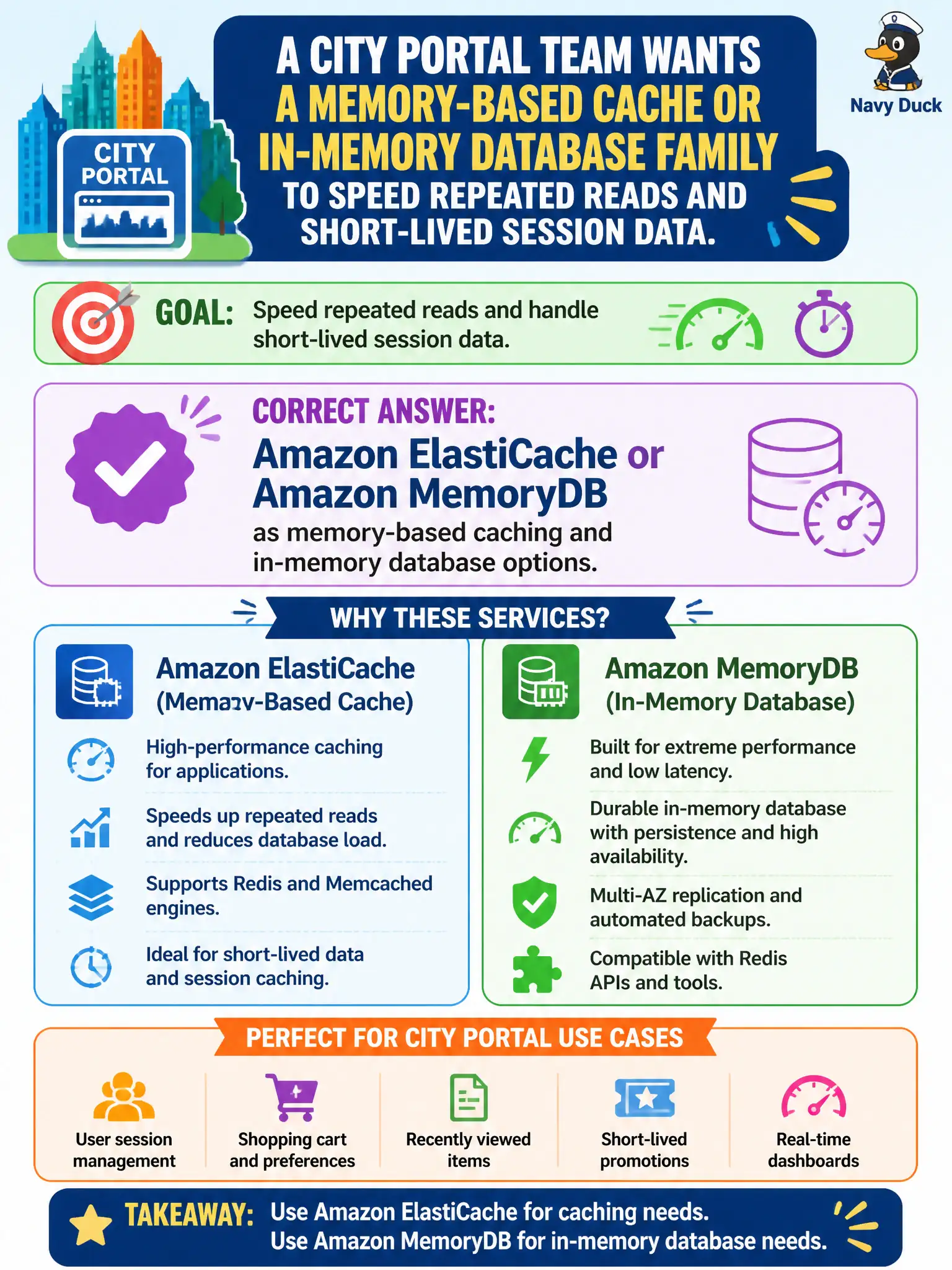
A city portal team wants a memory-based cache or in-memory database family to speed repeated reads and short-lived session data. Which AWS service family should they identify?
Select an answer to reveal the explanation.
Short Explanation
Memory-based services keep hot data on the tip of the tongue—fast reads for caches and short-lived sessions. ElastiCache and MemoryDB are the AWS names to remember for that. Backup protects copies, Glacier is archival object storage, and Textract reads documents—not an in-memory cache family.
Full Explanation
A city portal team that wants a memory-based cache or in-memory database family to speed repeated reads and short-lived session data should identify Amazon ElastiCache or Amazon MemoryDB. ElastiCache offers managed Redis- and Memcached-compatible caching to reduce latency for hot keys; MemoryDB provides a Redis-compatible in-memory database with durability features. Together they represent the AWS memory-centric family used to accelerate repeated reads and ephemeral session-style data in front of slower primary stores.
AWS Backup orchestrates backup policies across services; it is not an in-memory query engine. Amazon S3 Glacier Instant Retrieval is an archival object storage class for infrequently accessed data, not a hot in-memory session store. Amazon Textract extracts text and data from documents; it is not a Redis-compatible cache for portal performance.
Exam caveat: In-memory cache or in-memory database options → ElastiCache/MemoryDB. Archival retrieval, OCR, and backup services are common distractors when the stem emphasizes memory-based acceleration.
Operational check: deploy a Redis-compatible cache into private subnets beside the portal app tier, cache expensive read queries with explicit TTLs, monitor cache hit rates in CloudWatch, and ensure session payload handling meets municipal encryption and retention standards before promoting to production.