
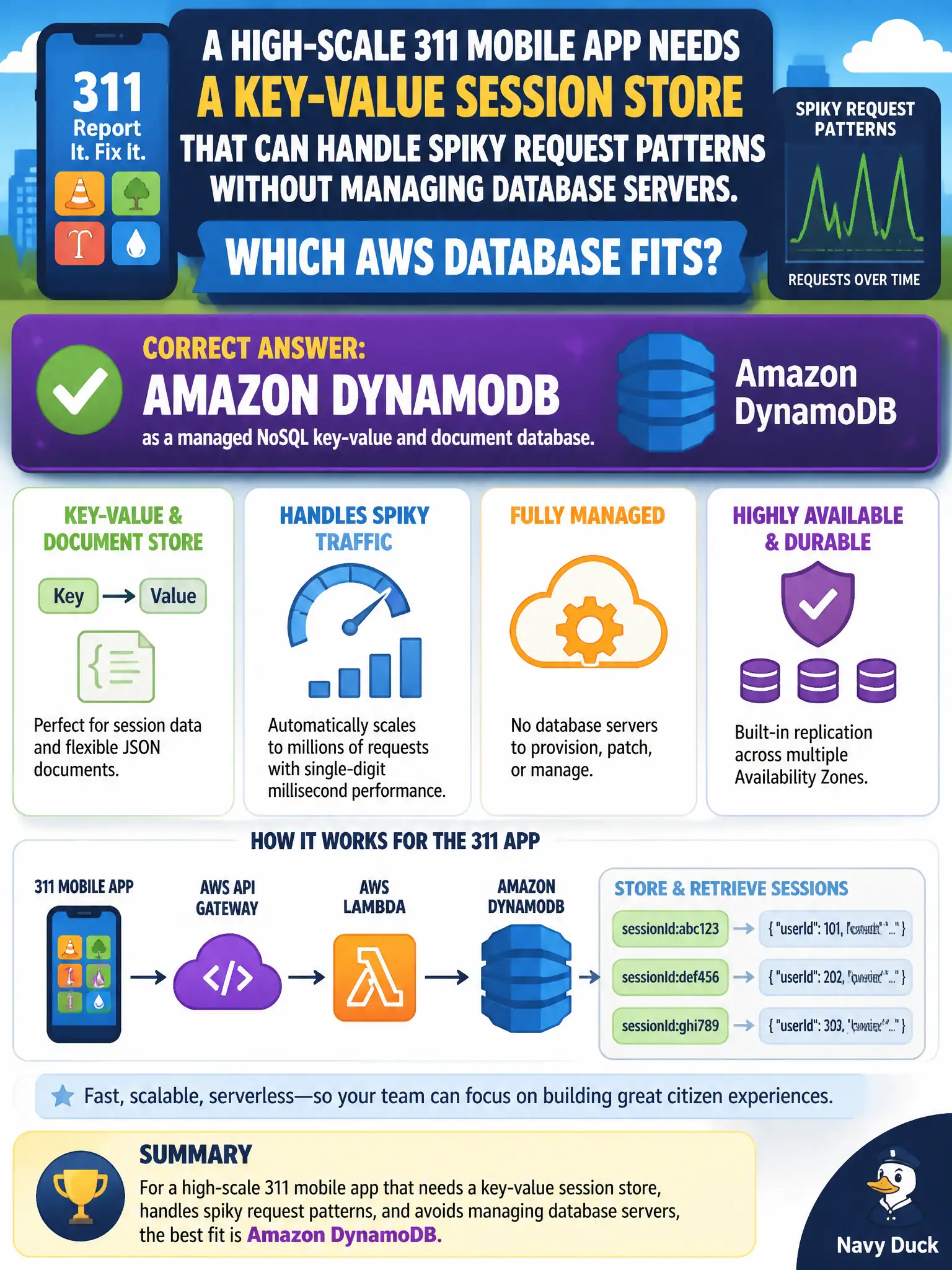
A high-scale 311 mobile app needs a key-value session store that can handle spiky request patterns without managing database servers. Which AWS database fits?
Select an answer to reveal the explanation.
Short Explanation
Think lockers with labels: key-value stores grab a session by its key fast, without spinning up database servers. DynamoDB is AWS's managed NoSQL for that pattern. Redshift is a warehouse for analytics, ACM manages certificates, and EFS is shared file storage—not a session key-value API.
Full Explanation
A high-scale 311 mobile app that needs a key-value session store able to handle spiky request patterns without managing database servers should use Amazon DynamoDB. DynamoDB is a fully managed NoSQL key-value and document database designed for single-digit millisecond performance at scale, with capacity modes that accommodate bursty mobile traffic without the city operating database hosts. Session tokens, user preference documents, and similar lookup-by-key patterns align with DynamoDB’s access model.
Amazon Redshift is a columnar cloud data warehouse optimized for analytics, not a key-value session cache for mobile apps. AWS Certificate Manager provisions and manages TLS certificates; it is not a NoSQL session store. Amazon EFS provides shared file storage for Linux workloads and is not a serverless key-value database API that mobile backends call for sessions.
Exam caveat: Key-value or document patterns with managed scale → DynamoDB. Relational SQL joins → RDS/Aurora. Analytics warehouse → Redshift. Shared files → EFS. Match the stem’s “key-value session store” and “without managing servers” language to DynamoDB.
Operational check: design session partition keys and TTLs (including DynamoDB TTL if appropriate), consider on-demand capacity for unpredictable spikes under city cost governance, encrypt with AWS KMS, restrict IAM access from the API tier, and load-test bursty complaint-submission traffic before the 311 mobile launch.