
A city wants to run microservices in containers using an AWS-native orchestrator. Which service best matches that requirement?
Select an answer to reveal the explanation.
Short Explanation
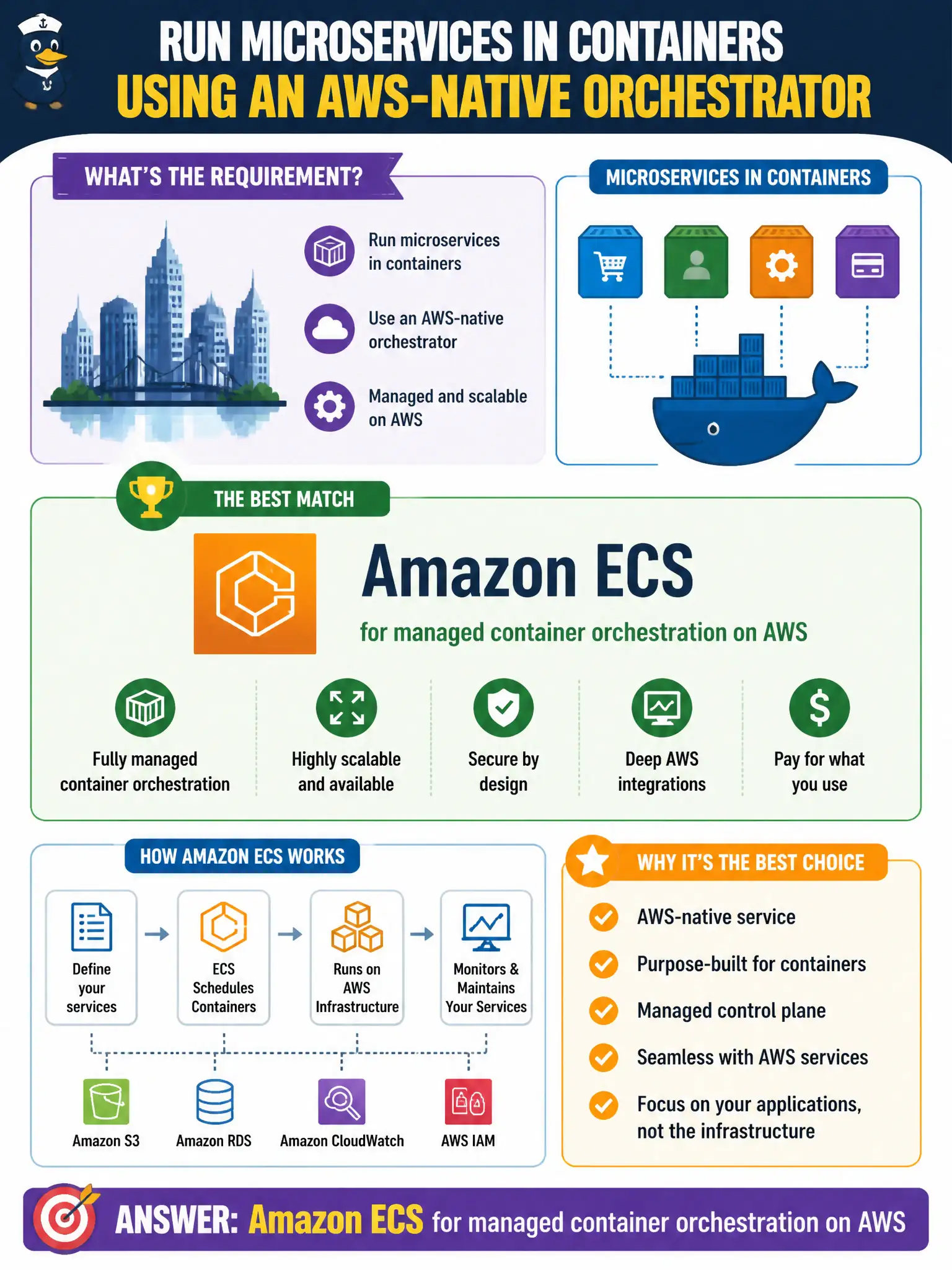
Containers for city microservices with an AWS-native control plane points straight at Amazon ECS. Transfer Acceleration, ACM, and Lightsail-for-RAC stories are different tools for different jobs—not container orchestration.
Full Explanation
A city that wants to run microservices in containers using an AWS-native orchestrator should choose Amazon ECS (Elastic Container Service). ECS is AWS’s managed container orchestration service for deploying, scheduling, and operating containerized services on AWS, with integration into IAM, load balancing, CloudWatch, and networking. For municipal microservice platforms that want an AWS-native control plane rather than self-managing raw Docker hosts alone, ECS is the foundational match.
Amazon S3 Transfer Acceleration speeds object transfers to S3 via edge locations; it does not schedule containers. AWS Certificate Manager provisions and manages TLS certificates; it is not a container cluster control plane. Amazon Lightsail offers simplified bundles for straightforward workloads and is not positioned as the Oracle RAC licensing path, nor as the primary AWS-native microservice orchestrator compared with ECS/EKS.
Exam caveat: ECS = AWS-native container orchestration; EKS = managed Kubernetes; Fargate = serverless compute option for containers on ECS/EKS. Pick ECS when the stem says AWS-native orchestrator without requiring Kubernetes APIs.
Operational check: define ECS task and service definitions for the microservices, choose EC2 or Fargate launch type based on patching preferences, place services in private subnets behind an ALB, ship logs to CloudWatch, and encode the stack in IaC so department teams deploy the same pattern.