
In onboarding materials for new cloud staff, how should an AWS Region be described at a foundational level?
Select an answer to reveal the explanation.
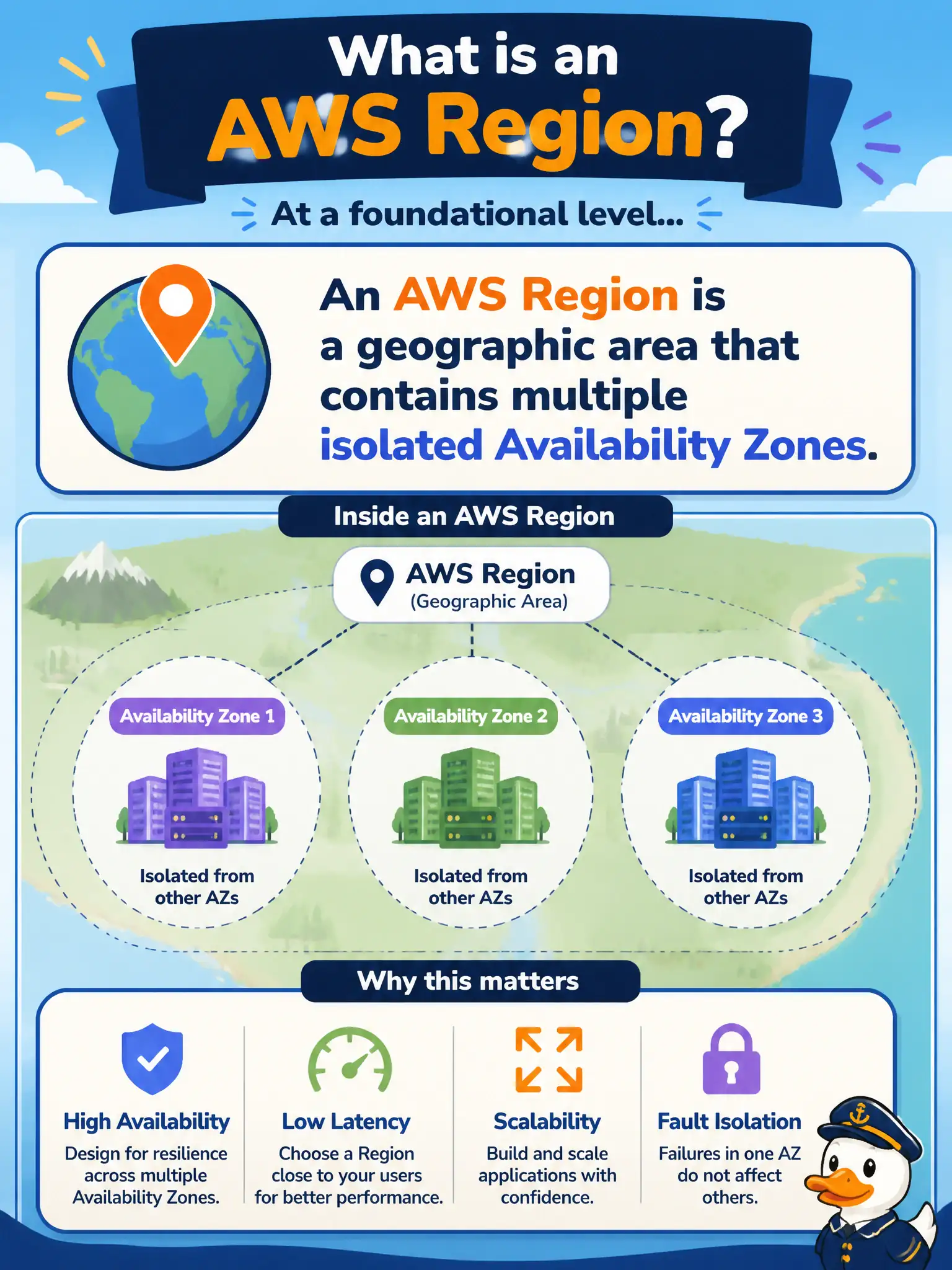
Short Explanation
A Region is a geography with several isolated Availability Zones inside it—like a metro with multiple hardened sites. That is the definition new staff need. It is not one global shared rack, a fake billing sticker, or an edge cache pretending to be everything.
Full Explanation
In onboarding materials for new municipal cloud staff, an AWS Region should be described as a geographic area that contains multiple isolated Availability Zones. That foundational definition frames how city architects plan for locality, data residency, latency, and high availability: choose a Region for geography and compliance needs, then distribute workloads across multiple Availability Zones inside that Region for resilience against facility-level failures.
A Region is not a single rack shared by all customers worldwide, nor is it a vague billing label without physical or logical boundaries. It is also not an edge cache node that stores every AWS service API. Edge locations belong to the AWS edge network and primarily help deliver content closer to users; they complement Regions rather than redefine them. Confusing these layers leads planners to treat a CDN point of presence as if it were a full disaster-recovery Region for citizen systems.
Exam caveat: Keep the hierarchy crisp—Region contains Availability Zones; edge locations sit closer to users for content delivery and related global services. Many wrong answers blur Regions with edges or with a single shared rack.
Operational check: update onboarding slides with the Region → Availability Zone → edge hierarchy, publish the short list of Regions the city is approved to use for production data, and require new staff to identify the Region of each account they touch before receiving console access or deploying a pilot workload.