
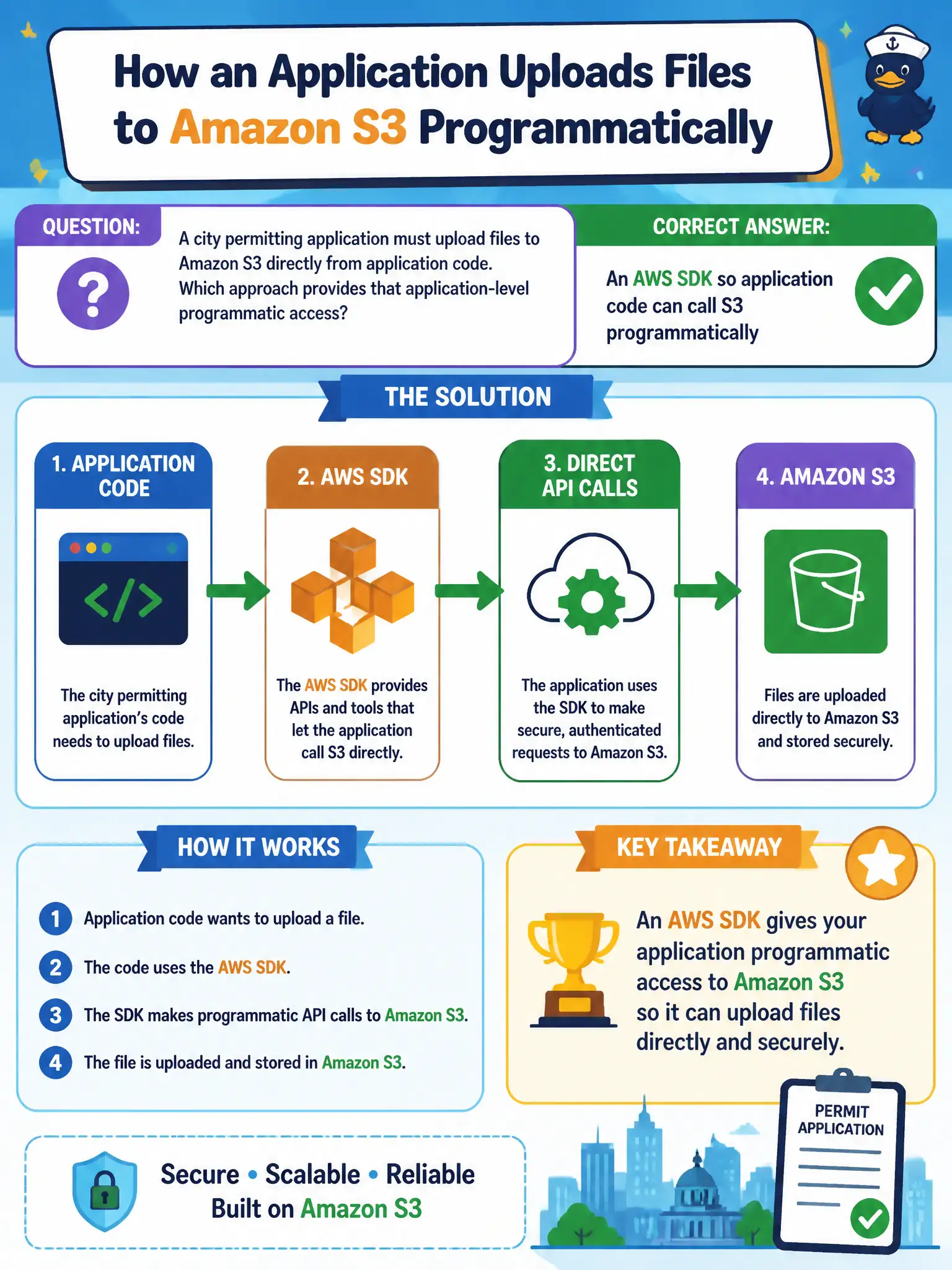
A city permitting application must upload files to Amazon S3 directly from application code. Which approach provides that application-level programmatic access?
Select an answer to reveal the explanation.
Short Explanation
When the app itself needs to talk to S3, you wire in an AWS SDK—the language-friendly toolkit—not a support ticket stuffed into the code.
Full Explanation
A city permitting application that must upload files to Amazon S3 directly from application code needs an AWS SDK. SDKs provide language-specific libraries (for example, Java, Python, JavaScript, .NET) that wrap AWS APIs so the application can call PutObject, generate presigned URLs, or otherwise interact with S3 programmatically inside its runtime. That is the standard pattern for citizen document uploads from a permitting backend or approved browser-based flow using temporary credentials.
AWS Support Center tickets are human support interactions, not application libraries. Amazon WorkSpaces provides managed desktop virtualization; it is not required for S3 access and does not replace SDKs. AWS Marketplace invoices are commercial billing documents, not API credentials for S3.
Exam caveat: Distinguish Console (GUI), CLI (shell scripts), and SDK (application code). When the stem says “from application code,” choose SDK. Presigned URLs and IAM roles for compute still sit underneath, but the programming interface is the SDK.
Operational check: select the SDK matching the permitting app’s language, attach an IAM role to the compute environment (EC2, ECS task, Lambda) instead of shipping static keys, enable default encryption on the destination bucket, block public access, log access via Server Access Logging or CloudTrail data events as required by records policy, and test multipart uploads for large plan-set PDFs.