
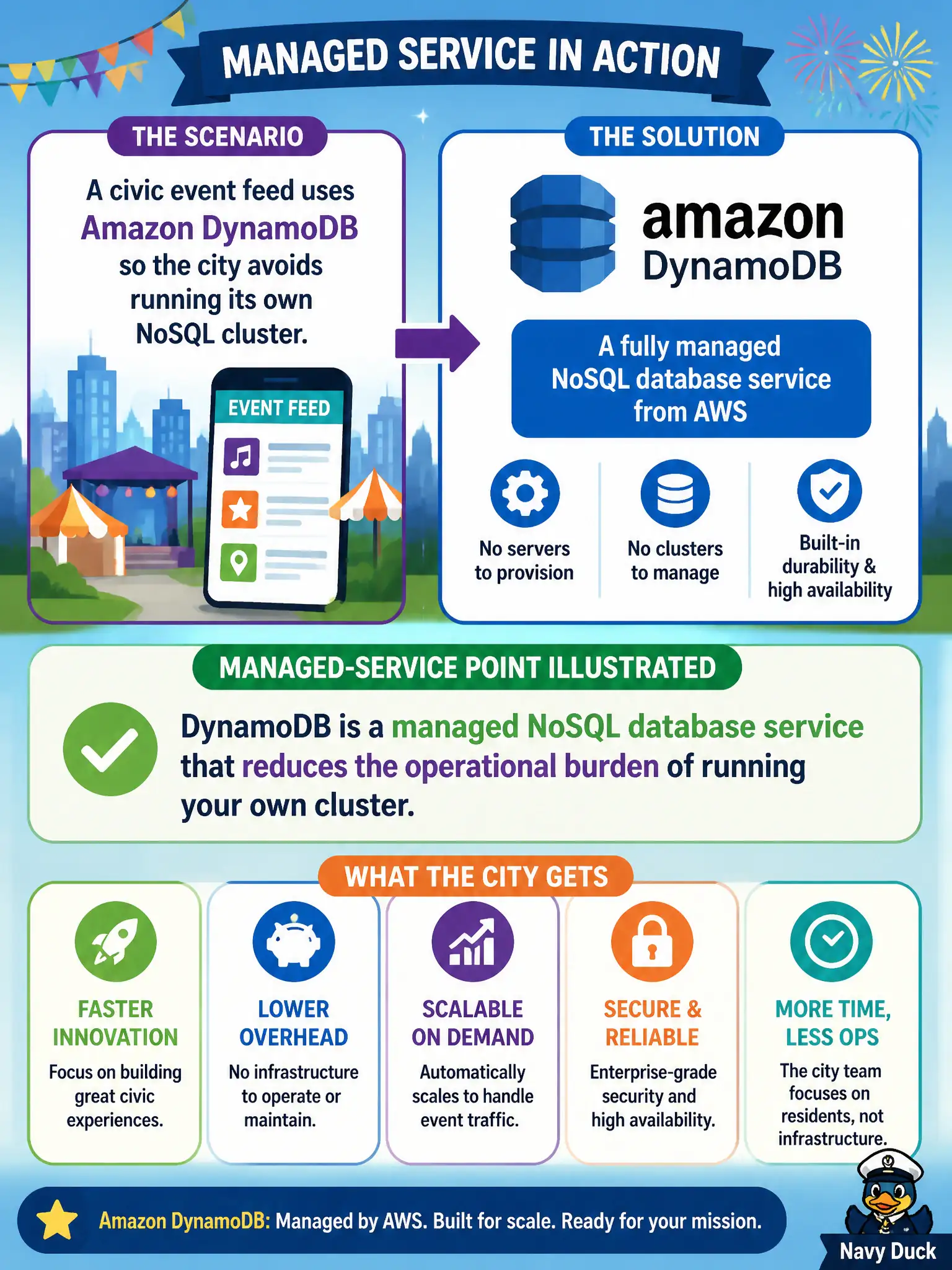
A civic event feed uses Amazon DynamoDB so the city avoids running its own NoSQL cluster. What managed-service point does this illustrate?
Select an answer to reveal the explanation.
Short Explanation
Running your own NoSQL cluster is like maintaining a private power plant for one streetlight. DynamoDB is the managed grid — you use the capacity without babysitting every node. Civic event feeds love that ops relief.
Full Explanation
DynamoDB is a managed NoSQL database service that reduces the operational burden of running your own cluster—exactly what a civic event feed illustrates by avoiding a self-managed NoSQL fleet. The city consumes a fully managed datastore for event items without racking and patching NoSQL nodes in a basement.
DynamoDB does not require the city to rack and patch its own database servers. It is not merely a CDN and can store application data. Avoiding a self-managed NoSQL cluster is possible on AWS precisely via managed services like DynamoDB.
Exam caveat: Managed NoSQL = less cluster ops; customers still design keys, capacity/on-demand mode, IAM, and encryption settings. Operational check: model the event-feed access patterns, create a DynamoDB table with least-privilege IAM, enable encryption and PITR as policy requires, and verify ops runbooks no longer include node patching.
Municipal teams should keep a one-page decision record linking this Cloud Practitioner concept to resident outcomes, revisit it after major traffic or compliance changes, and ensure runbooks still match the chosen design.
Municipal teams should keep a one-page decision record linking this Cloud Practitioner concept to resident outcomes, revisit it after major traffic or compliance changes, and ensure runbooks still match the chosen design.