
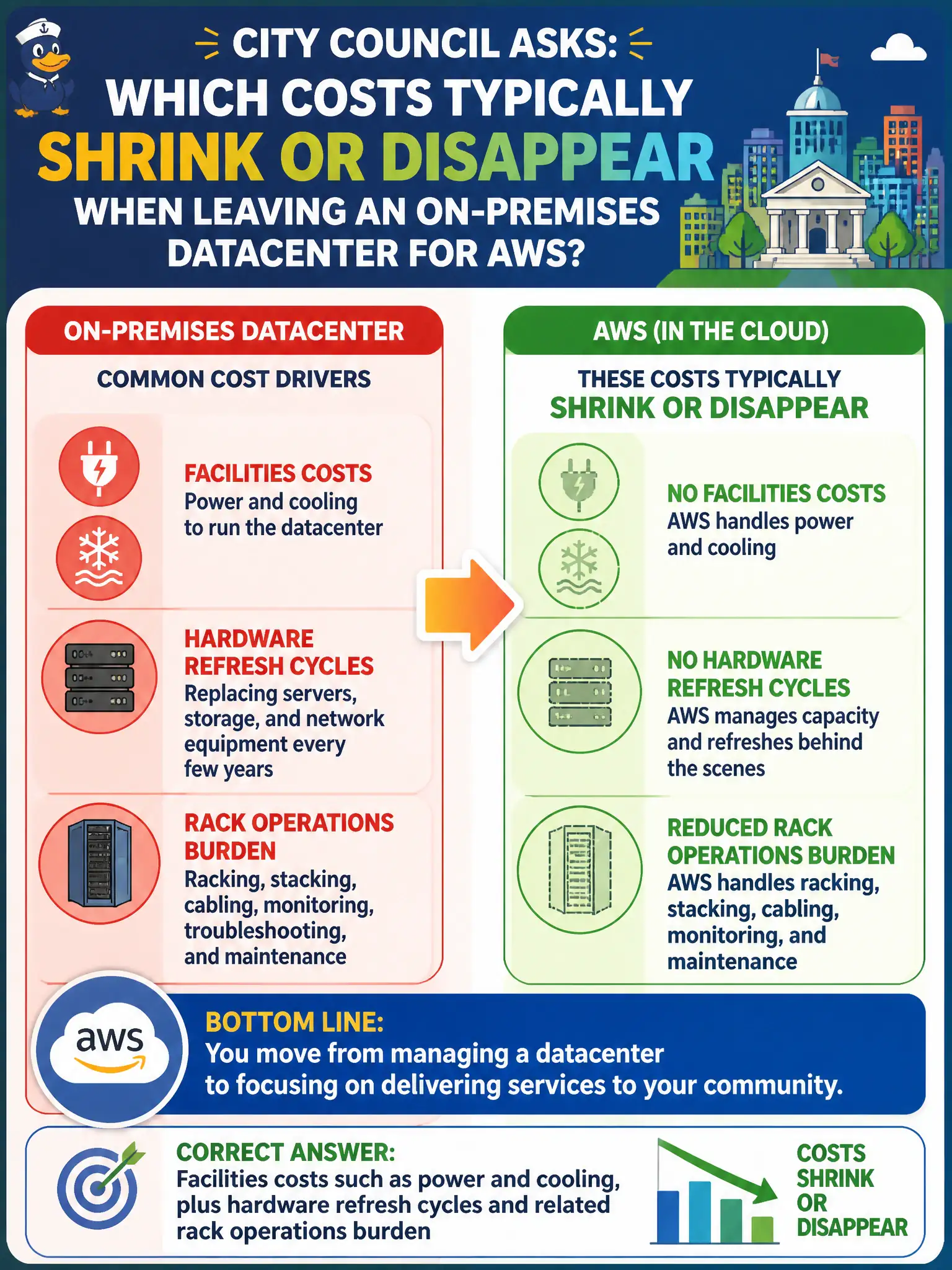
City council asks which costs typically shrink or disappear when leaving an on-premises datacenter for AWS. Which answer best lists common on-premises cost drivers?
Select an answer to reveal the explanation.
Short Explanation
A basement datacenter bill is not just “servers” — it is power, cooling, floor space, and the clock that says refresh the iron again. Moving to AWS often shrinks those facility and hardware-refresh burdens. Coffee machines in AZs make a fun joke, not a TCO line item.
Full Explanation
Facilities costs such as power and cooling, plus hardware refresh cycles and related rack operations burden, are common on-premises cost drivers that typically shrink or disappear when leaving a datacenter for AWS for those undifferentiated facilities elements. Council should hear that migration shifts those burdens away from city-operated machine rooms.
Saying only the AWS Support plan fee changes ignores facilities reality. Coffee machines moving into Availability Zones is nonsense. Claiming only domain registration fees matter while power/cooling/refresh are unrelated denies basic datacenter economics.
Exam caveat: Know classic on-premises cost drivers: power, cooling, space, hardware refresh, labor for racks. Operational check: itemize current datacenter facilities line items tied to workloads being migrated, forecast which end after decommission, and track actuals post-cutover.
Municipal teams should keep a one-page decision record linking this Cloud Practitioner concept to resident outcomes, revisit it after major traffic or compliance changes, and ensure runbooks still match the chosen design.
Municipal teams should keep a one-page decision record linking this Cloud Practitioner concept to resident outcomes, revisit it after major traffic or compliance changes, and ensure runbooks still match the chosen design.