
IT asks whether the AWS Cloud Adoption Framework replaces the AWS Well-Architected Framework. Which statement is accurate?
Select an answer to reveal the explanation.
Short Explanation
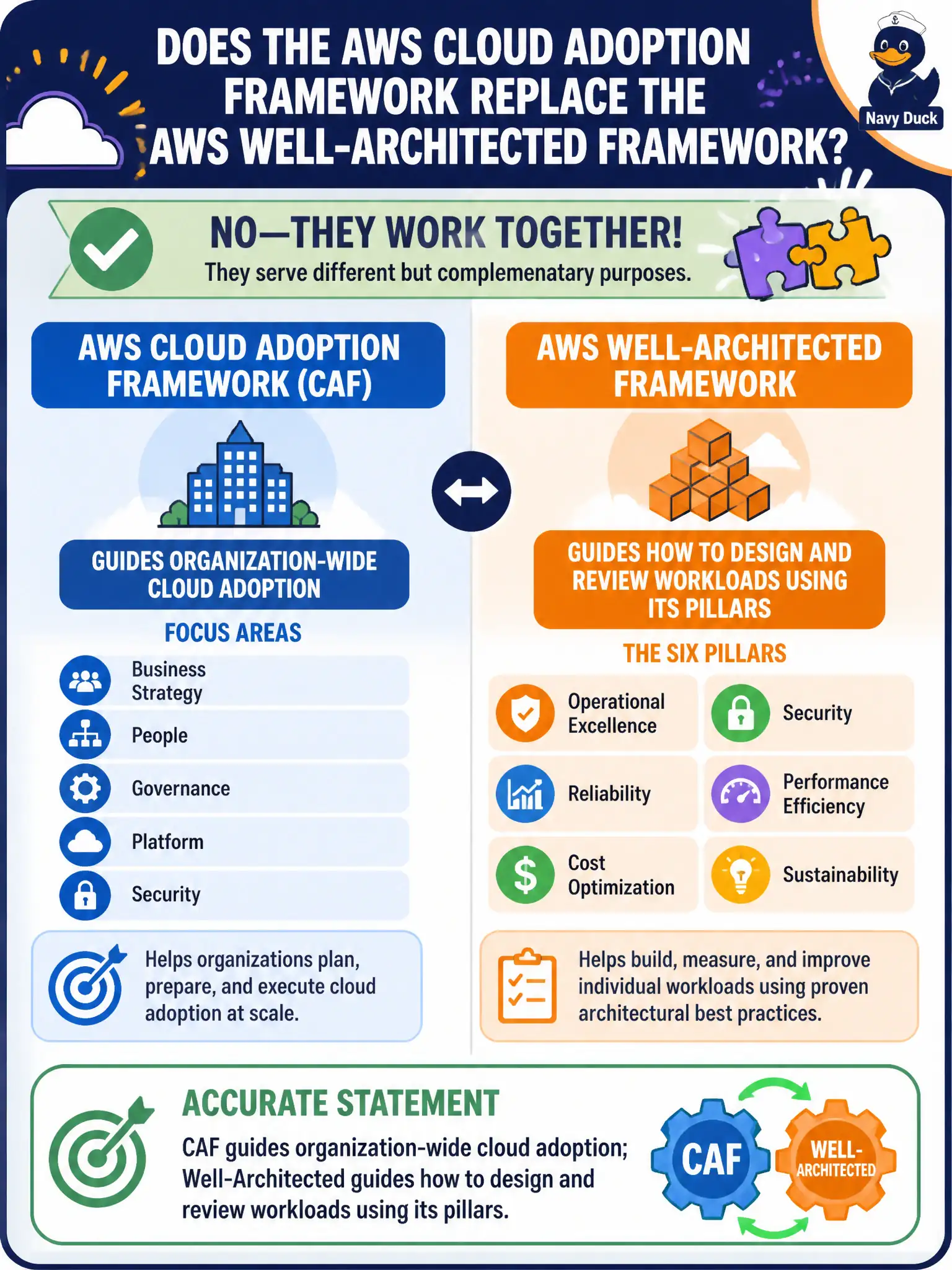
One framework helps the whole city adopt the cloud; the other grades how each workload is built. CAF is the adoption journey guide; Well-Architected is the pillar-based workload design guide. Neither deletes the other, and neither is "just billing" or "just EC2."
Full Explanation
CAF guides organization-wide cloud adoption; Well-Architected guides how to design and review workloads using its pillars. They complement each other for a municipality: CAF for the journey and operating model, Well-Architected for workload quality—neither replaces the other.
CAF fully replacing Well-Architected so pillars are obsolete is false. Calling Well-Architected only a billing tool and CAF only an EC2 feature confuses frameworks with products. Claiming they are identical documents with the same purpose erases their different scopes.
Exam caveat: CAF ≠ Well-Architected; both appear on CLF-C02. Operational check: keep a CAF adoption roadmap at program level and schedule Well-Architected reviews per critical workload, with separate owners and artifacts.
Municipal teams should keep a one-page decision record linking this Cloud Practitioner concept to resident outcomes, revisit it after major traffic or compliance changes, and ensure runbooks still match the chosen design.
Municipal teams should keep a one-page decision record linking this Cloud Practitioner concept to resident outcomes, revisit it after major traffic or compliance changes, and ensure runbooks still match the chosen design.