
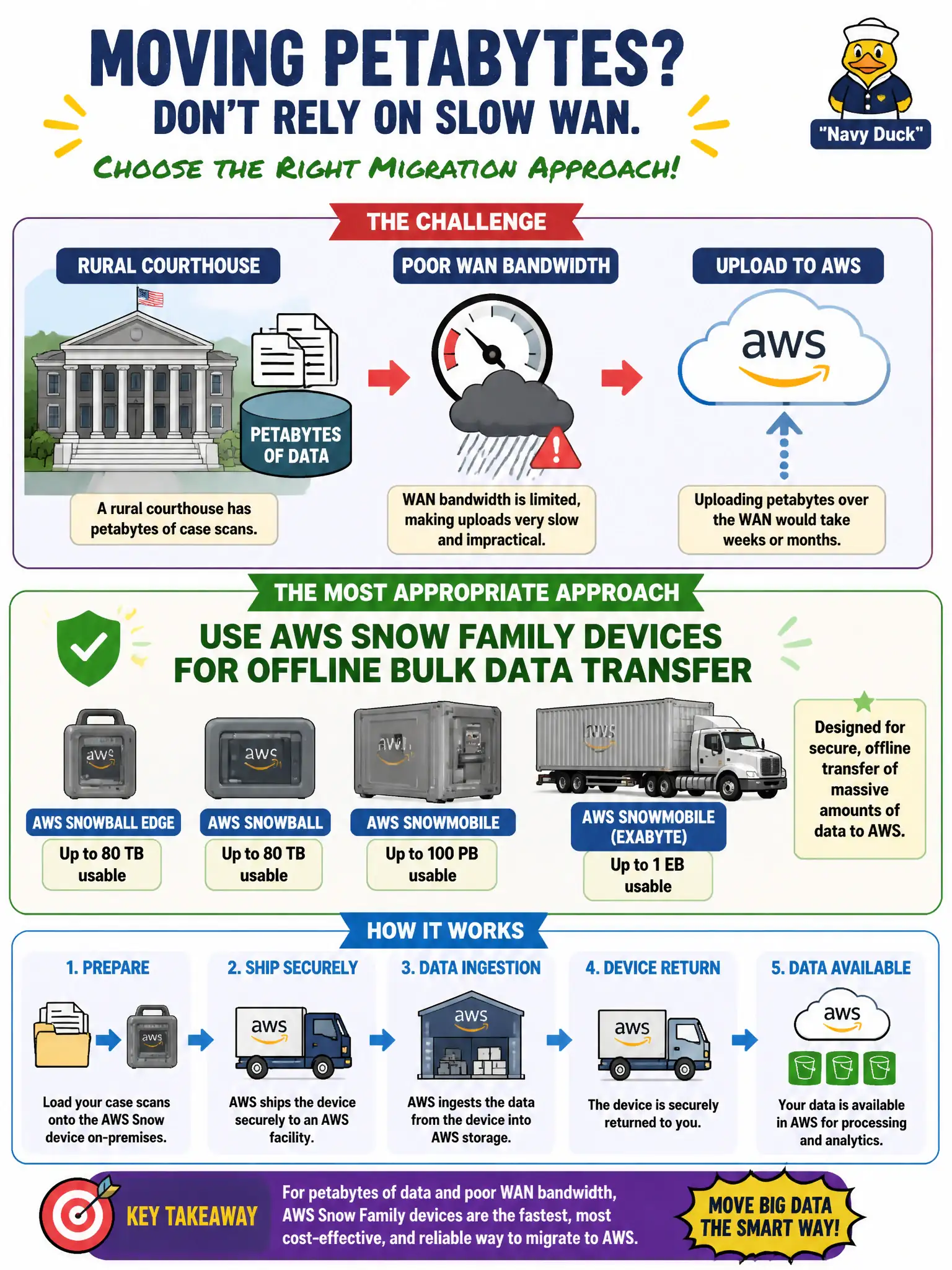
A rural courthouse has petabytes of case scans and poor WAN bandwidth for uploading to AWS. Which migration approach is most appropriate?
Select an answer to reveal the explanation.
Short Explanation
When the pipe is a garden hose and the pile is a mountain of scans, you ship the mountain. AWS Snow Family devices are built for large offline transfers when the network cannot keep up. A random USB stick, retyping petabytes, or freezing forever are not serious migration plans.
Full Explanation
AWS Snow Family devices for offline bulk data transfer are most appropriate when a rural courthouse has petabytes of case scans and poor WAN bandwidth. Physical transfer appliances move large archives without waiting months on constrained networks, which is a classic Cloud Practitioner migration pattern.
Relying only on a single overnight consumer USB stick mailed without encryption planning is operationally and security-weak for petabyte case data. Retyping every scanned page into the console is absurd at scale. Disabling all storage services until bandwidth improves indefinitely blocks the migration without solving bandwidth.
Exam caveat: Snow Family = offline/bulk transfer when networks are insufficient; know it exists at CLF depth without deep device SKU memorization beyond the concept. Operational check: size the data set, select an appropriate Snow device workflow, apply encryption and chain-of-custody controls, and verify uploaded archives in S3 (or target storage) before decommissioning local copies.
Municipal teams should keep a one-page decision record linking this Cloud Practitioner concept to resident outcomes, revisit it after major traffic or compliance changes, and ensure runbooks still match the chosen design.