
An auditor asks how the Reliability pillar differs from the Security pillar in the AWS Well-Architected Framework. Which contrast is accurate?
Select an answer to reveal the explanation.
Short Explanation
One pillar is the spare tire and recovery plan; the other is the lock on the doors. Reliability is about keeping workloads working and recovering from failures; Security is about protecting data and access. They work together in a good design, but they are not the same checklist.
Full Explanation
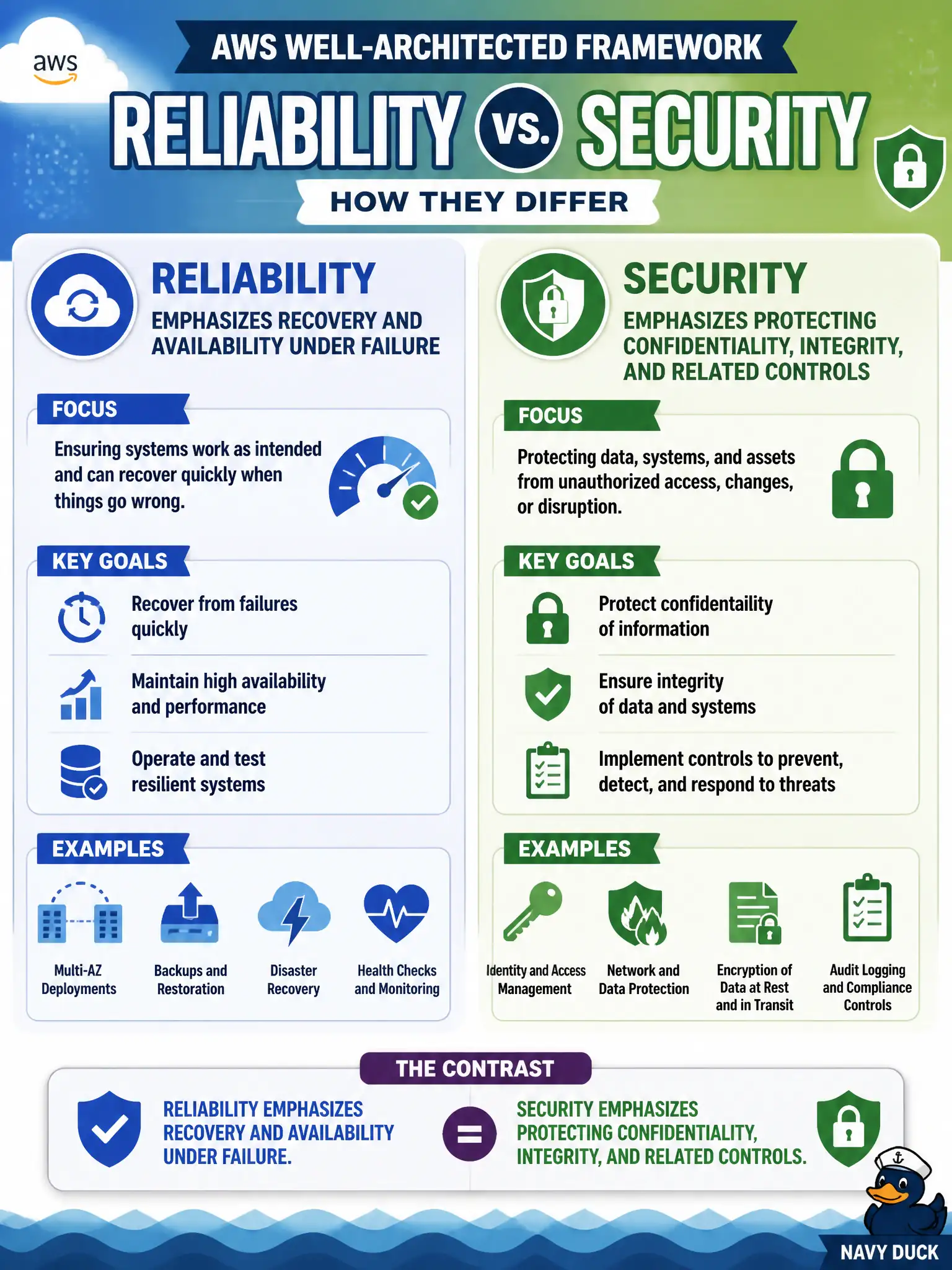
Reliability emphasizes recovery and availability under failure, while Security emphasizes protecting confidentiality, integrity, and related controls. That contrast correctly answers an auditor asking how the two Well-Architected pillars differ for municipal systems: one keeps the service up through failure, the other keeps data and access protected.
Saying Reliability only covers password length rules while Security only covers Auto Scaling reverses and garbles both pillars. Calling them alternate names for the same pillar is false—they are distinct. Claiming Security focuses only on electricity use while Reliability focuses only on lowering bills confuses Sustainability and Cost Optimization with these pillars.
Exam caveat: Keep pillar definitions crisp; CLF-C02 loves pairwise contrasts between Reliability and Security. Operational check: in an architecture review packet, list Reliability controls (multi-AZ, backups, failover tests) separately from Security controls (IAM, encryption, logging), and show the auditor evidence artifacts for each list without mixing categories.
Municipal teams should keep a one-page decision record linking this Cloud Practitioner concept to resident outcomes, revisit it after major traffic or compliance changes, and ensure runbooks still match the chosen design.