
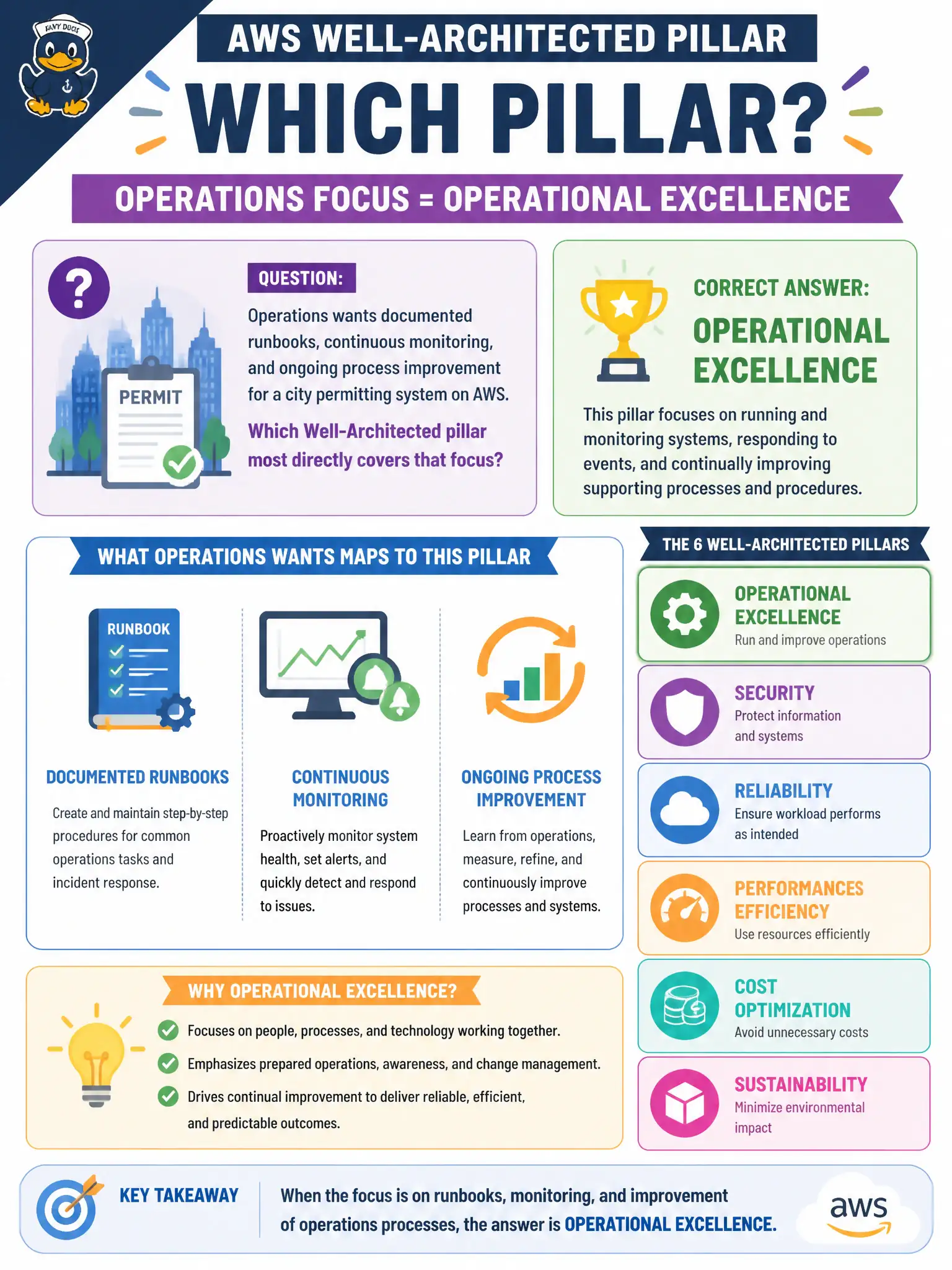
Operations wants documented runbooks, continuous monitoring, and ongoing process improvement for a city permitting system on AWS. Which Well-Architected pillar most directly covers that focus?
Select an answer to reveal the explanation.
Short Explanation
Think of Ops like a kitchen that keeps refining the recipe after every dinner rush. Operational Excellence is the pillar about running and monitoring systems and continually improving procedures — runbooks, observability, and learning loops. Reliability keeps the service up through failures, Security protects data and identity, and Sustainability trims environmental impact — different jobs on the same menu.
Full Explanation
Operational Excellence most directly covers operations’ focus on documented runbooks, continuous monitoring, and ongoing process improvement for a city permitting system on AWS. That pillar emphasizes organizing teams, preparing/operating/evolving workloads, and learning from events so permitting stays manageable as a living civic service.
Reliability centers on availability and recovery from failure, not primarily on runbook culture and improvement loops. Security centers on protecting data and access. Sustainability centers on environmental impact of workloads. Those pillars matter, but they are not the best match for runbooks-plus-monitoring-plus-improvement language in the stem.
Exam caveat: Runbooks, monitoring, and continual improvement → Operational Excellence on the exam. Operational check: publish permitting runbooks in a shared repo, wire CloudWatch (or equivalent) alarms to on-call, hold a short operations retrospective after each significant incident or release, and track action items to closure.
Municipal teams should keep a one-page decision record linking this Cloud Practitioner concept to resident outcomes, revisit it after major traffic or compliance changes, and ensure runbooks still match the chosen design.