
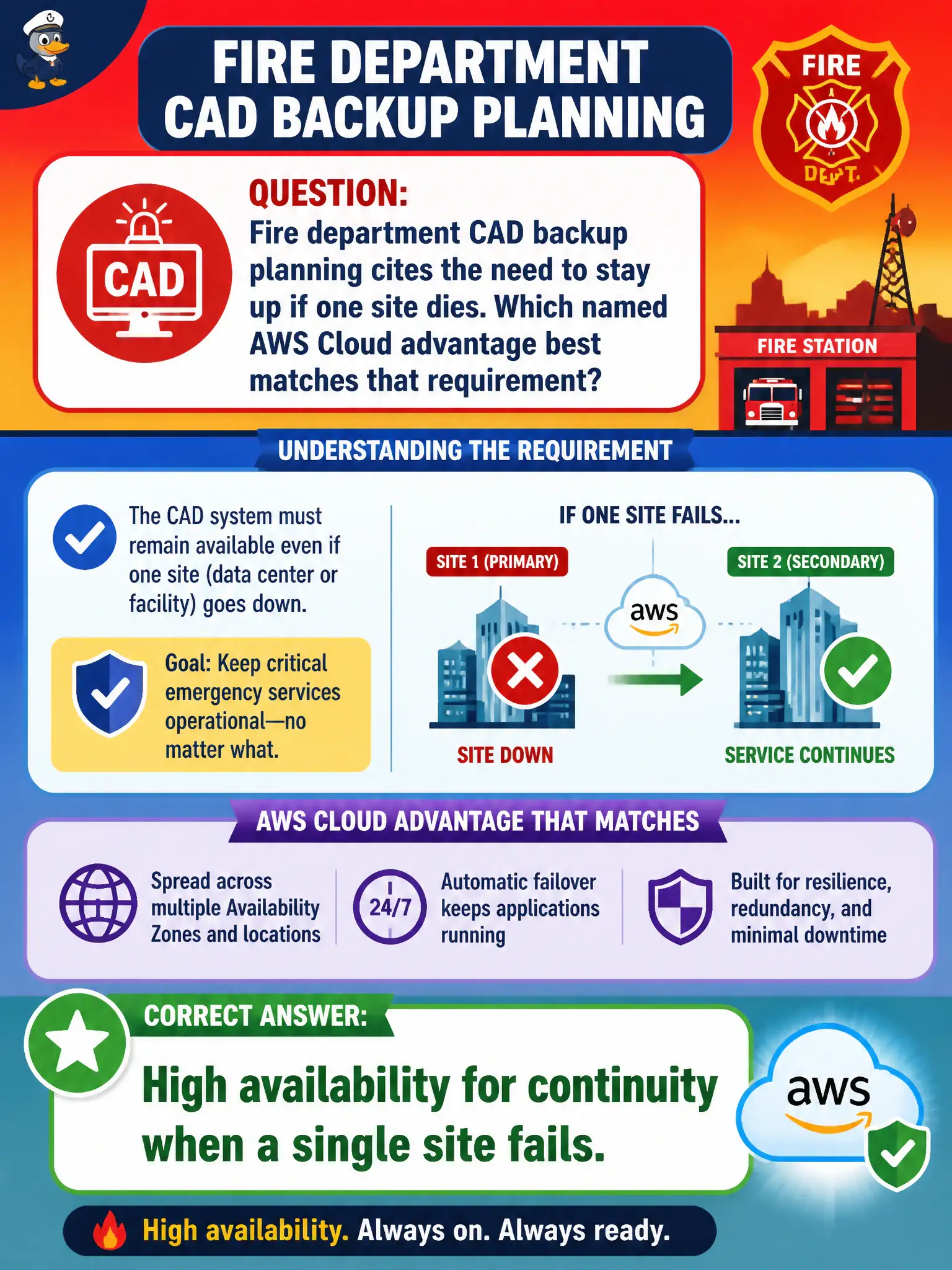
Fire department CAD backup planning cites the need to stay up if one site dies. Which named AWS Cloud advantage best matches that requirement?
Select an answer to reveal the explanation.
Short Explanation
If one firehouse site dies, CAD still has to answer. High availability is the named cloud advantage for staying up through that kind of failure—not a bargain CPU flyer. Continuity planning starts with HA, not coupons.
Full Explanation
High availability is the named AWS Cloud advantage that matches fire department CAD backup planning to stay up if one site dies. Designing for continuity across failure domains—rather than depending on a single facility—keeps computer-aided dispatch paths available when that site is lost.
Cheaper CPUs as the complete continuity strategy confuse unit pricing with multi-site resilience. Agility that only measures how fast grant forms are typed misapplies agility to paperwork speed instead of IT change. Economies of scale coupons that replace multi-site design cannot substitute for architectural high availability when a site fails.
Exam caveat: Continuity-when-a-site-fails language maps to high availability/resilience, not cost or agility distractors. Operational check: validate CAD backup or standby capacity in a second facility or AZ path, run a controlled primary-site impairment drill, and confirm critical dispatch workflows remain reachable with documented RTO evidence for public-safety leadership.
Municipal teams should keep a one-page decision record linking this Cloud Practitioner concept to resident outcomes, revisit it after major traffic or compliance changes, and ensure runbooks still match the chosen design.