
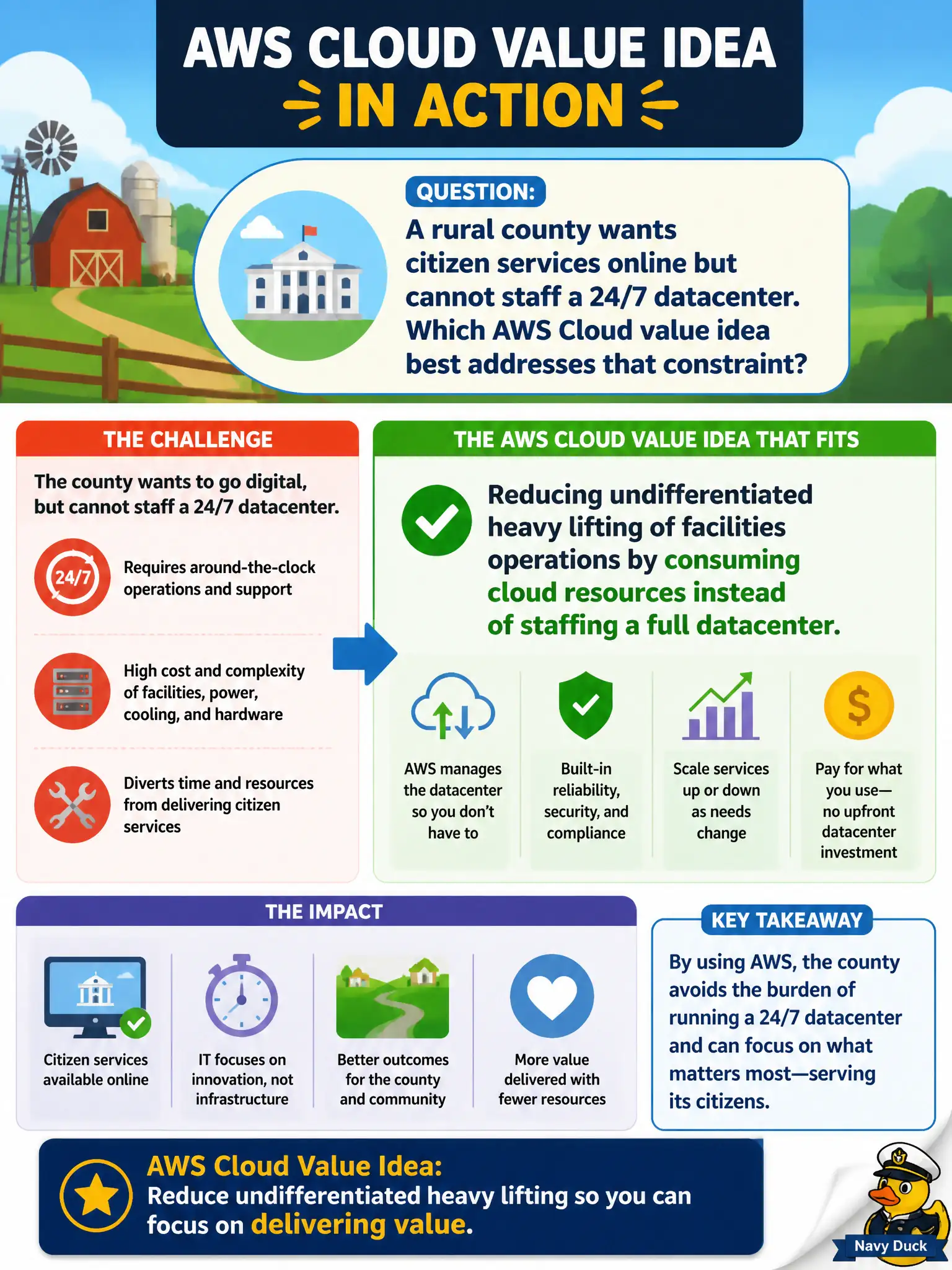
A rural county wants citizen services online but cannot staff a 24/7 datacenter. Which AWS Cloud value idea best addresses that constraint?
Select an answer to reveal the explanation.
Short Explanation
A small county should not have to run a 24/7 machine room just to take a permit form online. The cloud value here is offloading that undifferentiated facilities grind—power, cooling, racks—so staff focus on citizen services. Skip the generator-first CapEx story.
Full Explanation
Reducing undifferentiated heavy lifting of facilities operations is the AWS Cloud value idea that best fits a rural county that wants citizen services online but cannot staff a 24/7 datacenter. Consuming cloud resources shifts power, cooling, physical security, and rack operations to the provider so scarce county staff focus on applications and resident outcomes rather than generators and HVAC rounds.
Hiring round-the-clock guards and HVAC techs as the only path to online services forces the county into facilities staffing it cannot sustain. Requiring the county to operate its own Availability Zone building first misunderstands AZs as AWS constructs within Regions, not something each county must construct. Mandating CapEx for generators before any citizen form can be hosted recreates the facilities barrier the cloud value proposition is meant to remove for undifferentiated heavy lifting.
Exam caveat: "Undifferentiated heavy lifting" is classic AWS language for facilities and toil that do not differentiate the agency's citizen mission; do not confuse it with building your own AZ. Operational check: inventory tasks currently spent on the machine room (power checks, cooling, access control, hardware refresh), map which disappear when forms move to managed cloud hosting, and confirm on-call rotations no longer require 24/7 physical datacenter coverage for those workloads.