
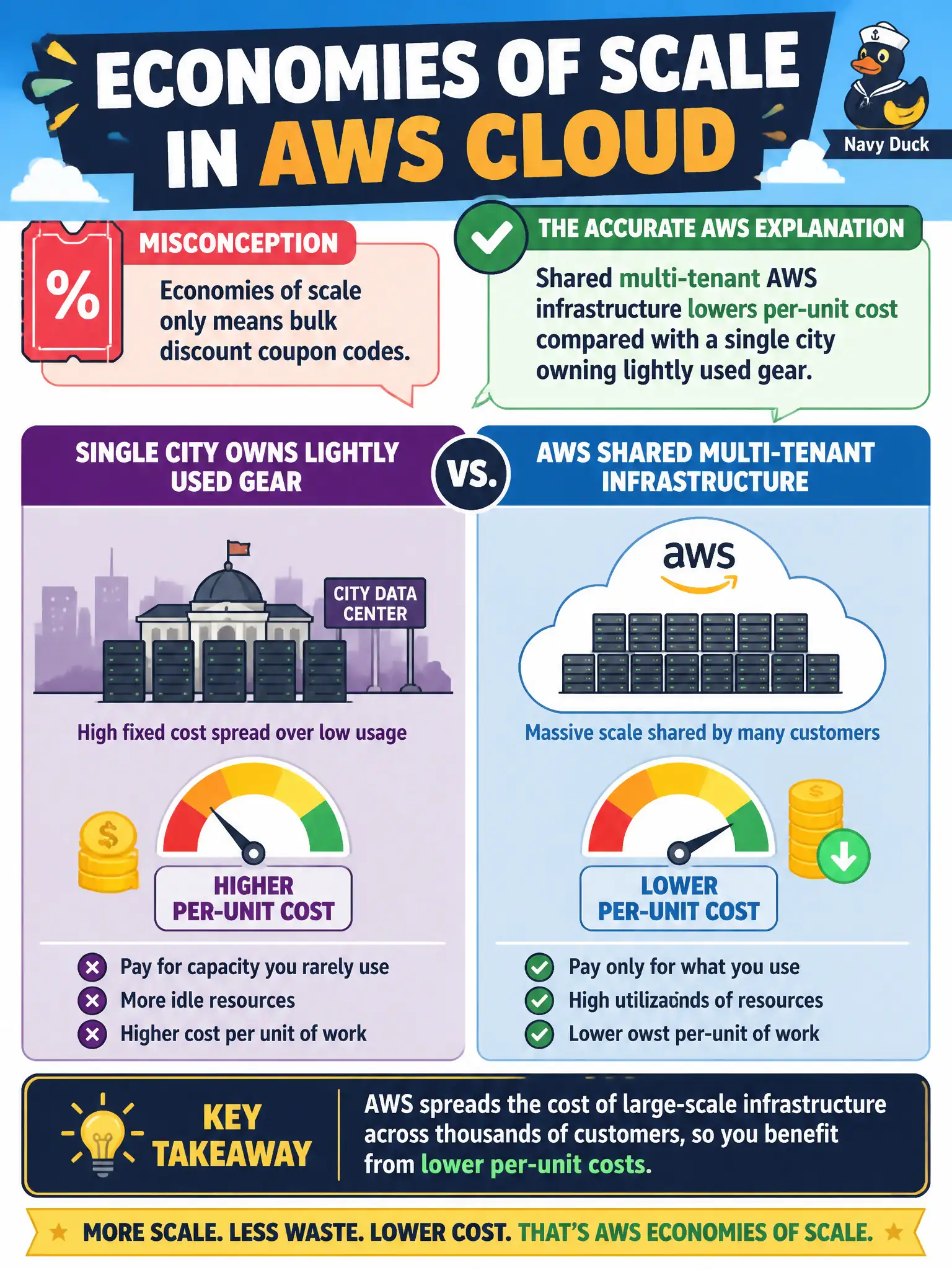
A finance director hears economies of scale and thinks it only means bulk discount coupon codes. What is the accurate AWS Cloud explanation?
Select an answer to reveal the explanation.
Short Explanation
It is not a stack of coupon codes in a drawer. AWS spreads huge shared infrastructure across many customers, so the unit cost drops below what one city pays for gear that sits half idle. Shared scale—not a PDF coupon—is the real economies-of-scale idea.
Full Explanation
Economies of scale in AWS are the structural effect of shared multi-tenant hyperscale infrastructure lowering per-unit cost compared with a single city owning lightly used gear—not a drawer of coupon PDFs. The finance director should map the phrase to aggregated demand and shared fixed-cost absorption across AWS's customer base.
Treating economies of scale as only printable coupon PDFs emailed after each invoice confuses promotional discounts with platform economics. Requiring the city to build its own hyperscale campus first inverts the benefit: municipalities consume scale rather than constructing it. Claiming every service is free when tagged municipal invents a billing fantasy unrelated to scale economics.
Exam caveat: Separate economies of scale (unit cost) from free tier, Enterprise Discount Programs, or Savings Plans—those may reduce bills but are not the definition tested in classic "what does economies of scale mean" stems. Operational check: show finance a side-by-side of owned-server fully loaded hourly cost versus on-demand unit rates for an equivalent vCPU/memory shape, annotated that the gap is largely scale-driven shared infrastructure—not a coupon code.
For municipal stakeholders, document the decision in plain language tied to resident outcomes, keep architecture diagrams current, and revisit the choice when traffic patterns or compliance scope change so the original Cloud Practitioner rationale still matches production reality.