
Public works needs a temporary flood-alert website online in days, not months of hardware procurement. Which AWS Cloud benefit most directly addresses that timeline pressure?
Select an answer to reveal the explanation.
Short Explanation
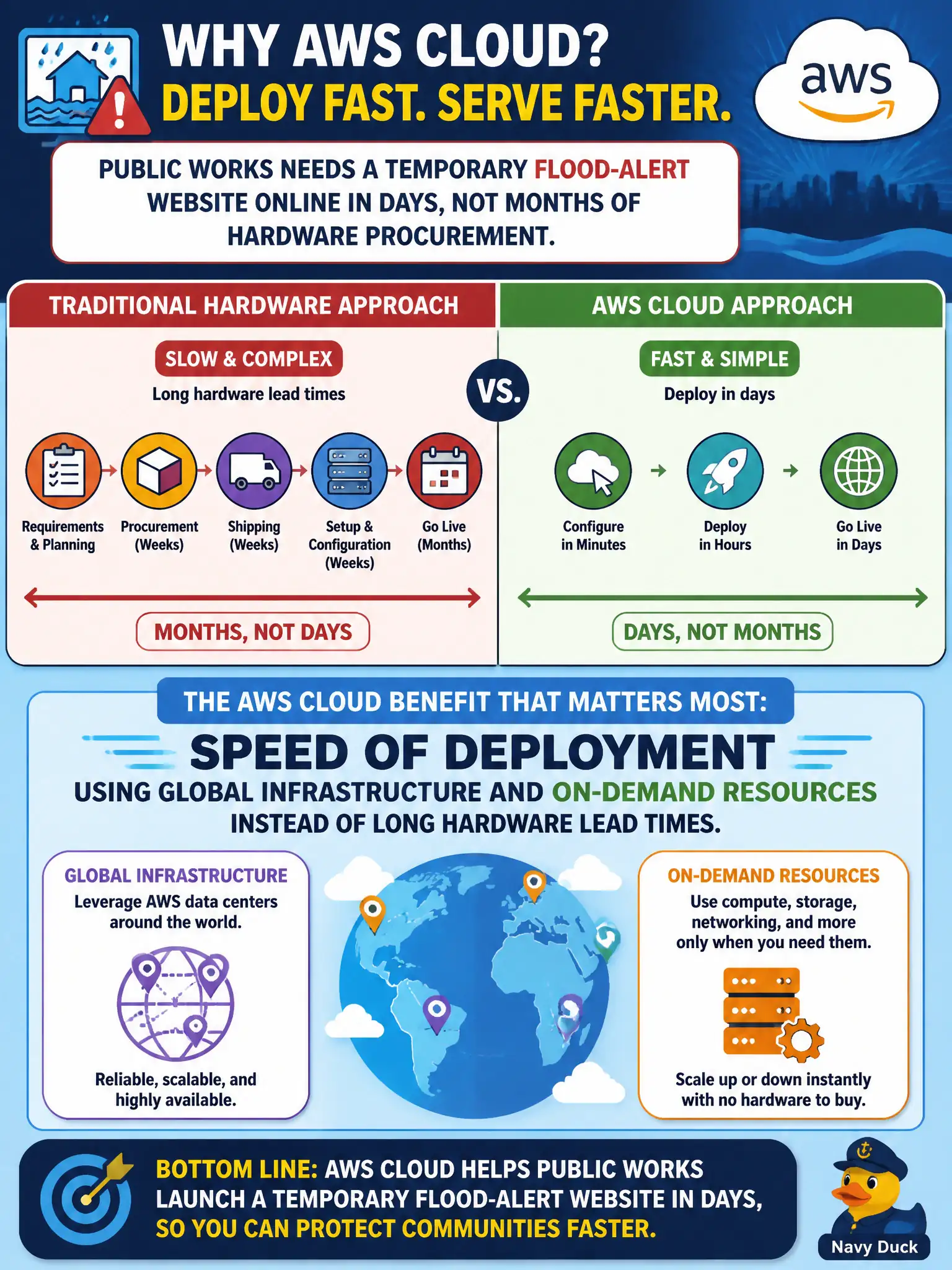
Flood season does not wait for a purchase order. With AWS you stand up the alert site with on-demand capacity instead of waiting months for racks to arrive. That speed-of-deployment benefit is exactly what public works needs when the water is rising.
Full Explanation
Speed of deployment is the AWS Cloud benefit that most directly answers public works' flood-alert timeline. Teams provision environments on global on-demand infrastructure instead of waiting through hardware procurement, receiving docks, racking, and facility build-out. A temporary flood-alert website can be online in days because capacity is requested from existing AWS Regions rather than ordered as iron that may arrive after the crest.
Dedicated Hosts that permanently pin every workload to one physical server optimize for licensing or compliance isolation needs; they do not accelerate standing up a temporary public-safety site and can add placement constraints. Mandatory five-year CapEx purchase orders before any environment can start recreate the procurement delay the scenario is trying to escape. Requiring a new basement datacenter for each temporary public-safety site maximizes lead time and facilities cost for a workload that may only need to exist for one season.
Exam caveat: "Speed of deployment" is a named cloud benefit on the Cloud Practitioner exam; do not confuse it with Dedicated Hosts (a capacity/placement feature) or with CapEx lock-in patterns that slow experiments. Operational check: time a dry-run deployment of the flood-alert stack (IaC or console) into a non-production account, measure hours-to-first-URL versus historical hardware lead times, and confirm teardown leaves no stranded CapEx assets on the municipal books.