
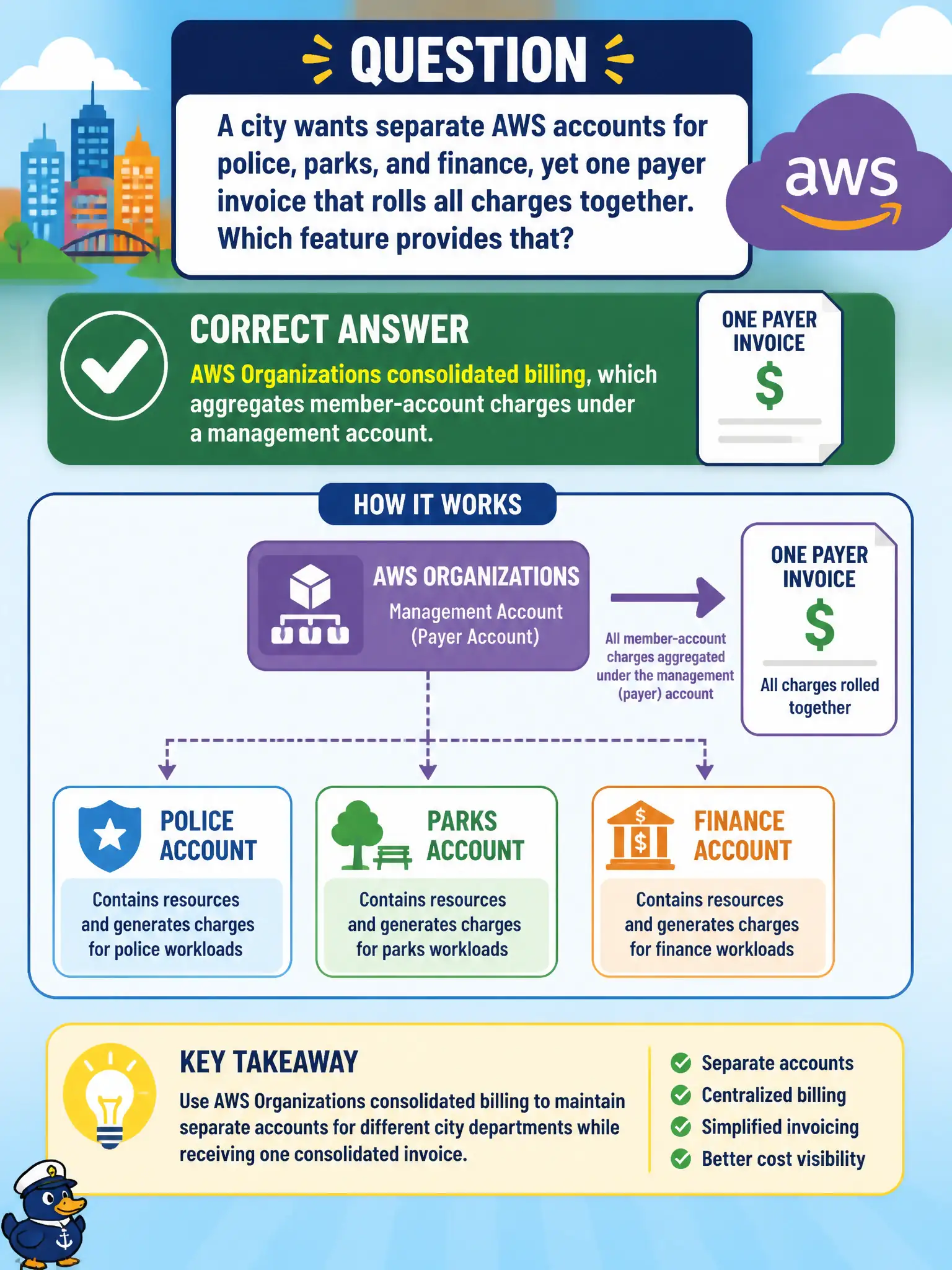
A city wants separate AWS accounts for police, parks, and finance, yet one payer invoice that rolls all charges together. Which feature provides that?
Select an answer to reveal the explanation.
Short Explanation
Many agency accounts, one city credit card statement—that is Organizations consolidated billing. Network peering and Shield do not merge invoices.
Full Explanation
A city that wants separate AWS accounts for police, parks, and finance—yet one payer invoice that rolls all charges together—should use AWS Organizations consolidated billing. Consolidated billing aggregates member-account charges under a management account payer while preserving account isolation for security and blast-radius control. That dual outcome—many accounts, one rolled-up invoice—is a core Organizations benefit for municipal holding structures.
Amazon VPC peering connects networks but does not combine invoices. AWS Shield Standard provides baseline DDoS protections rather than billing rollup. Amazon Cognito user pools manage application identities, not multi-account invoices. Networking, Shield, and identity services do not replace consolidated billing.
Exam caveat: Organizations provides OUs, SCPs, and consolidated billing. Account-per-department plus single payer is the classic consolidated billing story. RI/SP benefit sharing is a related bonus under consolidated billing.
Operational check for the city: create member accounts per department under Organizations, designate the management/payer account, confirm bills roll up, apply SCPs for guardrails, activate cost allocation tags, and give each department Cost Explorer visibility into its own account spend for showback even though one check pays AWS.