
After buying EC2 Reserved Instances for a web tier, operations asks whether some RI attributes can apply across sizes in the same instance family. What awareness is correct at Cloud Practitioner depth?
Select an answer to reveal the explanation.
Short Explanation
Some RIs are stretchier than others — within a family, size flexibility can let the discount cover a cousin instance size instead of one frozen shape. They still apply to EC2 On-Demand-style usage patterns they match, not to Spot-only worlds or S3 API nickels.
Full Explanation
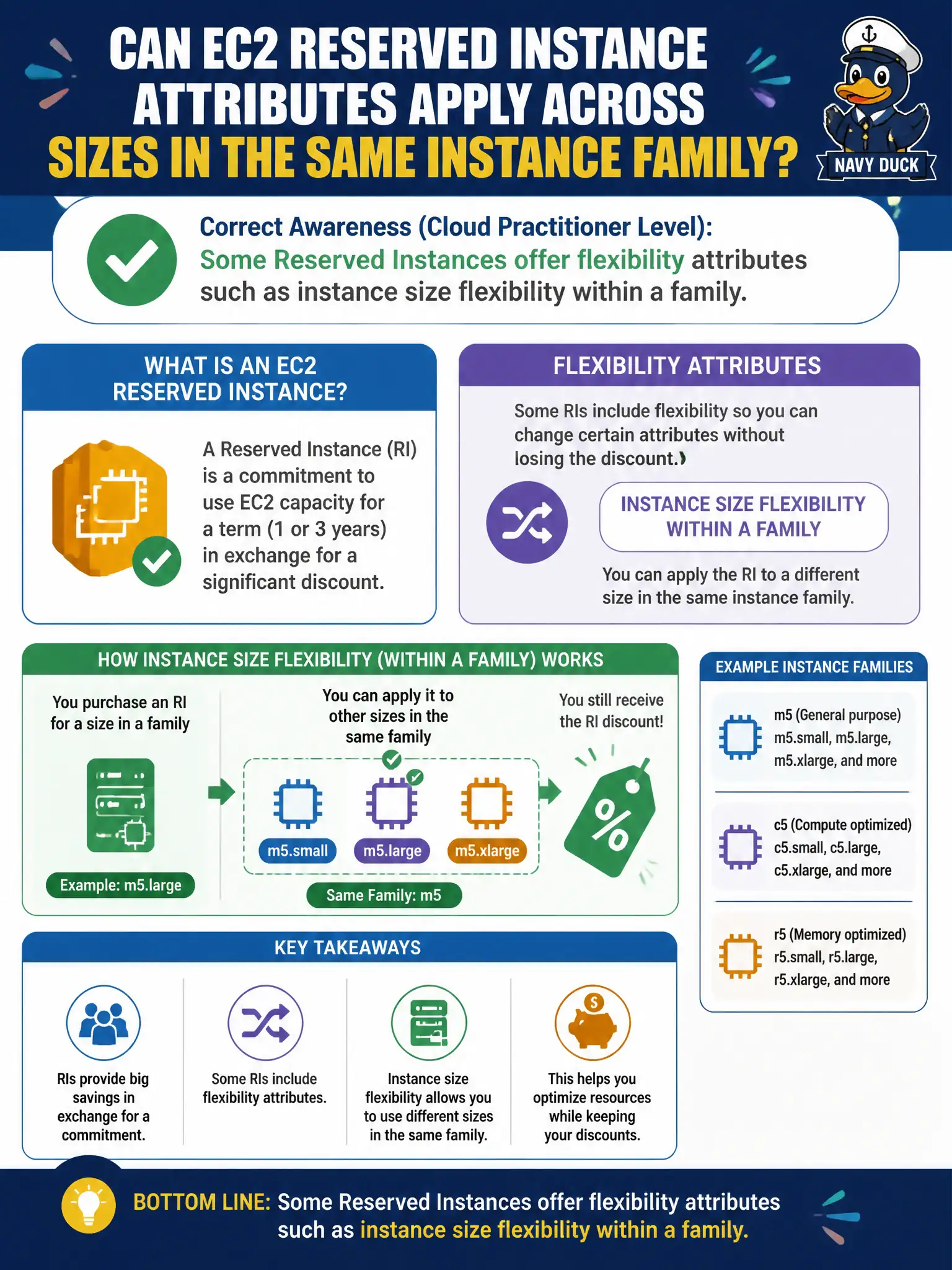
After buying EC2 Reserved Instances for a web tier, operations should know that some Reserved Instances offer flexibility attributes such as instance size flexibility within a family. At Cloud Practitioner depth, the awareness is that RI benefits are not always locked to one exact size forever within the family—size flexibility can apply for qualifying regional RIs on shared tenancy Linux/Unix style offerings, improving utilization when the city shifts between sizes in the same family. Exact mechanics can be nuanced, but the exam-level idea is that flexibility attributes exist.
Reserved Instances do apply to matching EC2 usage when purchased correctly; saying they never apply is false. RI benefits are not limited to Spot capacity only. RIs do not discount Amazon S3 API requests—they are compute commitment instruments. Distractors either nullify RI value or assign it to the wrong service.
Exam caveat: Size flexibility is not universal for every RI type/OS/tenancy. Convertible RIs and Savings Plans offer other flexibility paths. CLF wants recognition that flexibility can exist within families, not a deep licensing spreadsheet.
Operational check for the web tier: purchase RIs aligned to the dominant family, confirm whether size flexibility applies to the selected offering, monitor RI utilization hours, rightsize instances within the family when traffic evolves, and prefer Savings Plans if cross-family flexibility becomes the dominant finance need.