
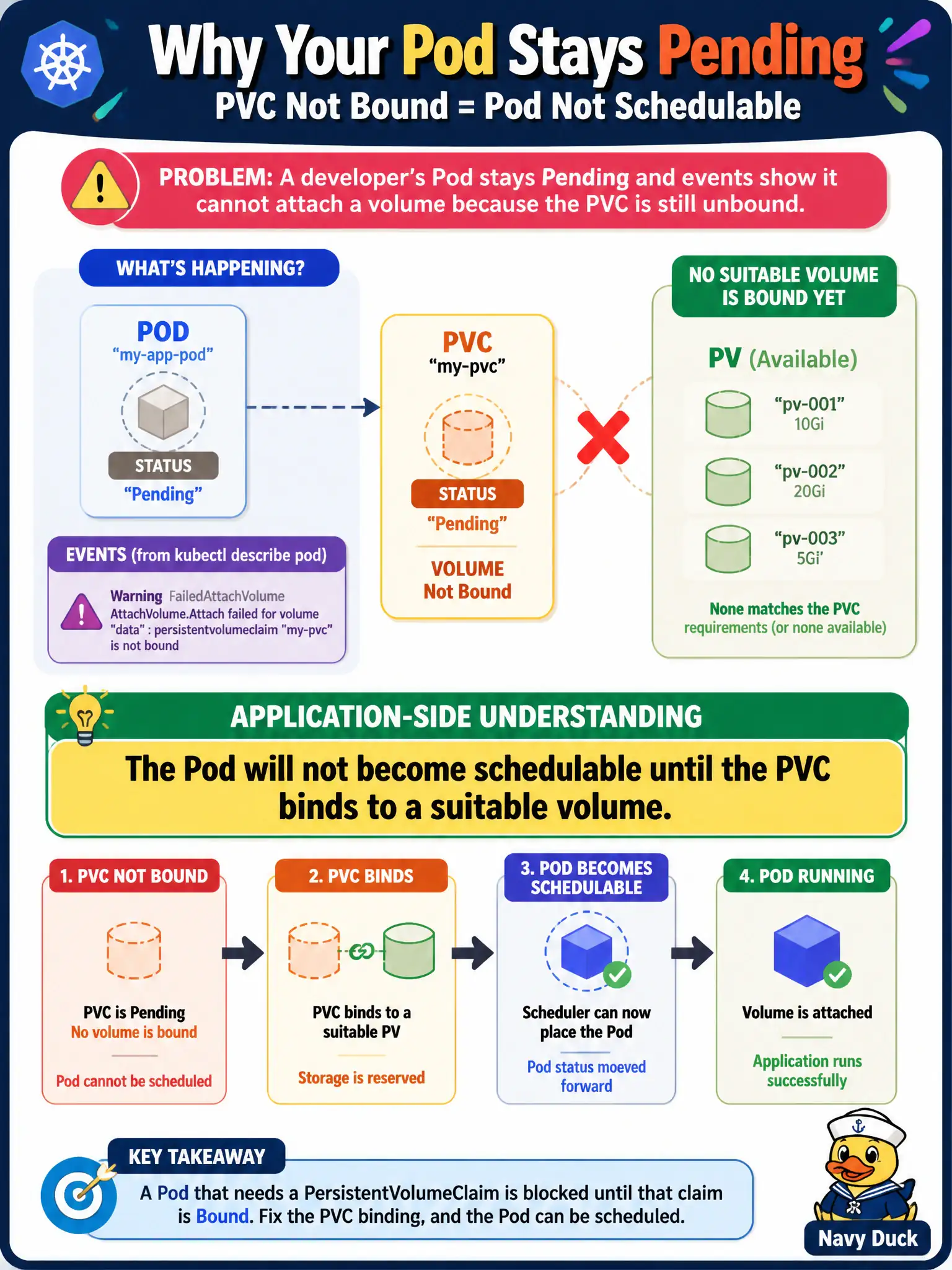
A developer’s Pod stays Pending and events show it cannot attach a volume because the PVC is still unbound. What is the application-side understanding?
Select an answer to reveal the explanation.
Short Explanation
No parking space, no car in the lot—if the PVC never binds, the Pod that needs that volume sits in Pending. Fix or wait for binding; yanking the Deployment or poking probes won’t invent a volume.
Full Explanation
When a developer’s Pod stays Pending and events show it cannot attach a volume because the PVC is still unbound, the application-side understanding is that the Pod will not become schedulable until the PVC binds to a suitable volume. Scheduling waits on volume binding constraints; unbound claims block municipal workloads even when CPU and images are fine.
Pending Pods do not always mean a missing image pull secret. The scheduler does not ignore PVCs in favor of readinessProbe timeouts. Deleting the Deployment does not auto-create a bound PersistentVolume—you must fix provisioning, StorageClass, or claim requests.
Exam caveat: WaitForFirstConsumer versus Immediate binding modes change when PVs appear. CKAD apps create PVCs; admins often provide StorageClasses/PVs.
Operational check: kubectl describe pod for FailedScheduling/volume messages; kubectl get pvc,pv; fix storage class or capacity; confirm PVC Bound then Pod Running. In municipal environments, document the chosen pattern in the service runbook so on-call engineers apply the same kubectl checks during incidents, and keep the change tied to the application Deployment or Job rather than ad-hoc node mutation. In municipal environments, document the chosen pattern in the service runbook so on-call engineers apply the same kubectl checks during incidents, and keep the change tied to the application Deployment or Job rather than ad-hoc node mutation.