
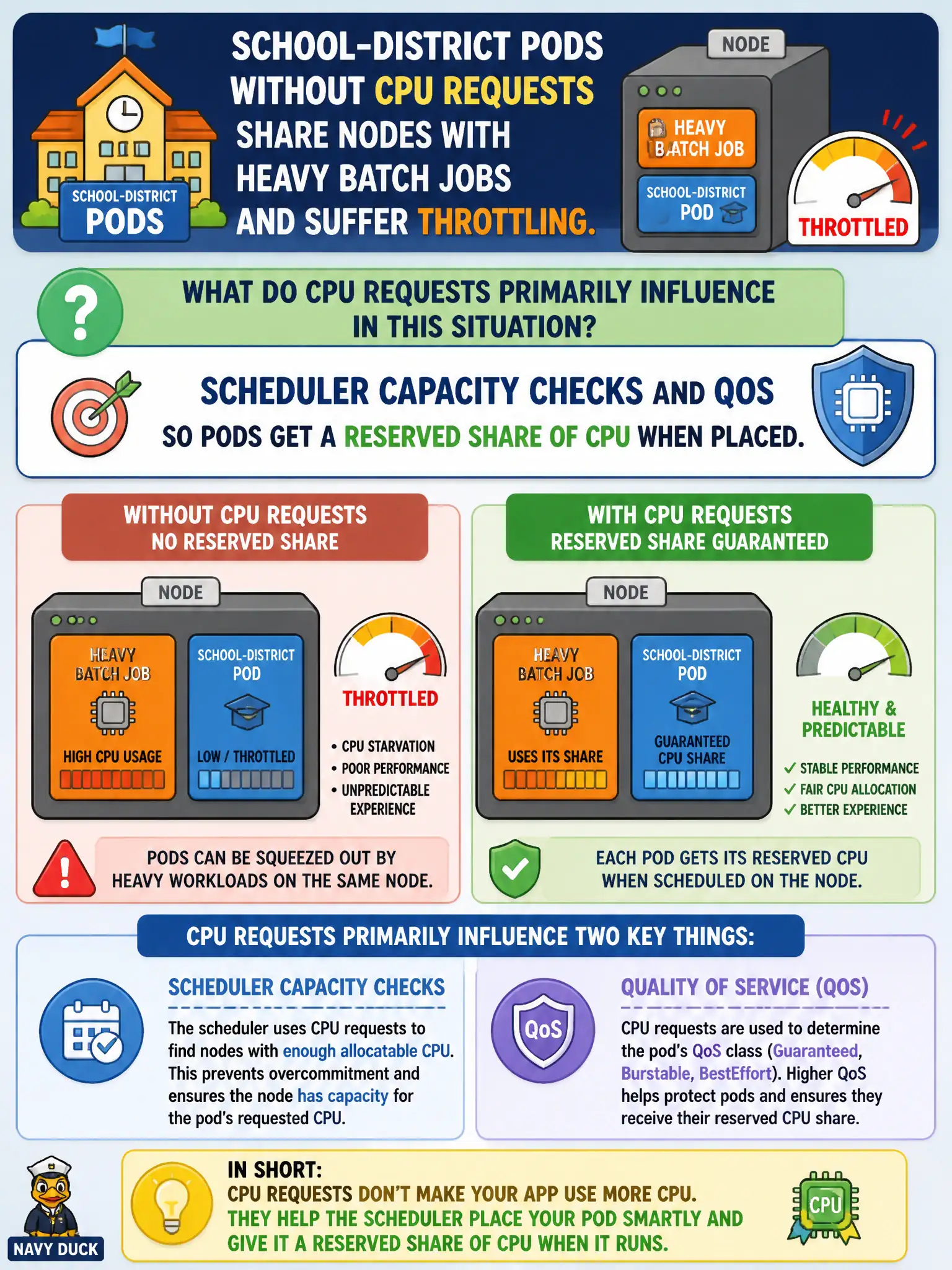
School-district Pods without CPU requests share nodes with heavy batch jobs and suffer throttling. What do CPU requests primarily influence in this situation?
Select an answer to reveal the explanation.
Short Explanation
CPU requests are how you reserve a slice of the pie before the scheduler seats the Pod. Skip them and noisy neighbors can crowd you out—requests will not change kube-proxy mode or invent NetworkPolicies.
Full Explanation
School-district Pods without CPU requests that share nodes with heavy batch jobs and suffer throttling highlight what CPU requests primarily influence: scheduler capacity checks and QoS so Pods get a reserved share of CPU when placed. Requests tell the scheduler how much CPU to reserve and contribute to QoS classification; without them, Pods are treated as BestEffort for CPU and fare poorly next to heavy batch neighbors during contention on shared education-cluster nodes.
CPU requests do not decide whether kube-proxy installs IPVS or iptables mode. They do not choose the default StorageClass for emptyDir mounts. They do not automatically create NetworkPolicy objects that guarantee CPU isolation between tenants.
Exam caveat: limits throttle CPU; requests affect scheduling and relative weight—know both under contention. Operational check: add CPU requests to district Pods, compare scheduling and performance beside batch jobs, and use kubectl describe and top to validate reservations. This distinction matters on the CKA because distractors often mix adjacent objects that sound related but solve a different control-plane problem. This distinction matters on the CKA because distractors often mix adjacent objects that sound related but solve a different control-plane problem.