
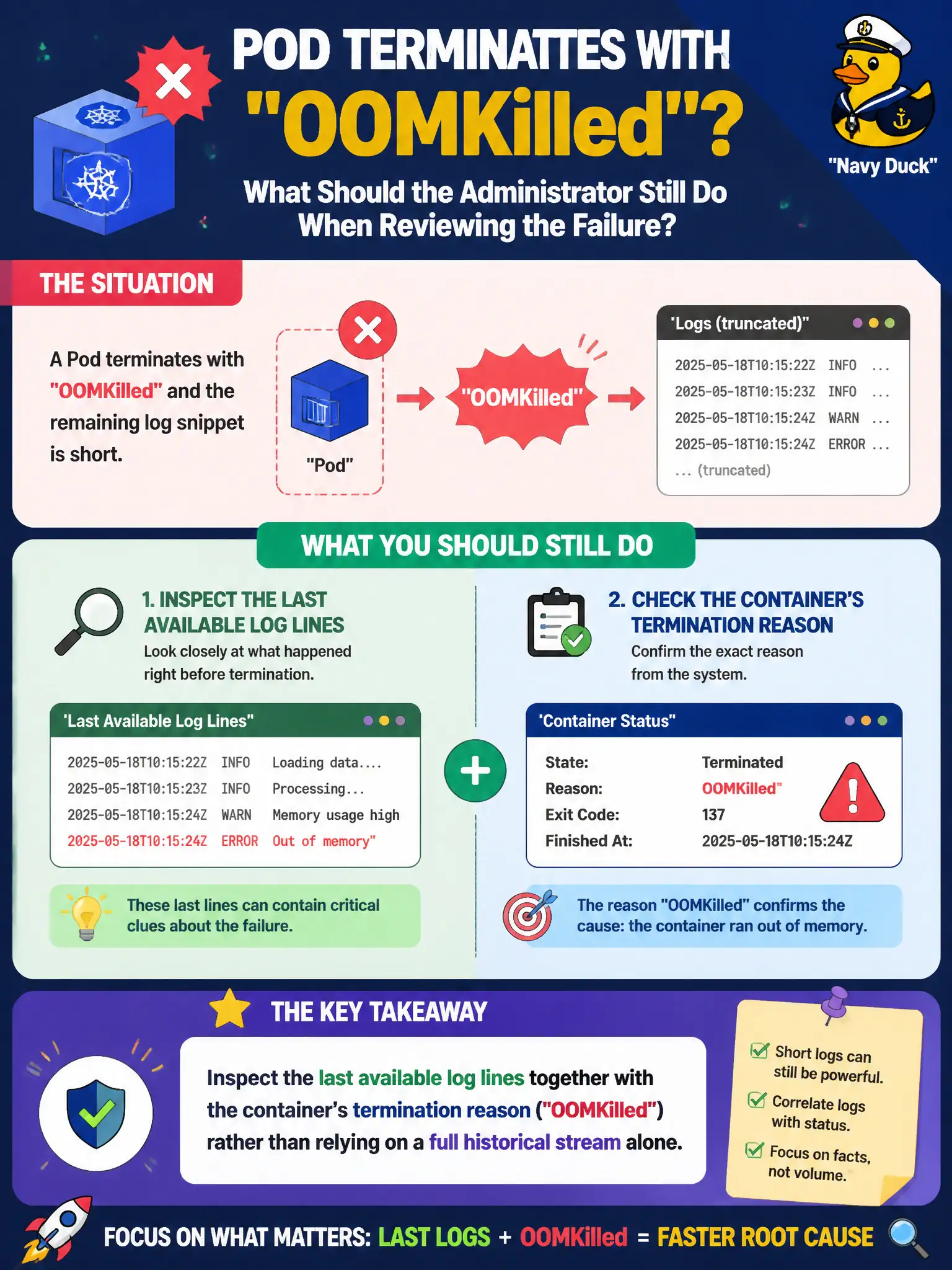
A court-records Pod terminates with OOMKilled and the remaining log snippet is short. What should the administrator still do when reviewing the failure?
Select an answer to reveal the explanation.
Short Explanation
When the container gets the memory axe, the diary may be a stub—but the last scribbles plus the OOMKilled stamp still tell the story. Pair sparse logs with the termination reason.
Full Explanation
When a court-records Pod terminates with OOMKilled and the remaining log snippet is short, the administrator should still inspect the last available log lines together with the container's termination reason (OOMKilled) rather than relying on a full historical stream alone. Sparse final scribbles plus the OOM stamp still tell a usable story about memory death. Discarding all logs and restarting the Deployment without checking why the container stopped wastes evidence and risks repeat OOMs. Treating OOMKilled as a DNS failure and only digging CoreDNS Pods misclassifies a memory termination as a name-resolution problem. Increasing the Service ClusterIP TTL so memory pressure clears automatically invents a nonsensical control; Service TTLs do not cure OOM. Exam caveat: OOMKilled may leave truncated logs because the process was killed mid-write. Check lastState in describe, events, and metrics for memory usage versus limits. Operational check: Describe the pod for OOMKilled, save the last log lines, raise memory limits or fix the leak, redeploy court-records, and confirm stable memory without recurrence. In municipal production practice, record the finding in the incident ticket with command output snippets, confirm the fix under change control, and re-validate the user-facing civic service before closing the change window.